
With its smooth curves and clean lines, this week’s subject could easily have been a prop on Space: 1999. Car and Driver called it the best-styled car of 1974, but some critics still consider it one of the ugliest designs of the seventies and it remains one of the most divisive. It was a bold move for struggling American Motors and ultimately became a financial disaster. This week, we look at the history of the AMC Matador and its midsize predecessors, the Rambler Classic and Rambler/AMC Rebel.

THE FIRST INTERMEDIATE
In 1956, American Motors chairman George Romney decided to bet the company’s future on the compact Rambler, abandoning the venerable Nash and Hudson brands and launching a vaguely messianic (if mercifully tongue-in-cheek) crusade against oversize, gas-guzzling “Detroit dinosaurs.”
In 1958, AMC’s first model year following the demise of Nash and Hudson, Romney hedged his bets with two additional Rambler models: the subcompact Rambler American (really the original Rambler with new skin) and the big Ambassador. This put AMC in the novel position of offering cars in three distinct sizes, something many of its competitors wouldn’t match until the mid-1960s.
Despite that variety, AMC’s bread and butter was the midsize Rambler; the American sold only half as many copies and the Ambassador was at best a niche item. About the same size as a modern Toyota Camry, the “standard” Rambler accounted for around 117,000 sales in 1958, about 259,000 in 1959, and almost 315,000 in 1960.

By 1964, the Big Three had bracketed the Classic with an array of compacts and intermediates. The Classic was smaller than new midsize rivals like the Ford Fairlane and Chevrolet Chevelle and AMC couldn’t match those competitors’ larger dealer networks or marketing budgets. Furthermore, by the mid-sixties, buyers were losing interest in economy cars and turning back to performance and luxury. Classic sales began to slide and AMC’s market share was shrinking at a similar rate.
THE BIG MAN ON TOP
George Romney left American Motors in January 1962 to pursue a political career. His departure marked the beginning of the end of AMC’s niche-market focus on compact cars. His successor, former sales VP Roy Abernethy, didn’t share Romney’s enthusiasm for compacts. Abernethy, a veteran of Packard and before that Kaiser-Frazer, subscribed to the attitude of many contemporary automotive salesmen and executives (even at AMC): Big cars were better than small cars because they were usually easier to sell, sold for more money, and made bigger profits.
The 1963 redesign of the Classic and Ambassador had already made them bigger and more orthodox-looking and much the same was true of the redesigned 1964 American. Under Abernethy’s auspices, AMC moved further toward the mainstream. The Classic and Ambassador got attractive if faintly anonymous new styling courtesy of new design chief Dick Teague and each line gained a convertible. For 1964, a V8 returned to the Classic line for the first time since 1961. A facelift for 1965 increased the Classic’s overall length an additional 5 inches (127 mm), bringing it closer in size to its intermediate rivals.


Despite those moves, Classic sales continued to fall, sinking to about 126,000 by 1966. The intermediate market was booming — Ford sold more than 317,000 Fairlanes in 1966 — but AMC, which had essentially pioneered the genre, was in danger of being shut out. The Classic was competent and pleasantly styled, but it was no longer particularly compact or economical. AMC was moving away from the values established by Romney, but it had yet to find any other defining virtues. Resale values were not robust and an increasing number of buyers didn’t look at Ramblers twice.
FISH STORY: THE RAMBLER MARLIN
American’s first attempt to address its image problem became one of its most memorable blunders: the Rambler Marlin.
In early 1963, stylist Robert Nixon penned a compact fastback coupe called Tarpon, based on the Rambler American platform. AMC showed a mock-up at conventions in Detroit and Chicago in early 1964, to generally good response. Dick Teague lobbied hard to build the Tarpon, which would have been AMC’s rival to the Ford Mustang and Plymouth Barracuda, both of which debuted a few months later.
Roy Abernethy, however, was concerned that AMC did not have a V8 that would fit in the Rambler American’s engine bay, which would put the Tarpon at a competitive disadvantage. Furthermore, Abernethy thought the Tarpon was just too small, particularly when he discovered that he couldn’t wear his hat in the back seat. Rather than simply vetoing the Tarpon, he suggested transferring it to the bigger Rambler Classic platform. Teague was hardly thrilled, but he reluctantly scaled up the design for the larger platform, which went on sale in early 1965 as the Rambler Marlin.
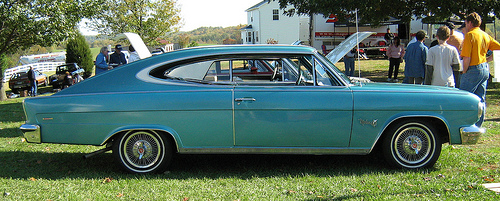
Like the contemporary Dodge Charger, which was similarly derived from the intermediate Dodge Coronet, the Marlin was essentially a Classic with a fastback hardtop roof. It looked sleek from some angles, gawky and odd from others. Even Dick Teague and his stylists didn’t like it much.
The public was not enthralled either. First-year sales were an uninspiring 10,327 and the second year was less than half that figure. Teague persuaded Abernethy to switch the Marlin to the even-bigger Ambassador platform for 1967, which at least gave it better proportions, but sales sank even further. The Marlin disappeared for good at the end of the 1967 model year.
AMC REBEL
Although it could be politely described as an interesting failure, the Marlin was at least distinctive, which could not be said for the contemporary Classic. In 1967, AMC transformed it into a cut-down version of the Ambassador — an interesting reversal given that the Rambler Ambassador had originally been a stretched Classic — which brought the midsize Rambler’s dimensions very close to those of the contemporary Chevrolet Chevelle. AMC also dropped the Classic name in favor of Rebel and began to phase out the Rambler marque. (It disappeared from Rebels in 1968.) The chassis was also updated, discarding the old torque tube for a new four-link rear suspension, and the new 290 cu. in. (4,751 cc) and 343 cu. in. (5,624 cc) V8 engines replaced AMC’s original, fifties-vintage V8s.
None of this helped; sales fell to fewer than 101,000 units in 1967 and fewer than 74,000 units in 1968. By comparison, in 1967 alone, Pontiac sold nearly 220,000 Tempests and Le Mans plus 81,722 GTOs.
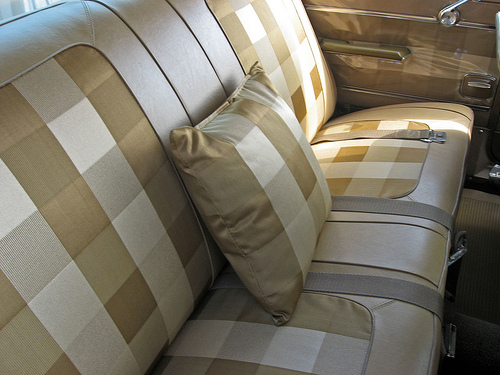
Roy Chapin, Jr., who replaced Roy Abernethy as chairman and CEO in January 1967, was trying hard to change AMC’s frumpy image, launching the sporty Javelin and AMX and initiating an aggressive racing program. He even gave the green light to the Hurst SC/Rambler, a hot rod version of the Rambler American. These efforts did nothing to help sales of the Rebel, which fell to a depressing 60,000 for 1969. Neither did the high-performance Rebel Machine, added in 1970, which arrived just as the market for intermediate Supercars was collapsing. Rebel sales were dismal and a model that had once been AMC’s core product was now nearly invisible.
Chapin and Gerry Meyers, who by that time was AMC’s VP of product development, were well aware of the Rebel’s shortcomings. The problem — which was becoming AMC’s perennial curse — was a lack of capital. The company’s scant resources were focused on the desperately needed Hornet compact and its wacky subcompact derivative, the Gremlin, both of which debuted in 1970. The moribund Rebel would have to wait.

WHAT’S A MATADOR?
The Rebel’s replacement finally bowed for the 1971 model year. For the second time in five years, it had a new name: AMC Matador. The new moniker did not go over well in some Spanish-speaking export markets; while “Matador” usually implies a bullfighter, it more literally means “killer.” (A less-confrontational nameplate would have been “Toreador.”)
Like the Rebel, the Matador shared much of its body structure with the Ambassador, distinguished by a different front clip and a shorter wheelbase: 118 inches (2,997 mm) versus 122 inches (3,099 mm). In overall dimensions, the Matador was only slightly smaller than the “Detroit dinosaurs” George Romney had decried a decade earlier and it was wholly undistinguished in both design and engineering.
Whatever else the Matador was, it was not a strong seller. 1971 volume was fewer than 46,000 sales, rising to about 55,000 for 1972. Sales for many intermediates were down in the early seventies as buyers gravitated to compacts and subcompacts and AMC, which had never firmly established itself in the intermediate market, was hit particularly hard. AMC’s ad agency, Wells, Rich, Greene, Inc., whose past campaigns had already established a tone of bemused self-deprecation reminiscent of Doyle Dane Bernbach’s famous Volkswagen ads, opted to make a joke of the Matador’s anonymity with a series of 1973 spots asking, “What’s a Matador?” It didn’t help much.
Fortunately, American’s investment in the Hornet and Gremlin was paying off, allowing the company to post a modest profit for 1971 and even better numbers for 1972 and 1973. AMC’s market share climbed from 3.3% in 1972 to 4.2% in 1973 and the company reported profits of $44.5 million.
Nevertheless, Gerry Meyers was not happy about AMC’s lack of presence in the intermediate market, which was starting to grow again by 1972, reaching nearly 20% of the market the following year. AMC didn’t have an entry in the popular and lucrative personal luxury class either. In fact, the hardtop coupe was the slowest-selling Matador, in a segment where two-door hardtops were customarily the most popular (and profitable) models. Customers were not taken with the Matador’s blocky styling and peculiar protruding snout and NASCAR drivers Mark Donohue and Dave Marcis, who drove Matador stock cars for Roger Penske, likened it to a brick.

Fortunately, thanks to the profits the company had earned in 1971 and 1972, AMC finally had the money to do something about it. Meyers asked Dick Teague to develop a better-looking Matador coupe for the 1974 model year.
STYLING COUP: THE AMC MATADOR COUPE
Bob Nixon, who had styled the 1964 Rambler American, the Tarpon, and the Gremlin, became AMC’s Director of Design for Exteriors in the late sixties. He led the exterior design of the new Matador coupe while his friend and colleague Vince Geraci, who had previously headed large-car design, developed the interior.

Unlike the previous Matador coupe, the new coupe shared no sheet metal with the sedan and wagon, which looked boxy and rather ordinary despite their peculiar grille treatment. The coupe also had a shorter wheelbase, 114 inches (2,896 mm) compared to 118 inches (2,997 mm) for the four-doors. GM had used a similar split-wheelbase strategy for its intermediate coupes and sedans since 1968, but this was new for AMC, which seldom had the money for such extravagances. While the coupe broke no new ground mechanically, it was different enough from the sedan to make it expensive to build. AMC spent around $40 million on development and tooling, which wouldn’t have been a vast amount for GM or Ford, but was a lot for the perpetually cash-strapped independent.
Like GM’s 1973 “Colonnade” intermediates, the Matador coupe abandoned the customary pillarless hardtop style for fixed B-pillars and wide rear quarter windows. The B-pillars were linked by a steel hoop through the headliner in anticipation of more stringent roof crush standards. Like the old Rambler Marlin, the coupe had a steeply sloping fastback roof, flowing smoothly into the flared rear fenders and drooping tail.

Many contemporary observers assumed the sleek styling was dictated by the need for better aerodynamics on the high-speed NASCAR ovals; Mark Donohue hadn’t compared the old Matador to a brick simply because he didn’t like its looks. However, despite press reports to the contrary, Bob Nixon said that racing had relatively little to do with the design. He was more concerned with issues like how to integrate the now-mandatory 5 mph (8 km/h) bumpers in an aesthetically satisfying way, something few automakers successfully managed during this period.

FASHION VICTIM
When the Matador coupe went on sale in the fall of 1973, it was not only a striking departure for AMC; it defied the contemporary trend toward feverish neo-Classical design, embodied by the Lincoln Continental Mark series and Chevrolet Monte Carlo. In November 1973, Car and Driver compared it to the work of artist Charles Eames, praising the Matador’s lack of ersatz formal grilles and opera windows. On the latter point, the magazine spoke too soon; opera windows and a padded vinyl roof become optional on the top-of-the-line Brougham coupe in January 1974.

With a V8 and a full load of options, the new Matador weighed 4,050 lb (1,837 kg), which put straight-line performance somewhere between sleepy and brisk depending on powertrain. There were six choices, offering between 100 and 235 net horsepower (75 and 175 kW): the base 232 cu. in. (3,801 cc) six, an optional 258 cu. in. (4,235 cc) version of same, the base 304 cu. in. (4,977 cc) V8, the optional 360 cu. in. (5,892 cc) V8 with either a two- or four-barrel carburetor, and the 401 cu. in. (6,573 cc) four-barrel. Road & Track‘s 1974 test car, equipped with the four-barrel 360 cu. in. (5,892 cc) option (offering 195 hp/145 kW), managed 0-60 mph (0-97 km/h) in around 9 seconds and a top speed of 116 mph (187 km/h), which wasn’t bad for 1974. Car and Driver‘s Matador X, with the bigger 401 cu. in. (6,573 cc) engine, was almost a second quicker to 60 mph (97 km/h). Enthusiast publications didn’t bother testing the smaller engines, but the sixes were undoubtedly on the sluggish side.
The Matador’s other virtues were a mixed bag. On the plus side were the automatic (now Chrysler’s excellent three-speed TorqueFlite); decent steering response from the optional variable-assist power steering (a Saginaw system purchased from GM); and disc/drum brakes with better-than-average front/rear proportioning, giving reasonable stopping power. Less happily, the coupe’s interior was cramped, more of a 2+2 than a true four-seater; there was more noise and harshness than in a contemporary Ford Torino or Chevrolet Chevelle; and fuel economy was dismal with any of the larger engines, a consequence of the hefty curb weight and primitive emissions controls. AMC had a come a long way since the days of George Romney, not necessarily for the better.

The Matador coupe’s sales, like those of those of the industry at large, took a nasty hit from the OPEC oil embargo, which began shortly after its introduction. When the dust settled, AMC had sold almost 100,000 Matadors, more than 62,000 of which were the new coupe. Compared to the dismal sales of the previous Matador and Rebel hardtops, that was quite good, even beating out a few competitors, like the Plymouth Satellite Sebring and Mercury Montego. On the other hand, Oldsmobile sold almost 240,000 Cutlass coupes in 1974 while Chevrolet sold 240,000 Chevelle, Malibu, and Laguna two-doors and 312,000 Monte Carlos.
The slick new body also failed to make the Matador a serious contender on the racetrack. Roger Penske’s Matadors scored only a single victory in 1974. Bobby Allison managed three wins in 1975, which was respectable, but the 1976 season was a disaster. Plagued with technical failures, the Matador scored no victories and AMC terminated its support of NASCAR at the end of the season. The following year, Roger Penske switched to Mercury.

REMAINDER BIN
If the Matador had continued to sell at its 1974 volume, AMC probably would have deemed it a success. Unfortunately, once the initial demand was sated, customers were few and far between. With buyers still reeling from the oil embargo, Matador coupe sales fell to less than 23,000 in 1975 despite the car’s featured role in the James Bond movie The Man with the Golden Gun, in which the villainous Scaramanga (portrayed by Christopher Lee) transforms his Matador into an airplane to escape from 007. Buyers were apparently not moved; Matador sales dropped by more than 30%, coupe sales by 65%. Gremlin and Hornet sales fell significantly as well, a decline that the introduction of the new Pacer and decent Jeep sales couldn’t fully counterbalance. AMC ended the 1975 fiscal year with a $27.5 million net loss.
One of AMC’s more interesting marketing tactics in this era, and one that would later be widely imitated, was offering special co-branded editions in collaboration with well-known fashion designers. In the Matador’s case, this was the 1974–1975 Oleg Cassini edition, which featured a special black, white, and copper color scheme conceived by the designer and AMC’s Vince Geraci. The Oleg Cassini package was modestly priced — $299 in 1974 — and initially sold a respectable 6,165 cars. Sales for 1975 fell to less than 30% of that figure despite a price cut to $236, so AMC pulled the plug.

Things didn’t get better for the Matador in 1976. Although the domestic auto market was starting to recover, the Matador still sold poorly. The engine lineup had shrunk from the original six choices to four; the smaller six and the 401 cu. in. (6,573 cc) V8 had disappeared in 1975, so the most powerful engine was now the 360 cu. in. (5,892 cc) four-barrel, with 180 net horsepower (134 kW). A non-branded “Barcelona” special edition replaced the slow-selling Oleg Cassini package. Total Matador sales slumped a further 30% and AMC had to offer $600 rebates to clear out unsold cars. Worse, an emissions control problem forced the company to recall almost all non-California intermediates, which cost AMC more than $5 million and contributed to a net loss of $46.3 million for the fiscal year.
In 1977, NASCAR driver Bobby Allison, no longer affiliated with Roger Penske, persuaded AMC to back another run at the Winston Cup. Allison’s Matador failed to win a single race, however, and the publicity value was minimal. Meanwhile, the production Matador line was further simplified, with only three engine options and standard automatic transmission, and a singularly gaudy two-tone Barcelona II edition was added in a vain attempt to attract interest in the coupe. Matador sales fell to 30,847, a drop of more than 25% from 1976.
Fewer than 7,000 of those 1977 sales were coupes and AMC sold only 2,006 for 1978, the coupe’s final year. As with the contemporary Pacer, the Matador coupe’s novelty wore off quickly and we suspect the only reason AMC kept it alive was to minimize the losses it was going to take on the coupe’s tooling. Sales of sedans and wagons weren’t much better, so AMC canceled the entire line after 1978. Gerry Meyers, who became chairman in the fall of 1977, decided there wasn’t enough demand to merit a replacement. By 1979, AMC’s biggest car was the compact Concord, introduced in 1977.

AFTERMATH
AMC had high hopes for the Matador coupe; if it had been a hit, it would have brightened the company’s financial picture considerably, especially given the commercial failure of the Pacer. Bob Nixon’s team even did some design studies for sedan and wagon derivatives of the coupe, which could have replaced the existing four-doors. As it was, AMC lost a lot of money on the coupe. Total production was something less than 110,000 for five model years (no precise body-style breakouts are available for 1976), which was probably not enough to recoup its tooling costs.
The Matador’s failure only exacerbated AMC’s financial problems. Paul Tippett, who became president in 1977, joked grimly that the company should change its name to “Ailing American Motors” since the press so often described AMC that way. AMC did recover somewhat late in the decade, posting profits of $36.7 million in 1978 and $83.4 million in fiscal 1979, thanks mostly to robust Jeep sales, but even so, it remained dangerously under-capitalized, posting severe losses from 1980 to 1983.
With the company’s long-term future still in doubt, the AMC board opted for an alliance with the French automaker Renault. That relationship did not prove successful for either side and Renault finally sold AMC to Chrysler in early 1987. By the time of the Chrysler buyout, AMC’s survival had become increasingly dependent on the Jeep brand, which is the only part of the company that still survives today. [Author’s note: It is now, like other Chrysler marks, the property of FCA US LLC.] (We should note that designer Bob Nixon, who eventually replaced Dick Teague as VP of styling, also led the design of the extremely successful Jeep XJ Cherokee and ZJ Grand Cherokee. He joined Chrysler styling after the merger and retired in 1992.)

Thirty-five years on, the Matador coupe remains a polarizing design. Like its Pacer cousin, it has become something of a cult object. There are fans who still insist it was the best-looking domestic car of the seventies, a judgement that in our view says more about contemporary American design than it does about the Matador. To our eyes, the Matador coupe is an agglomeration of interesting details that don’t quite add up to a pleasing whole. It’s fascinating to look at, but not pretty.
Dick Teague himself claimed that no big fastback had ever really succeeded and sales figures tend to support that conclusion; the early Barracuda and Charger weren’t much more successful than the Marlin and Matador and even the Mustang fastback, beloved of so many modern collectors, didn’t sell nearly as well as the notchback hardtop.
More to the point, the clean, sleek, space-capsule lines so praised by contemporary critics were not what coupe buyers were after in the mid-seventies. What the market wanted, for better or worse, were upright grilles, padded formal roofs, opera windows, coach lights, stand-up hood ornaments; the comparative sales of the Matador and Chevrolet Monte Carlo make that clear enough. True, Chevrolet had something like three times as many dealers as AMC and Chevy’s annual advertising budget exceeded the Matador coupe’s total development costs, but the Matador was significantly cheaper than the Monte and we would expect that to count for something. The fact that the Monte Carlo outsold the Matador by around 10 to one suggests that buyers just didn’t care much for the Matador’s looks.
On the other hand, we’re not sure that a cookie-cutter Continental Mark IV knock-off would have sold much better. AMC generally did best when it went its own way; whenever the company tried to follow the herd, it usually got trampled.
When the Gremlin came out in 1970, Dick Teague said AMC had made that car look different on purpose, hoping to give it character and attract attention. Odd as it was, we doubt that the Gremlin would have sold nearly as well if it had been more orthodox. The Matador coupe took a similar calculated risk and even though it didn’t quite pay off, it was a commendably bold effort. Indeed, if AMC hadn’t been willing to take such chances, we don’t think the company would have survived half as long as it did. For that reason, we kind of like the Matador, even if we do find the styling a little cross-eyed.
NOTES ON SOURCES
Our sources on the AMC intermediates and the development of the 1974-1978 Matador Coupe included “AMC gambles $60-million on a new compact,” Business Week 20 January 1975, pp. 76-78; “American Motors Matador X,” Road & Track Vol. 25, No. 7 (September 1973) pp. 42-45; the Auto Editors of Consumer Guide, “1970 AMC Rebel Machine: Portrait of a Muscle Car,” HowStuffWorks.com, 12 September 2007, musclecars. howstuffworks. com/ classic-muscle-cars/ 1970-amc-rebel-machine.htm, accessed 16 August 2009; “1974-1978 AMC Matador,” HowStuffWorks.com, 26 October 2007, auto.howstuffworks. com/ 1974-1978-amc-matador1.htm, accessed 7 December 2009; and Encyclopedia of American Cars: Over 65 Years of Automotive History, (Lincolnwood, IL: Publications International, 1996); “Autos: American Motors Hangs in There,” TIME 14 February 1977, www.time. com, accessed 7 December 2009; “Autos: American’s Moment of Truth,” TIME 26 October 1970, www.time. com, accessed 7 December 2009; Craig Bond’s website, “The Coupe Coop!” Matadorcoupe.com, August 2008, www.matadorcoupe. com, accessed 7 December 2009; Arch Brown, “1965 Rambler Classic V-8: Shedding the Little Old Lady Image,” Special Interest Autos #63 (May-June 1981), reprinted in The Hemmings Book of Postwar American Independents: driveReports from Special Interest Autos magazine, eds. Terry Ehrich and Richard Lentinello (Bennington, VT: Hemmings Motor News, 2002); “Business: AMC’s Charge,” TIME 19 November 1979, www.time. com, accessed 7 December 2009; “Corporations: American Flits Ahead,” TIME 29 November 1971, www.time. com, accessed 7 December 2009; Barnaby J. Feder, “A.M.C.’s Long, Hard Struggle, The New York Times 10 March 1987, www.nytimes. com, accessed 9 December 2009; Patrick Foster, American Motors Corporation: The Rise and Fall of America’s Last Independent Automaker (Minneapolis, MN: MBI Publishing Company, 2013); “Bob Nixon: AMC’s Master of Design,” Hemmings Classic Car #55 (April 2009), pp. 48–51; “Designing the Future at AMC: Part III: Bob Nixon and the Sizzling Sixties,” Special Interest Autos #161 (September-October 1997), pp. 46-53; “1974 AMC Matador Coupe: Kenosha’s Question Marque,” Collectible Automobile Vol. 13, No. 4 (December 1996), pp. 50-58; Standard Catalog of Jeep, 1940–2003 (Iola, WI: Krause Publications, 2003); The Story of Jeep (Iola, WI: Krause Publications, 1998); and “Vince Geraci: Living in Style,” Collectible Automobile Vol. 22, No. 2 (August 2005), pp. 66–75; John Gunnell, ed., Standard Catalog of American Cars 1946-1975, Revised 4th Edition (Iola, WI: Krause Publications, 2002); Dave Holls and Michael Lamm, A Century of Automotive Style: 100 Years of American Car Design (Stockton, CA: Lamm-Morada Publishing Co. Inc., 1997); Charles K. Hyde, Storied Independent Automakers: Nash, Hudson, and American Motors (Detroit: Wayne State University Press, 2009); David Knowles, MG: The Untold Story (Osceola, WI: Motorbooks International, 1997); Donald MacDonald, “Wither AMC?” Motor Trend Vol. 18, No. 5 (May 1966), pp. 36-40, 70; Wolfgang A. Mederle, “AMC History,” American Motors 1954-1987, 3 May 2009, www.american-motors. de/en/ history/ 70s/, accessed 7 December 2009; Todd Ruel’s interviews with former AMC marketing VP Bill McNealy (“Torq-O Podcast #7: Interview with Bill McNealy,” 20 July 2008, Torq-O: The Cog Blog, www.torq-o. com (audio recording), accessed 1 February 2010) and product planning VP Gerald Meyers (“Torque-O Podcast #9: Interview with Gerald Meyers,” 12 October 2008, Torq-O: The Cog Blog, www.torq-o. com (audio recording), accessed 7 December 2009); Rich Truesdell, “Pete Harrison’s 1970 AMC Rebel” 2001, clubs.hemmings. com/clubsites/ classicamx/RebMachArticle/ RebMachineArticle.html, accessed 16 August 2009; Bill Vance, “Motoring Memories: AMC Matador Coupe, 1974-1978,” Autos.ca, 19 September 2008, www.autos. ca/ classic-cars/ motoring-memories-amc-matador-coupe-1974-1978/, accessed 8 December 2009; and remarks of former AMC ad manager Barney Brogan at the So. Cal. AMC All AMC Classic Car Show & Beach Cruise 2009 in El Segundo California on 12 September 2009. Dick Teague’s comments about the intentionally outré styling of the Gremlin appeared in an interview with Eric Dahlquist in Motor Trend Vol. 22 No. 3 (March 1970), p. 72.
We also consulted the following period road tests: “AMC Marlin: A Reflection of Difficulty, Built in Small Numbers,” Car Life Vol. 14, No. 3 (April 1967); “Car Life Road Test: Rambler Classic V-8,” Car Life Vol. 11, No. 2 (March 1964); John Etheridge, “Road testing the new fastback Marlin,” Motor Trend Vol. 17, No. 3 (March 1965); Steven Kelly, “American Look-Alikes – Rebel SST & Ambassador,” Motor Trend Vol. 19, No. 2 (February 1967) “Marlin by Rambler, Ambassador, Rambler Classic, American,” Auto TopicsNovember 1965, Bob McVay, “2 Rambler Rag Tops,” Motor Trend Vol. 17, No. 7 (July 1965); “Rambler Six,” Road & Track Vol. 11, No. 6 (February 1960); “Rebels, a Pair – 770 & SST,” Car Life Vol. 14, No. 5 (June 1967); “Track Burner from AMC — The Machine,” Road Test May 1970; and Jim Wright, “Rambler Classic and Ambassador (Car of the Year),” Motor Trend Vol. 15, No. 2 (February 1963), all of which are reprinted in AMC Rambler Limited Edition Extra 1956-1969, ed. R.M. Clarke (Cobham, England: Brooklands Books Ltd., ca. 2004); “American Motors Matador X: Sleek & fast but oversize & thirsty,” Road & Track Vol. 25, No. 7 (March 1974), pp. 42-45; Bob Hall, “AMC Matador Barcelona II: What price individuality?” Motor Trend Vol. 29, No. 8 (August 1977), pp. 107-109; “Matador Coupe,” Road & Track Vol. 25, No. 1 (September 1973), pp. 110–112; “Matador X: It is, unquestioningly, this year’s style leader,” Car and Driver Vol. 19, No. 5 (November 1973), pp. 41-46, 104; Jim McCraw, “Matador X 401: It’s the Real Thing!” Super Stock February 1974, pp. 50-52, 67, and “The Personal Luxury Cars,” Motor Trend Vol. 26, No. 3 (March 1974), reprinted in Thunderbird Performance Portfolio 1964-1976, ed. R.M. Clarke (Cobham, England: Brooklands Books Ltd., ca. 2000), pp. 129–132.
Although AMC never seems to have made many lasting engineering/styling contributions to the automobile, I do recall that the early 1960s Rambler (’63, I believe) was the first american manufacturer that used curved side windows. These very soon were copied by all domestic car companies.
The ’63 Ramblers did have curved glass, but it wasn’t first — Imperial used curved side glass from 1957 on, as did the Lincoln Continental from 1961 to 1963.
Many? Or any? Nash Weather Eye was and still is the basis of all automotive air conditioning – that’s EVERY car, EVERY maker. Worldwide. 70 YEARS. That’s pretty “lasting.” How about unibody construction? The automotive industry has AMC to thank for that too. There were more…
The Weather Eye was undeniably influential, but unitized construction is a somewhat more complicated matter. GM’s Vauxhall and Opel divisions adopted it before Nash did, and a lot of the engineering push came from Budd and Briggs before that. (And of course unit construction had precedent in shipbuilding and, by the ’30s, aircraft design.) In terms of the U.S. industry, the adoption of unit construction by Nash, Hudson, and AMC ended up being something of a counter-incentive, at least for a while. Unibody construction limited styling changes, which proved to be a serious commercial handicap for a while, and Ford and GM maintained for a very long time that unit bodies didn’t make a lot of engineering sense for full-size cars. (It was obviously feasible, but, at the risk of alienating a lot of Mopar fans, its advantages for full-size cars were not vast with ’60s or ’70s technology.)
I owned one of the rare 1978 Barcelona coupes. Thank you for the rare youtube video clip of the Barcelona II! After seeing it, even I have a renewed appreciation for it! It comes off as much more eye-catching (in a positive way) in the “moving” picture than it does in still photos.
God bless the folks of American Motors, for all they accomplished and for all that they set out to do.
In 1974, my dad gave me a black, limited edition 1974 Matador as a graduation present. It had the 1/2 vinyl roof and porthole windows in the back. For some reason, I want to say it was a Mario Andretti special edition?? Can ANYONE give me more information on this car? I’ve tried to tell my husband about it, but he says he’s never seen nor heard about one with the porthole windows. I LOVED this car and would give anything to have another one just like it. Any information you could give me would be greatly appreciated!!
The Matador that your Dad gave you was most likely a 1974 Matador D/L coupe. When Penske racing tested the Matador coupe on the Nascar superspeedways they found that the big quarter window created too much aerodynamic drag. To solve this problem they had AMC create the D/L
package, with the small “porthole” rear quarter window. Thye had to offer it as a production model because Nascar rules stated that 500 of a car model must be avaialable to the public to qualify it as a stock item that could be used on the tracks. If you see a picture of Penske’s first 1974 Matador prototype it has the big rear window. Whenit hits it’s first race, the Winston Western 500, it had the small quarter window. When asked about the rear window treatment, Penske replied it was a “Penske window” which is what you might have heard your dad say when you got the car. depite what was said in this site, the AMC Matador won 3 races in 1975, and finished in the top 5 10 times in 17 races, despite it being the only Mataodr on the track. Hope this helps you.
Bob — Thanks for the info!
The only ’74 special edition Matador of which I’m aware was the Oleg Cassini Edition, which is mentioned in the article text. Midway through the ’74 model year, AMC added the D/L Formal Window Package, which had "opera windows." Since they’re not round, they probably don’t technically count as portholes, but that’s really nitpicking.
I’m not sure if you could combine the Formal Window Package with the Cassini package, but that would be my guess.
I don’t know of any Matador packages named after racing drivers. There was a Mark Donohue Edition of the Javelin, but while Donohue did race Matadors, I don’t believe they did any similar packages for the Matador. It’s conceivable that there was some super limited edition I’ve never heard of, though.
The Matador D/L package was based on the top line Brougham model and consisted of the special padded vinyl top and a list of several other specific options for that package…No additions or deletions were allowed on this model…The padded vinyl top with the opera window was never available on the Cassini models…The D/L package was only available from dealers in about 8 of the United States larger cities, and these special models are very rarely seen…
I had a 1967 Rambler Rebel, with a small V8, that gave decent MPG and power. I still consider it one of the best cars I’ve ever owned, and I’ve had stuff from the “big three” as well as Jeep; and German & Japanese cars. I loved my Rebel, and regret that AMC isn’t around any more to give me another option when car shopping.
Robert Wilson – have to disagree with you about AMC not making any lasting engineering/styling contributions to the automobile. Remember the Dodge Intrepid/Chrysler Concorde twins of the early nineties through about 2002? The cab forward design originally came from the crew at AMC. Chrysler got it when they bought the company out in ’87. Unfortunately, they scrapped everything but Jeep, took over the cab forward design, and plowed most existing parts into the ground. Makes it a real pain for folks like me, trying to restore my ’71 Mat.
But didn’t the cab forward idea come from Renault?
Given the close relationship between the two companies between 1980 and 1987, it seems like the best answer is probably “sort of?”
What about unit construction?
What about it specifically? The Matador was indeed unitized — AMC (and before it, Nash and Hudson) had been early adopters of monocoque construction, in Nash’s case even before the war. By the mid-seventies, it was no longer all that novel, since Chrysler, Ford, and (to a lesser extent) GM had all been offering at least some unit-bodied models since 1960. Sadly, it probably did contribute to the Matador’s financial losses, since unit construction is more expensive to tool. There were arguably noise and vibration penalties, as well. It’s worth noting that Ford abandoned unitized construction for all but its compact and subcompact models a few years before the Matador coupe; the Ford and Mercury intermediates switched back to body on frame for 1972.
Oh, I thought AMC invented it. My bad.
Nope — unit body construction for cars was patented by Vicenzo Lancia back in 1919. Nash (which later merged with Hudson to form AMC) was among the first American automakers to adopt it, for the 1941 Nash 600, although that gets into some fussy arguments about whether the ‘bridge-and-truss’ construction of the Chrysler Airflow and Lincoln Zephyr counts as unitized or not. (They did technically have separate frames, but they weren’t really self-supporting.)
Vincenzo Lancia, not Vittorio!
Ack, you are absolutely right. I’ll correct that in the original comment to avoid future confusion. Thanks!
I want a Matador Barcelona. What a wonderfully awful car that was…
It’s too bad the Matador didn’t sell very well. My parents had a 74 Matador coupe, and they didn’t like the car. I don’t blame the car, I blame my father. My father wasn’t at all good with maintenance of cars, so he just let the car go to pot. It’s too bad, since it was a nice looking car as well.
[b]I’ve always been interested in the AMC Matador. Unfortunately, my interest in the Matador didn’t start under the best of circumstances. My parents had a 1974-75 Matador coupe when I was about 4 or 5 yrs of age. A nice looking car at the time. The problem was that it wasn’t very reliable. It had problems galore, everything from trim parts falling off the car, to the engine performing like it had only four cylinders instead of the eight like it had. At the time, my mom blamed the car itself, or blamed American Motors for developing a p.o.s. car. I, for one, disagree. As with anything that’s machinery, it takes maintenance to keep a car running reliably, and unfortunately, my father didn’t take care of his cars very well. Therefore, the car didn’t run well half the time.[/b]
AMC was the first to use unitized construction on the entire US built car line. And it was leaps ahead of the big three.
It was the first U.S. automaker to do so, yes, although as I mentioned previously, by the time the Matador was introduced, unitized construction was no longer all that novel.
I used to drive an early 70’s, think it was a 72 or 74, police suspension version of the 4 door at work. My recollection of them was that I liked them except for one thing, even when they had low miles, around 24K, the shop could never get the shake out of them. Cruising the interstate at speeds over 65 made the front end feel like it was coming apart and no matter how many times I had it serviced it always shook. Ihink it only had the base V8 but it was very peppy, perhaps it had a performance axle ratio, and the drive train felt very “tight”. I like “boxy” up to a point and always thought these cars were pretty decent looking for their purpose.
My parents had a 1974 or 75 AMC Matador coupe when I was a boy, probably age 3 or 4 yrs. While its styling may have been attractive, it wasn’t very reliable. It seemed to run on 4 cylinders instead of the 8 cylinders that were under the hood.
I liked the Matadors, the ones in Canada were veritable “Toughies”. When I saw one in The Man with the Golden Gun, I had to fight off crowds in the Quebec City AMC dealer to get one, and it gave me sterling service when I took it to BC. We Canadians were satisfied with the big AMC’s even if Roger Moore drove a Hornet X. I STILL want a Matador Wagon, and I love those cars over ANYTHING the so-called “Big 3” had, in spades!!
Ive had every body style of Matador and the 71-73 hardtop is the best looking and performing of them all. My current version has a stout 401 and 727 automatic and will outhandle and outrun ANY bugeye coupe. The size of the bug eye is its downfall in every way and destroyed handling. WAY better looking than the hideous bugeye as well
I seriously doubt the underlying premise that the car was a financial failure. It may not have been as successful as expected. There are no financial break outs in any publication by AMC of it’s costs to developed or Gross Margin earned related to any model, including the Matador The $40,000,000 figure is pure speculation and not cited in any document. Being an Accountant, I can assure you that this is some figure someone made up on the internet or came out of an interview of an elderly AMC employee that remembered incorrectly the figure. I would suggest the figure was more like 4,000,000, 10 times less. This incorrect figure has been now taken as fact. The fate (sales dropping off) is more related to the OPEC Energy Crisis and shift to smaller cars than it was to styling. It was just ill timed, like Chrysler’s 1974 Larger C body cars. The 74 AMC Matador Compared to a 74 Torino/Montego Coupe or a Plymouth Satellite Sebring Coupe, styling isn’t that different. Only GM was moving forward with formal personal luxury cars hard. Ford, Chrysler and AMC all had to play catch up. You can hardly call the Chevy Chevelle or Pontiac LeMans of 1973 or 74 Neoclassic in design either. Other inaccuracies in your article relate to Renault and Chrysler, Renault never merged with AMC, they only owned a less than 50% Stake. Chrysler acquired AMC thru a public offering in the stock market buying up shares after Renault sold it’s 46% stake. The comment about “Ailing AMC” was too taken out of context from Time. The point was that it wasn’t always “ailing”, but the press always referred to it that way. There were periods in the 70’s where AMC was producing significant amounts of cash and it wasn’t cash strapped. The original Renault connection was an extension of a business relationship that had existed since George Romney. AMC and Renault had ties far back. Renault Ramblers were sold in France and Ramblers were produced in Belgium by Renault. The original stake Renault took in AMC was small and it was an “Alliance” to jointly develop and reduce design costs. This article propagates many myths and is factually flawed in many ways.
Fair point regarding the word “merger” in regards to the AMC-Renault deal, and I’ve amended the text.
However, I must point out that the text does NOT say that AMC *lost* $40 million on the Matador, but that that was the estimated cost of development and tooling, which seemed reasonably credible based on what AMC was spending on other new products during this period. (By contrast, I don’t think a $4 million tooling budget sounds credible for an American car of that era, if that’s what you meant by the $4 million figure.) Obviously, the only way AMC would have lost ALL of its tooling and development costs would have been if the car had never gone on sale at all (which wasn’t the case) or perhaps in the event of some really horrendous recall or other calamity (likewise). Also, I will freely acknowledge that trying to estimate per-car profits or losses at the corporate level is always challenging and complicated because a lot depends on amortization schedules and allocation of fixed overhead costs.
Looking at the prevailing sales trends of the era, it’s very hard for me not to conclude that the Matador was a commercial flop. Yes, most new car sales were affected to some extent by the OPEC embargo, but the mid-seventies were a boom time for intermediates and particularly for personal luxury coupes. As a case in point, sales of the Chevrolet Monte Carlo actually increased by about 10% from 1973 to 1974 despite the embargo, higher base prices, and the elimination of the price leader base model. Of course, no one (probably least of all AMC) expected the Matador to sell in Chevrolet numbers, but the fact that the Matador coupe was unable to claim a bigger slice of such a rich market segment strongly suggests it was just not in step with the trends of the time.
One may, of course, take issue with the term “neoclassical” to describe the prevailing American styling idiom of the time (discounting outliers like Stutz or Excalibur), but the point remains that what contemporary buyers seemed to prefer in midsize coupes tended to the ornate and overdecorated, both at the lower end of the spectrum (the aforementioned Monte Carlo) and at the high end (Chrysler Cordoba, Lincoln Continental Mark IV and V, et al). Even at GM, intermediates that tried to pursue a sportier styling direction, like the Chevrolet Laguna and the first Pontiac Grand Am, didn’t go over very well in comparison. I think the Matador coupe fell into the same unfortunate trap as the outgoing Dodge Charger and Plymouth Satellite/Sebring: It was too flamboyant for people who just wanted an unassuming two-door intermediate, but not sufficiently formal to make a smooth transition to the plush velour lounge lizard era.
The 40,000,000 is a figure (design cost) that’s seems to be floating around on the internet in terms of how much it cost to design the Matador of 74. Yes, you didn’t specifically say that but it’s out there and my assumption was that you had seen that figure elsewhere in stating the car was a financial loss for AMC. That was an assumption I made on your believe and could be wrong. But think about it, 4,000,000 is probably more like a correct figure, there’s no design changes to the platform, share much interior, Dash Board is the same as wagon or sedan, engine and drive train, suspension under the sheet metal is not new.
My point is about it not being a flop is also more associated to it’s increase in the market versus the previous year’s as well as it topping the Montego and Sebring in sales. Unless you think the Sebring and Montego were flops too? Comparison to the Monte Carlo is unfair because although an intermediate, the Matador was never designed to compete against that car.
There were sub category or sections of the intermediate class of cars just like the full sized car market. You don’t compare a full sized Ambassador to a full sized Cadillac. The flaw is you’re defining success in a category of size versus the success in a price range or tier which was how the market was defined.
It was ill timed and not able to take advantage of the market, had the car been introduced two years earlier, (Same for the C bodies of Chrysler of 1974) then there could have been more success potentially, they could have ridden the wave.
Finally, I do appreciate you editing for other areas.
I’m not sure if the $40 million figure typically quoted for the 1974 Matador is just for the coupe or for the restyled Matador line; I would tend to think the latter. Consider that AMC spent a quoted $12 million on the Gremlin (which was heavily based on the Hornet) and $60 million on the Pacer, $40 million for the ’74 Matadors seems entirely credible to me, but $4 million definitely does not. Tooling for unitized cars is frighteningly expensive even if all the mechanical pieces are carryover. Because the coupe was such a different shape than the sedan, a lot of the shell ended up being different. (I think the ’74 Matador coupe had less in common structurally with the sedan than a ’71 Gremlin did with a ’71 Hornet.) I don’t doubt that AMC made an effort to share as much as could be shared of stuff like the cowl assembly and floorpan stampings, but I think the coupe has its own doors and it looks like the only glass that’s shared is probably the windshield. All that stuff adds up.
I don’t assume that the Matador coupe was aimed at the Monte Carlo per se. However, I strongly suspect that AMC, like Dodge with the 1971 Charger, figured that by making the intermediate coupe more distinctive, they could get some of the personal luxury car business as well as some two-door intermediate buyers, and based on that logic decided it was worth stretching the budget a bit to separate the coupe from the sedan. It was not an unreasonable idea by any means, although it hadn’t worked out all that well for Dodge either. (I’m sure AMC would have been dancing in the aisles if the Matador coupe had sold as well throughout its life as the 1971–74 Charger had, but the fact that Dodge split off the Charger as a separate line again in 1975 so they could reintroduce a regular two-door Coronet is probably revealing.)
As for beating the Sebring and Montego in ’74, given how well they were selling — or not, rather — I don’t know that I’d call that a great victory so much as a sign that it could have been worse. The Montego was in the third year of a design cycle that hadn’t been a big hit to begin with. The Sebring (and the Satellite, if you want to aggregate them) was in the fourth year of similar. (It’s probably noteworthy that when Plymouth restyled the intermediates for 1975, they dumped the Sebring and Satellite names in favor of representing the B-body as a ‘downsized’ Fury!)
The Matador’s 1974 sales were really not that bad all things considered and had it continued to sell at that level, AMC would probably have been reasonably happy with it. However, it didn’t, even though AMC actually did a better job than a lot of rivals of holding the line on prices. I’m not going to accuse the Matador coupe of singlehandedly causing AMC’s financial declines in this period (which I’ve seen people do), but it obviously wasn’t helping much either.
I suppose it comes down to how you define a flop. If you want to say the Matador coupe bought AMC a decent one-year blip they might otherwise not have had in a generally dismal decade for American Motors intermediate sales, fair enough. If you want to argue that that made it a hit or worth what it cost, well… I’m dubious about that. I also don’t think the picture would have looked much different if the ’74 Matador had come out in ’72. In ’68, maybe, but had it run 1972–1976, I think most of the story would have been about the same: Another curiously styled seventies AMC product, like the Gremlin and the Pacer, that made a modest splash for one year and then became kind of a joke.
I feel obliged to point out that I’m pretty sure AMC *did* once explicitly compare the Ambassador to a Cadillac, in a print ad around the time they tried making air conditioning standard on Ambassadors. (And yes, I do know it was meant facetiously — I think even the ad copy said something like, “Okay, not really, but did you know…”) In any case, maybe they SHOULD have gone after the Monte Carlo and Cutlass Supreme. Chevelle sales from this period actually weren’t so hot, but the Monte Carlo and Cutlass Supreme were remarkably resilient even in ’75.
I do think it’s a bit much to accuse the Matador of causing AMC’s financial downfall in this era, which I’ve heard people do (but don’t think I’ve done), but it’s also pretty clear that it wasn’t helping much either.
The figure I have for the Matador Coupe tooling is $17 million not $40 million.I never understood where the $40 million figure came from. The Matador coupe is really just a heavy face lift of the 1967 Rebel/Classic/matador tooling. It was not entirely new. The real problem was the rapid increase in tooling costs. $60 Million for the Pacer Coupe every thing new but the floor pad based on a Gremlin , and then 2 year latter $100 for the Pacer Wagon for just the back half of the car. Then you get up to the Premier and that was $500 million plus another $500 for a new factory in Canada. Tooling costs just got out of control.
The $40 million number came from contemporary press reviews, and so was probably in the AMC press kit (which I have not seen). How such figures are calculated pretty inevitably involves a certain amount of sleight-of-hand. (This is true of all manner of corporate statements, incidentally — public relations people are highly adept at presenting favorable-sounding data even in fairly dismal situations. The quoted figures are almost always accurate, technically (public companies can get in a LOT of trouble if they’re not), but the caveats in the fine print may be extensive and, uh, creative.)
It should be said that all these cost figures were really quite modest for the U.S. auto industry. This was the ongoing problem for the independent automakers: Trying to update or replace existing products that may be past their prime or out of step with the market is costly; not doing it may be fatal, but making the investment requires a good deal of faith that the change will pay off. If the company doesn’t have a lot of capital, it doesn’t take many missteps for that to become a vicious downward spiral.
The figure I have is $14 million for tooling but that may be for the whole 1974 AMC lines. The Matador Coupe was pretty much a reskinned 1967 Rebel/Matador. Every thing under the skin is still 1967 AMC.
You hit the nail on the head. It’s the definition of the term Flop or Failure. In automotive journalism these days, it seems that, that term is in reference to anyone that finished in 2nd place.
“Ailing”, “Demise”, “Failure”, all end up being terms to describe AMC, but in any other industry, AMC and for a short time, the Matador would be considered a success. Hundreds of thousands of cars being sold annually is nothing to sneeze at. Operating independently for almost 35 years is an amazing thing.
Today, nobody would say Motorola is a failure because it was acquired by Google. But AMC was acquired by Chrysler so it’s a Failure. It makes no sense. A failed auto company is a company like Studebaker-Packard, or Crosley or Franklin, companies that closed the doors and fired the workers and failed it’s shareholders.
On one other note, I think your comments (and other literature sources too) is extremely unfair to the Matador and it’s racing record at NASCAR. Five victories over a couple year time period is extremely successful for a company that hadn’t been involved in Racing. One car, competing against 40 other cars of 5 to 6 brand names over a two year season with limited races is a spectacular record, Focusing only on the first place finished totally diminishes the accomplishments. No. 16 by Bobby Allison did amazing in 74 and 75 and built a cult following in NASCAR at the time. It’s not surprising to see AMC leave as the Oil Crisis was changing peoples opinions at the time on racing and the Javelin was gone too so there was nothing for Trans Am racing for AMC. It was a logical pull out.
One thing I feel auto historians must do to understand what the auto industry was doing is to not only focus on the Magazine articles of the day or the advertising, they need to focus on the Salesmen Materials, the historical documentation on film and in print. There needs to be a better understanding of the market at the time as well. All too often, there are people claiming or making assumptions of what they “Think” the car company was doing. But very often, it’s right there in print. That AMC Matador was target at the Torino and the Chevelle, not the Monte Carlo. Some of the folks that are out there too still alive and can tell you what was going on. (although they can have bad memories) They need to understand pricing. a 200 to 500 dollar price difference is like thousands of dollars today in price difference. With out understanding the manufactures targeted market and price point history will be distorted.
I’ve written press releases in the past, so I know how one can spin the numbers to make any performance look like a victory. The potential handicaps are endless: that it’s not fair to compare the Matador to middle-tier intermediates or specialty cars on price, but that one can’t expect an AMC product to outsell a Chevelle or a Torino, etc. Since the AMC press office no longer exists and thus is not about to hire me to do that, I’m not inclined to if the facts don’t lead me in that direction. Again, the Matador did passably well in ’74, all things considered, but couldn’t sustain that and ended up looking like at best a flash in the pan.
Yes, AMC stuck it out for a remarkably long time against tough odds. However, by the latter half of the seventies, AMC could no longer really even make a go of it in the segments — compacts and the low-end of the intermediate market — that had previously been their bread and butter. That’s the part I’d call a failure. It’s not that I don’t see why it happened or that I think it was the result of some kind of moral failure or bad judgment, but it’s a failure nonetheless. There were other successes during that period, including the ascendancy of Jeep (which ironically Gerry Meyers hadn’t supported buying), but their original core really collapsed and there wasn’t any obvious way to fix it.
For the record, Studebaker-Packard survived for quite a long time after getting out of the car business. The board had wanted to diversify because the auto business was too unstable for their tastes, so they bought up a bunch of other businesses, many of which still exist. But as a car company, well…
Just one other issue…..sorry….I get obsessive. This idea or concept that AMC niche market strategy was ended by Abernathy and altered the plans of a successful Romney plan get’s tiresome and is really old and slightly inaccurate. It’s because of Romney’s politicking for years saying that Abernathy caused the problems, but the problems were created by Romney, the move to only two sized wheelbases for 1963 is when the sales declines began and that was Romney’s idea.
The reality is this AMC thru 1957 sold very large cars and very small cars. The American was re-launched in 58 and the Rebel was expanded in size vs. the 57 models and the new Ambassador was the big car, a stretched Rebel. There were three sizes, four if you count the Metro. That didn’t change until 1962 when the Ambassador shared the same wheel base as the Classic.
1963 and 1964, the Ambassador was smaller now than ever and it’s sales collapsed. Abernathy only altered the idea to re-align it with exactly what Romney did for the 1957 thru 1961 period where AMC was expanding sales, not contracting. three sizes, American, Classic and Ambassador. The Ambassador in 1961 was just as big as a 57 Chevy or Ford.
Sales increased on the Ambassador for 1965 when it’s size increased. The confusion for the customers was when Romney made the Ambassador smaller for 1963. Abernathy fixed that problem. What Abernathy broke was the American by not keeping it new.
Yes, this is just my opinion, but it lines up with the facts. Abernathy didn’t make a gigantic strategy change, he only stepped it back to three sized from two sizes as AMC had for years.
I disagree with most of your assessment. First, I think Romney’s goal was to ultimately have one model line with multiple variations. The whole reason he had decided to focus on the Rambler and dump Nash and Hudson was that he knew AMC’s ability to afford several car lines was likely to be marginal for the foreseeable future. The fact that AMC had four was, from Romney’s standpoint, essentially a temporary expedient. The Metropolitan was made out of house, the American was a rehash of existing tooling, and the Ambassador was (as you note) a stretch of the Six/Rebel shell — and the only reason AMC did that was that Abernethy and the sales guys had blanched at the thought of giving up ALL their big cars. Romney’s future plans were to consolidate as it became possible to do so: moving the Ambassador back to the non-stretched Classic shell and giving the American greater commonality with the Classic (which happened for ’64).
During Romney’s tenure, the Rambler Ambassador was a very marginal item. If you count the Rebel/Classic V-8 as part of the Six/Classic line, the Ambassador was consistently the slowest-selling model, well behind even the Rambler American. When the Ambassador switched back to the 108-inch Classic wheelbase for ’62, essentially replacing the Classic V-8, sales *increased* — 1962’s total was almost twice 1961’s. The restyled ’63 did a little better than that and set a new record for Rambler Ambassador sales (which still wasn’t much). So, your assessment that sales dropped because of the smaller platform is incorrect.
It’s true that Ambassador sales dropped for 1964 (although they were still no worse than 1961), but so did Classic sales — by about a third. I think that had less to do with AMC’s merchandizing strategy and more to do with the introduction of GM’s A-body intermediates — if you wanted something in that class, you could now have a Chevelle or, for the price of an Ambassador, a Pontiac Tempest or Oldsmobile Cutlass. Enlarging the Ambassador for 1965 (at which point it was still only the size of an A-body increased sales, but only to about 65,000 units. Shifting some Classic customers to a somewhat bigger Ambassador wasn’t a terrible idea from a salesman’s perspective, but it didn’t help stop the decline in market share and it meant spreading resources around in a way Romney had been trying to reverse.
I’m not implying that Romney could do no wrong and I’m conscious of his later efforts at spin control, but I don’t think he was wrong that AMC couldn’t afford to go model for model with the Big Three.
The very last sentence again is propagating the myth of Romney and Abernathy. No where, is there any proof or evidence that Abernathy wanted to go model for model with the big three. It’s just a myth. No Cadillac or Pontiac, no Buick or Oldsmobile. AMC was targeted against the low price three, Chevy, Ford and Plymouth. He wasn’t going after every model in those brands either, there is no Pick Up or Van or El Camino or Corvette, or sporty corvair just Impala, Chevelle and Nova would be the Chevy Targets, that’s the only segments he was attacking, hardly model for model of the big three.
He wanted a piece of small, middle and large low price car market….that’s it.
Abernathy had compact, intermediate and full-size represented. Three segments, again, the same segments that Romney occupied up until 1962 (the year he left) That concept was frankly followed thru the late 70’s by AMC and was what turned things around. He did that with two platforms. Romney did want to go to one as you stated, and that was a mistake. The very thing people say Abernathy screwed up was exactly what AMC did thru 1978.
Romney caused the market share reversal, by changing the winning strategy they had in 1959, 1960 and 1961 (Very ugly styling on the one year only Ambassador hurt the sales, not the size of the car)
Romney left in 1962 after leading the direction for 1963 and 1964. Abernathy had to deal with the sales declines that Romney created. The confusion Romney created for the Ambassador and Classic type customer.
Abernathy got booted due to financial losses of 1966 before he could see the financial turn around in the early 70’s. Which was solidly his concepts, two platforms, and those were used in 4 market size categories.
Again, your assumption that the Romney-era big Ambassador sold well is not at all supported by the numbers; it was a very marginal item from 1958 to 1961. The big seller of that period was the Six/Classic, followed by the smaller American. Also, your assertion that Romney’s consolidated models tanked is not correct. After Romney left, the 1962 and 1963 model years were Rambler’s strongest.
The point where sales started to slip was in 1964, which was almost certainly due to the arrival of GM’s intermediate A-bodies, which were similarly priced and a little bigger. The Rambler Classic and Ambassador could hold their own against the Ford Fairlane and Mercury Meteor (the latter of which was a flop), but against the Chevelle/Malibu, F-85/Cutlass, and Tempest/Le Mans, it got a lot harder. How Romney would have responded to that if he’d stuck around is an interesting question. Having exited while the company was still riding high made it easier for him to later present himself as the guiding light and say that AMC had gone astray because they’d deviated from his path.
I don’t think AMC was wrong to get into some of their later specialty cars — the Javelin panned out pretty well for them, for instance. However, no matter how much Abernethy (that is how it’s spelled, BTW) wanted to get into the low-priced big car market, I think that was foolhardy. The late ’60s Ambassador was a nice enough car, but that segment was totally dominated by Ford and Chevy to the point where even Plymouth was having a hard time of it. The best the Ambassador ever did was in ’66, and even that was only about 80,000 units. I can understand how a sales guy like Abernethy would want to have something for Classic customers to trade up to, but Rambler/AMC didn’t have the image, the marketing budget, or the dealer network to draw meaningful numbers of people out of the Chevy/Ford/Plymouth brand loyalty box, and the sales numbers bear that out. The ‘comer’ of that period was Pontiac, mostly because their image was pretty much 180 degrees opposite AMC’s.
I saw something rather interesting about the AMC production figures for the mid-60’s. First, the 1963 Rambler Ambassador’s total production was 37,811 units (including 800 Fleet cars, 880’s, and 990’s). The 1964 Rambler Ambassador’s total production was 18,647 units (990’s only – AMC discarded the 880 and 800 trim levels). Second, the 1965 Rambler Classic’s total production was 204,016 units (including 550’s, 660’s, and 770’s), plus 10,327 Classic chassis Rambler Marlins (introduced on February 10, 1965). The production total for the Rambler Classic 660 during the 1965 model year was 85,187. Third, the 1966 Rambler Classic’s total production was 126,006 units (including 550’s and 770’s – no 660’s were produced that model year) plus 4,547 AMC Marlins. I was wondering why, if AMC was so eager to be competitive with intermediate cars, the company eliminated the 880 Ambassador, and 660 Classic trim levels, especially in light of the later 66.7 million loss for the 1967 model year?
That’s a good question to which I don’t know the answer! I would have to study the comparative price lists to see if there was any evident logic to it.
Looking at the 1966 price list, it looks like AMC was trying to position the Classic very carefully against Big Three rivals in price. The 550 was not the cheapest car in the segment — it was $36 more than a basic Chevelle — but the 770 managed to undercut the Malibu, Fairlane 500, and Belvedere II, which was probably deemed commercially useful. That positioning left a gap of only $99 between the 550 and 770 four-door sedans, which is a pretty narrow space in which to insert another trim level. (Chevrolet did, offering a Chevelle 300 Deluxe between the base 300 and the Malibu, but the spread between the 300 and Malibu was $150, so there was a little more room there.)
Interesting story. My parents had a 1974 AMC Matador coupe when I was a boy. As attractive as it was, it wasn’t very reliable. Its engine seem to run on only 4 of its 8 cylinders. Is there anyone who has, or had a Matador coupe, sedan, or even a wagon and found it to be reliable?
Absolutely. Yours was a rarity @Car nut. I ran an AMC dealership throughout the 70’s. The majority of the buying public coming to our dealership continue to return.
I just want to interject one thing not mentioned by the author of the above article. At the dealership I ran in the 70’s. Across the way we had an Olds dealership. Of course we were always made fun of, especially when the Gremlin’s arrived. We would hear there goes that little Nash Rambler. Ramblers are still being made? On and on this went. But, we had the last laugh. The two GAS CRISIS……73/77. The Olds salesmen couldn’t give their boats away. 98-88-Toronado’s just sat the collecting dust. Needless to say these very salesmen wanted to sell the Nash’s/Rambler’s as they call them. All of sudden AMC was the name used, and became their BFF. I would not allow them to sell not one. As the longest lasting independent. I certainly miss AMC. I still believe to this day. Had Jim Nance accepted Romney’s off to merge Packard/Studebaker as was done with Hudson. It might had been a different scenario. 4 majors, no independents left.
The effects of the fuel crisis certainly boosted compact sales, but that’s largely outside the scope of the article, since the Matador certainly wasn’t a compact by ’70s standards.
The Studebaker-Packard/AMC relationship is discussed in more detail in the Packard in the ’50s article, but to be clear, Romney did not offer an AMC/Studebaker-Packard merger. Nance and George Mason had talked about it at some length, but after Mason’s death, Nance and Romney were at odds — I think because they both thought they should be in charge of any merged entity — and any remaining possibility of it collapsed.
I grew up in Worthington, Ohio (North Columbus, which is properly spelled “Klumbis”). The Worthington Police used to drive Rambler Ambassador 990s in the ’60s. One of the cops once told me that he’d been on a run (stolen car, I think) in his 990 at up to around 100 mph. Another PD caught the guy so he went back to his routine patrol, when, he told me, the right front wheel of his Ambassador went “crunch, crunch, BONK!”, settled down on the ground and planted itself, and he watched the right front wheel slowly roll away from the front of the car.
My grandfather also had a ’61 Buick LeSabre with a 365 c.i. “Wildcat” engine which was amazingly fast for a car of that time. The thing was a solid-steel battering ram. The engine sounded almost exactly the same and as smooth as the engine in his ’53 Packard, which WAS a battering ram. “Yeah, OK dude, pull out in front of me. We’ll see what happens.”
A friend of mine once said, “Give me a ’57 DeSoto and I defy anybody to pull out in front of me!”.
Other than styling, AMC had “no excitement”! Chrysler had dropped the 426 Hemi by ’71 from its cars, and AMC should have cast the Hemi-block in aluminum, hung two catalytic converters on it, and put it in the Matadors as its top engine option, which, even with the coupe should have had ONLY ONE wheelbase, 118″. I’ve seen work-ups of coupe-fronts on 4dr & wagon prototypes and they looked Awesome! Also, after the Pacer topped-out its 1975 top-year, the Javalin AMX should have been brought back, YES, with an Aluminum 426 HEMI, as the Pony-car had a LOT of life, as the Pontiac Trans-Ams have shown. There was at least one aluminum foundry that could have handled the castings right in Wisconsin. If Chrysler didn’t want to lisc. the Hemi to AMC, AMC could have dummied-up a 4-valve version OHC aluminum head 401, or proceeded with its still-born, only tested, 464cu” V-8. Pontiac, desperate for small engines for its early 60s Tempest compacts, used the left-half of a 389 V-8, and AMC could have done the same with half of a 401 or half of a Hemi [BETTER!]. What to do with the Right-half of a 401? Sell them cheaply [cost] to circle-track racers, or cast in aluminum/magnesium, make out-board motors/motorcycles like the classic straight-four Indians & Harleys. Argentina HAD a SOHC alloy-head on the small 3.8L AMC inline-6 that COULD have give the lowliest Gremlin/Spirit/Hornet 200 honest HP, even on the street,back then. Then, even if AMCs were “thirsty”, they’d STILL have sold, because they’d have been a “poor-man’s BMW. In aluminum, the 1/2-a-Hemi would’ve made a good engine for the too-heavy Pacer, 600lbs overweight due to the all-iron 232/258/304cu” engines put in them over their run.
By the early ’70s, I really don’t see AMC having either much of a budget or much of a market for that kind of excitement. Throughout the U.S. industry, automakers discovered during that period that the number of people who wanted that kind of thing AND could afford the cars (which with all the desirable features ended up costing nearly $5,000 new) AND could afford the massive insurance rates they entailed weren’t enough to justify the engineering costs of trying to get that kind of equipment to comply with ever-tighter emissions standards, especially once the standards switched from percentage of exhaust volume to grams per mile. That was why Chrysler dropped the 426 Hemi, which they’d only ever revived in the first place to justify it as a racing engine. (I can’t see it making sense for Chrysler to sell those engines, whose blocks were a variation of the standard RB block, to another automaker or for another automaker to want to buy them for what they would have cost, but that’s another matter.)
As I’ve said before, redoing an existing iron engine in aluminum is quite expensive and except for specific racing applications, it’s not an extra cost that makes a lot of sense to the average consumer. Both AMC and Chrysler had been down that road before and found that not many people were willing to pay extra (and deal with potential problems like coolant electrolysis) to save 70 or 80 pounds. AMC’s existing engines were not all that terribly heavy for their displacement (the V-8s, even the tall-deck versions, were really pretty light compared to most rivals); that was really only an issue for the Pacer because the Pacer was intended to take the GM RC-206. So, it was a costly solution in search of a problem. An OHC conversion would have been a similar story. It would have provided a modest performance benefit, probably, but less, ultimately, than electronic fuel injection and less-primitive emissions controls, as evidenced by the later Jeep 4.0 derivative of the AMC six, which was an excellent, long-lived engine. (The Argentine OHC six to which you refer was NOT related to the AMC engine and is a much more involved story for another day.) These costs are additive, so an all-aluminum, SOHC conversion of a 360 or 401 — or the 232/258/284 six — would not have been cheap.
As for a slant four version of the 401, eek! A 3.3-liter inline four without balance shafts would not have been pleasant company, probably less so than the odd-fire Fireball/Dauntless V-6 that AMC had already decided not to continue even for Jeep. The old Tempest slant four was expedient from a tooling standpoint, but it wasn’t especially light, smooth, or efficient. Putting an OHC head on it might have helped a bit with the third, but not at all with the first two. (Before anyone says, “Well, Porsche did it,” I’ll interject, “Yes, but they also paid to add balance shafts.”) An AMC spin on it would not have reminded anyone of a BMW engine.
I do concur that AMC could probably have made some money with an appropriately flashy-looking third-generation Javelin in the latter ’70s. I say “flash-looking” because the late ’70s pony cars (and the Corvette and Datsun 280Z, for that matter) were mostly about image. You could outfit a reasonably quick Camaro or Firebird Trans Am if you were patient and did some careful reading of the options list, but that pretty obviously wasn’t the point for most buyers. AMC at that point could have used some image, and having a car with decent profit margins that would lend itself to judicious product placement in some Charlie’s Angels knockoff probably would have helped.
The fundamental problems for AMC in the ’70s were that (A) they didn’t have unlimited money; (B) they no longer really had a core product to build on; and (C) because they were concerned (I think rightly so) that doing anything too conventional would just get immediately overrun by Big Three rivals, they kept trying to come up with clever novelties that ended up mainly seeming eccentric — clever to a point, but (due mostly to problem A), not fully baked. Of course, GM had more than a few of the latter over the years, but had vastly more money and a lot of bread-and-butter segment dominance to fall back on.
So, while I know fans of AMC and of independent automakers in general love counterfactuals (“They could have survived, if they had only done this”), it’s hard for me to see any specific thing that wouldn’t have made a huge difference other than, “Stop not having any money!” — which is obviously unhelpful. Pouring more resources into cool performance hardware after 1970 might have been fun, don’t get me wrong, but would have cost money AMC didn’t have to spare and not done them any particular good. So far as technology AMC could have used is concerned, No. 1 would probably have been FWD, which was where the economy car market was going, and No. 2 would have been a new family of physically smaller four- and six-cylinder engines, maybe but not necessarily aluminum/part-aluminum/OHC, suitable for use with No. 1. That would have been a tall order from a cost standpoint, which is why AMC ended up getting involved with Renault.
Regarding the “Porsche did it” argument, I’d also point out that Jack is talking about three changes in the hypothetical half-a-401:
1) Cast block in aluminum instead of iron;
2) Convert from OHV to OHC;
3) Cut V8 in half to make an I4.
The Porsche 928 V8, from which the 944 engine was derived, was an all-aluminum OHC design, so Porsche was already most of the way there.
I’ve heard that the cutoff displacement for a reasonably smooth I4 without balance shafts is about 2 liters. Aaron, would you agree?
Also, the Porsche OHC V-8 was aimed at a complete different price class than AMC’s ’70s lineup. (By modern standards, it’s pretty ordinary, but the original 928 is now going on 40 years old!)
The question of when an engine needs balance shafts isn’t entirely cut and dried. The secondary force is proportional to displacement and particularly stroke length (Mark Wan’s AutoZine website includes a discussion of why that happens), but deciding when the shake becomes obnoxious enough to merit the extra cost and power consumption (running a balance shaft, or in this case two counter-rotating shafts, uses some engine power) is kind of a subjective judgment. Even some ‘square’ or undersquare 2-liter fours are on the buzzy side, which gets more pronounced if displacement is taken out a bit further. Also, from a production standpoint, it may depend somewhat on the engine’s provenance. A four that started life at 1.6 liters that’s been pushed out to 2.0–2.2 liters may be less likely to have balance shafts not because it doesn’t need them, but simply because it would be an additional tooling hassle for an engine nearing the limits of its design capacity.
Of course, it also depends what you’re comparing it to. By some standards, Toyota’s old 3S four was a little buzzy, the bigger 5S version somewhat moreso, but if you were trading up from a used Citation with the 2.5-liter Iron Duke, you might think it was glassy smooth.
This is 2016 and I have just got hold of the limited edition of a 1978 Matador Barcelona 2.
The interior has been designed by an interior designer for houses and looks quite frilly!!
The paintwork is 2 tone gold complete with colour painted bumpers and is really quite unique.
If anyone desperately wants to own this rare icon, please get in touch. The price will end up in a haggle around £10,000 GBP. Go on, contact me. Thanks, Richard, South Wales UK
I’ve been a “car guy” my whole life (I’m 55), but I sadly must admit that whenever I think “AMC”, I instantly equate it with “Ugly”. I guess people who like them are into “different”.. Maybe because I’m also an artist and I’m very sensitive to nice lines… What designs DO I like? 1963-67 Corvette, Lambo Miura, ’69 Shelby Mustang, Jag E-Type, AC Cobra, MGA, Datsun 2000, Mitsu 3000GT, Intermeccanica Italia, later-model Viper coupes… Get the picture? The only AMC car I kinda like is the Javelin: Maybe because when I was a kid my big brother had a gold ’73 and I loved it, and everything my brother had was cool to me. But looking back, it kinda looked like a Shelby, so that’s probably the appeal..
In Australia they didn’t start making the revised 1974 “coffin nose” Matador sedan/wagon until December 1975. Most were assembled in 1976 and were sold as a “1976” model. A handful were made in 1977 from the same 1974 kits and then they stopped.
I own second-generation Matador sedan build # 004, built December 1975. (Yes, that means Australia built the first-generation 1973 model again in 1974 and 1975!)
We never got the U.S 1975, 1976, or 1977 models.
My mother bought a new 1960 Rambler 6 [before called Classic], then was my folk’s car when married same year. Traded in for 1964 Classic wagon, when I was 3.
But, when family got bigger, parents were ‘sick of Ramblers’ and got used 1 y/o ’68 Plymouth Fury Custom Suburban, with A/C and 3 row seats. Was a ‘luxury family car’ compared to Rambler.
IMO, the buyers who made Rambler #3 simply went to Big 3 compacts, middies and ‘Pony cars’. Some returned for Javelins/Hornets/Gremlins, but their bigger cars were IMO mainly for AMC employees. Many in Kenosha and SE Wisconsin. ’74 Matador 2-door was trying too hard and aimed at a fading market, fastback coupes. 1968 was ages ago by then.
Former AMC executives like John Conde have also said that the bigger cars were originally (and probably mostly remained) a concession for AMC executives and probably AMC dealers and senior sales staff. The sales figures seem to bear that out; AMC never had anything to seriously threaten the Galaxie/LTD or Impala/Caprice market.
“Gerry Meyers, who became chairman in the fall of 1977, decided there wasn’t enough demand to merit a replacement. By 1979, AMC’s biggest car was the compact Concord, introduced in 1977.”
Ironically, AMC came full circle to George Romney’s emphasis on compacts. At this point, it smacked of making a virtue of necessity. To use a cliché, the foray into bigger cars presumably seemed like a good idea at the time.
If they’d been able to develop a FWD platform (prior to the Renault merger, I mean), the continued emphasis on compacts might well have worked out for them in the late seventies and early eighties. An AMC equivalent to the K-cars, launched in 1979 or thereabouts, would have been at least approximately the right car at the right time.
Why do you think the Renault-AMC tieup didn’t work out?
I think mostly because Renault wasn’t really in step with the tastes of the U.S. market (certainly not to the degree contemporary Japanese automakers were), and AMC wasn’t in a position to make up for that.