
When the original Chevrolet Corvette was introduced in 1953, it was a somewhat Pyrrhic effort to create something approximating a Jaguar XK120 using a fiberglass body and a lot of off-the-shelf passenger-car parts. It had neither scorching performance nor roll-up side windows and it sold poorly. It was nearly canceled in 1955 before salvation arrived in the form of Chevy’s new V8 engine, which gave its performance a much-needed shot in the arm. The Corvette also acquired a new chief engineer, a bright and mercurial Russian immigrant named Zora Arkus-Duntov, who did his level best to make it into a genuine sports car.
In 1958, legendary styling chief Harley Earl retired and his longtime deputy, Bill Mitchell, took over GM’s styling department. Mitchell was a car guy, fond of sporting iron and motorcycles. He loved the Corvette, although his vision for what it should be was sharply removed from Duntov’s notions of serious performance. The battle of wills between these two men in the normally stratified and reactionary corporate culture of General Motors would produce many clashes before both Duntov and Mitchell retired in the 1970s, but it also produced the classic Sting Ray and the fearsome third-generation Corvette, known to its fans as simply “C3” — a car of immodest looks and immodest performance. This car:

DUNTOV VS. MITCHELL
Although its styling changed significantly, all 1953-1962 Chevrolet Corvettes used evolutionary versions of the original chassis, itself derived from the standard Chevrolet sedan. In 1963, that platform was replaced by the spectacular new Corvette Sting Ray (known as the C2).
Not only did the Sting Ray have sexy looks, it had an advanced new chassis with a new fully independent rear suspension, which was still such a novelty in the U.S. in those days that Chevrolet felt the need to run magazine ads explaining how it worked. The Corvette Sting Ray was a fast car, but it was also one of the few American cars of its era with handling and braking matching its scorching straight-line performance. By modern standards, it was a bit slapdash, particularly in structural rigidity, but it was a formidable rival for any of its contemporaries on either side of the Atlantic.
The design of the Sting Ray had been the source of many clashes between Bill Mitchell and Zora Arkus-Duntov. Duntov was contemptuous of the car’s nonfunctional styling gimmicks and poor aerodynamics; the C2 had low drag, but an alarming amount of high-speed lift. Duntov was only an engineer, however, while Mitchell was a vice president of one of GM’s most powerful departments. Although Mitchell never enjoyed the almost unquestionable clout of his predecessor, who had had the patronage of GM chairman Alfred P. Sloan, GM’s senior management was well aware that Mitchell’s work was responsible for a great deal of GM’s market domination. In a clash between Duntov and Mitchell, the victor was inevitable.
MAKO SHARK
Duntov wanted the Corvette Sting Ray’s replacement, which originally was slated to appear for the 1967 model year, to be smaller, leaner, and more aerodynamic, ideally with a rear- or mid-mounted engine. Mitchell, for his part, loved to make cars look aerodynamic, but he wasn’t terribly concerned if they actually were or not.
Like Harley Earl before him, Mitchell was a believer in the formula of longer-lower-wider, and he felt sports cars should have long hoods. He was no fan of the rear-engine layout that Duntov wanted, which he thought would be ugly. Mitchell envisioned the third-generation Corvette more like the XP-755 show car, known as Mako Shark.

Bill Mitchell developed the XP-755 show car, later named “Shark” after Mitchell caught a shark during a fishing trip) in early 1961, foreshadowing the styling of the 1963 Corvette. Mitchell used the Shark as his personal car for a time; Chevrolet general manager Semon “Bunkie” Knudsen also ordered a copy for his own use. In 1965, the XP-755 was renamed “Mako Shark I” when Chevrolet unveiled the Mako Shark II show car, which foreshadowed the 1968 Chevrolet Corvette C3. (Photo: “1961 Corvette Mako Shark” © 2008 Jim Greenfield (Jim G Photography); used with permission)
Contemporary automotive journalists sneered at the many gimmicks of the Mako Shark and its successor, the 1965 Mako Shark II, both of which were the work of stylist Larry Shinoda, designer of the Sting Ray. Duntov didn’t care much for it either, but public reaction was favorable and in short order, the Mako Shark was approved as the basis of the third-generation C3 Corvette.
As for Duntov’s desired mechanical changes, GM senior management had no stomach for an expensive revamp of the Sting Ray platform. With Corvette sales on the upswing, there seemed to be no reason to mess with success. As a result, it was determined that the new Corvette would carry over most of the Sting Ray’s mechanicals, including the chassis, suspension, transmissions, and engines.

The photo car is a 1969 Corvette Stingray with the 427 cu. in. (6,996 cc) big-block engine. Theoretically, this car might have any of the six engine options, although it’s probably the milder L36 with a single Quadrajet carburetor and hydraulic lifters, which was the most common big block. It cost $221.20 extra.
MOUSE AND RAT MOTORS
From 1957 through mid-1965, all Corvettes had used variations of Chevrolet’s small-block V8. Introduced in 1955, the Chevy small block was a compact, inexpensive, relatively lightweight engine with nearly infinite hop-up potential. It was officially called the Turbofire V8, but because of its modest size and great potential, it eventually became known as the “Mouse motor.”
In the mid-fifties, Chevrolet also developed a separate line of physically larger (“big block”) engines that could be expanded to greater displacement than the Turbofire. Sometimes known as the W engine, the big block was originally intended as a truck engine, but in 1958, it found its way into the passenger car line as well. Its initial displacement was 348 cubic inches (5,694 cc), later stretched to 409 cu. in. (6,702 cc) and immortalized in song by the Beach Boys. A second-generation version of this engine, the Turbojet, was introduced for 1965, becoming optional on full-size Chevrolets. The big-block Turbojet was larger, heavier, and meaner than the Mouse, so it inevitably became known as the Rat motor.
Originally, Chevrolet had no plans to offer the Turbojet in the Corvette, but the 1964 introduction of Pontiac’s Tempest GTO, with its optional 389 cu. in. (6,372 cc) engine, upset the applecart. Duntov was loath to jam the heavy big-block engine into the Sting Ray, where it would compromise weight distribution, but he could not allow the Corvette to lose its supremacy as GM’s #1 performance car. He finally accepted that there was no choice and the Rat became an option on the Sting Ray midway through the 1965 model year.
In its initial form, the big engine displaced 396 cubic inches (6,488 cc) and made 425 gross horsepower (317 kW), a huge bump over the 375 hp (279 kW) fuel-injected small block that had previously been the Corvette’s top engine option. The “fuelie” was a better fit for the Sting Ray than the 396, which was about 150 pounds (68 kg) heavier, but the big Rat was both more powerful and cheaper to buy. The initial L78 big-block engine cost $292.70 compared to a whopping $538 for the L84 fuelie. In short order, the Rat overshadowed the Mouse, leading to the elimination of the latter’s most highly tuned variations.
The big block returned for 1966, now bored out to 427 cubic inches (6,996 cc), but the high-strung fuel-injected engine was gone; fuel injection would not return to the Corvette until 1982.

This 1969 Corvette Stingray sports much wider tires than the stock bias-plies, but they still seem marginal for the car’s prodigious torque and they don’t quite fit the wheelhouses. The C3 Corvette’s wheelbase is 98 inches (2,489 mm), the same as the earlier Sting Ray.
UNFIT MOTHER#$(*&%
Duntov was no doubt dismayed when the new Corvette emerged as even more of a triumph of styling and gimmickry than the Sting Ray. The new car was nearly 7 inches (170 mm) longer than its predecessor and weighed about 150 pounds (68 kg) more, model for model. It had the Mako Shark II’s radically flared fenders and inward-sloping roof, giving it voluptuous, wasp-waisted proportions, but its packaging — the amount of usable interior room relative to exterior size — was disastrous. The pinched waist (it was actually a fraction of an inch narrower overall than its predecessor) and radical tumblehome made the interior extremely cramped and visibility over the broad fenders and sloping nose was poor.
Despite being delayed a full year from their originally scheduled inception, 1968 Corvette also tended to be poorly assembled. Car and Driver was so appalled by the build quality of their early demonstrator that they refused to test it.

With the lights off, this 1969 Corvette’s headlights can be seen through the grilles under the bumper. These grilles originally were closed, but Duntov discovered at the last minute that big-block Corvettes didn’t have enough airflow over the radiator to prevent overheating, so the grilles were hastily opened to compensate.
The 1968 Corvette C3 offered the same engine lineup as the 1967 C2, including a pair of 327 cubic inch (5,354 cc) small blocks and five 427 cu. in. (6,996 cc) big blocks. A three-speed manual transmission was still standard, although most buyers chose one of the optional four-speed manual transmissions instead. The Turbo Hydra-Matic three-speed automatic was a new option, a vast improvement over the two-speed Powerglide that had been the Sting Ray’s sole automatic. Performance depended on engine and transmission, ranging from brisk to terrifying.
The big-block cars were naturally the strongest. The most powerful street engine was the L71, with high-compression heads, four-bolt main bearings, and three two-barrel carburetors. It was nominally rated at 435 gross horsepower (324 kW), which was enough to push the Corvette from 0 to 60 mph (97 km/h) in a fraction over five seconds. On a whole other level was the L88, a highly strung engine intended for racing duty. The L88 approached 550 hp (410 kW), but was not suitable for civilian use; it was almost totally unwilling to idle, prone to overheating, and subject to severe detonation with anything less than 102 RON racing fuel.

A Cowl Induction-type reverse scoop was available for the 1969 Corvette, but this elaborately dished hood is purely a styling gimmick — it isn’t open at all.

These are not the stock exhausts, but you could indeed buy side pipes on a 1969 Corvette. They were very, very loud and many owners converted back to the conventional exhaust system. The chrome trim on the louvers was actually a $21.10 option. The 1968 Corvette didn’t have any Stingray (or Sting Ray) identification; it was added for ’69.
C3 CORVETTE
Although the extra weight did its handling no favors, the Corvette C3 retained its predecessor’s fully independent suspension and benefited from wider fenders, which could accommodate fatter tires than the C2. The standard tires were now F70-15 Wide Ovals, reasonably impressive for the time, but smaller and higher in profile than the tires on many modern compacts and really inadequate for a sports car with such monstrous torque. (Chevrolet actually lagged behind the times when it came to tire technology; radial tires weren’t offered on the C3 Corvette until 1973.) The Corvette remained the only American car of its era with standard four-wheel disc brakes, which provided acceptable stopping power.
As Bill Mitchell wanted, the C3 Corvette was laden with every gimmick known to man. Aside from the flip-up headlights, a key novelty feature was concealed windshield wipers, which were hidden behind a vacuum-operated panel between the base of the windshield and the cowl vents. It made for a clean appearance, but in winter, snow and ice could pack the doors closed, rendering the wipers useless. The interior had a full set of instruments along with toys like a fiber-optic light monitor that activated warning lamps if headlights or brake lights were out. You could spend extra for a full assortment of gimmicks, ranging from AM/FM stereo to a speed warning device that would buzz if you exceeded a preset speed (although actual cruise control wouldn’t be offered until the late seventies). The Corvette now featured Chevrolet’s much-vaunted “Astro Ventilation” system, which was supposed to provide good flow-through ventilation with the windows closed, although critics complained that it never worked very well.
Coupes now had lift-off roof panels, of a design that would later be called T-tops. (Originally, the removable roof panel was intended to be one piece, à la contemporary Porsche 911 Targa, but completely removing the roof made the body too willowy; the center bar was retained for structural reasons.) The rear window could be removed, too, approximating the feel of a full convertible.
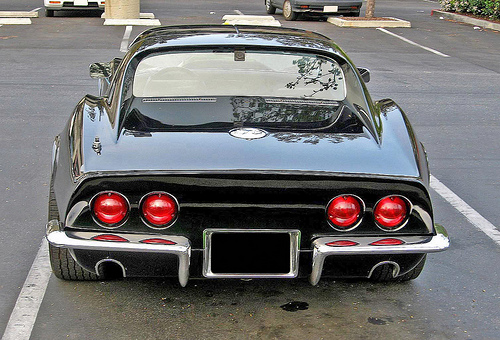
You can clearly see from this angle how far the fenders of this 1969 Corvette flare from the body. Rear tread width is 59.4 inches (1,509 mm), but the C3 Corvette is 69 inches (1,753 mm) wide overall! Note the cutouts in the rear modest panel where the exhaust pipes would normally run, empty on this car because of the side pipes.
THE BARBARIAN TRIUMPHANT
However horrified Duntov may have been by all the gewgaws, buyers responded enthusiastically and Corvette sales climbed impressively throughout the C3’s 14-year run, improving nearly every year. In 1969 alone, nearly 40,000 Corvettes were sold, despite prices starting at a rather steep $4,781 — a lot less than a Jaguar E-Type or a Porsche 911, but still a lot of money in those days. A decade earlier, Chevrolet managers would have been overjoyed to hit even a quarter of that total. A decade later, Corvette sales would approach 50,000 units a year.
By modern standards, the C3 Corvette’s handling had decent balance, but very limited grip, a consequence of the modest tires. Its brakes, although strong by the standards of 1969, are only adequate, particularly on the heavier big-block cars. Comfort was not a strong point; the C3 was about as roomy as a packing crate, its ergonomics were dubious, and the Astro Ventilation system provided limited airflow unless the rear window was removed. Ride quality of big-block Stingrays was choppy thanks in part to the 690 lb (313 kg) mass of the engine itself. Moreover, no Corvette of this era felt very solid, shaking and rattling over rough pavement.
For all these faults, a big-block Corvette had one inarguable asset, and that was torque. Even with the mildest of the 427s, there was enough grunt to simply liquefy the bias-ply tires. The gearbox was largely a toy; the big blocks have so much torque that starting in top gear was not a difficult exercise. Assessing exactly how much real horsepower and torque the big-block V8s actually made is a matter of much debate, but it could be summarized as “way too much,” at least with period rubber. Acceleration was mostly a matter of traction; top speed, a question of gear ratio and intestinal fortitude, because you tended to run out of either revs or courage before you ran out of horses.

The 1969 Corvette Stingray was big for a sports car, 182.5 inches (4,635 mm) long, and almost too curvaceous to believe. It’s contrived, but it has tremendous presence. This color is called Tuxedo Black; it was temporarily discontinued after this year and not offered again until 1977. This car’s list price in 1969 was probably around $6,000, Cadillac money in those days.
GONE BUT NOT FORGOTTEN
Zora Arkus-Duntov never quite gave up his dreams of a smaller, mid-engine Corvette. That dream came very close to fruition in the mid-1970s — there was very nearly a mid-engine C4 with a four-rotor Wankel rotary engine, but the Wankel program was canceled and the mid-engine was forgotten. Not long after that, Duntov retired. Bill Mitchell followed him in 1977.
As much as Duntov and Mitchell butted heads, in many respects they were similar: opinionated, sharp-tongued men who were willing to fight for what they believed in within a corporate culture that did not encourage individuality. After Mitchell was gone, GM management decided that there should be no more autocratic styling chiefs of his ilk. They wanted team players, and eventually they got them. Unfortunately, it also heralded a new era of cookie-cutter styling and corporate complacency that destroyed GM’s image and led to a long, precipitous loss of market share.
The C3 continued through several evolutions until 1982, long after its originally scheduled replacement. The C4 introduced in 1984 had a similarly long run. The fact that the Corvette survives at all despite continuing corporate ambivalence and a host of increasingly stringent federal and company rules, is remarkable; make no mistake, the engineers who designed and built the subsequent C5 and C6 Corvettes are rock stars. But there are no radical innovations in that realm, in either styling or engineering. Corvette styling remains a continual honing of the cues that Larry Shinoda drew back when John F. Kennedy was president and the idea of GM doing something as dramatic as the C3 today is hard to conceive.
In that sense, the Stingray is worth celebrating. Whatever its faults, it remains a bold statement in a world where bold statements have become all too rare. True, an over-styled, absurdly phallic fiberglass rocket packed with pointless gimmicks and a psychotic amount of horsepower is not everyone’s cup of tea, but the 427 Stingray is as glorious a gloriously useless device as America has yet produced.
NOTES ON SOURCES
Our sources for this article included “1968 Chevrolet Corvette 427 Coupe: Beautifully styled, lusty, exciting — Chevy’s Corvette coupe is the automobile world’s Barbarella,” Car and Driver Vol. 13, No. 11 (May 1968); Robert C. Ackerson, “King Kong Sting Ray: 1967 Corvette 427,” Special Interest Autos #50 (March-April 1979), reprinted in The Hemmings Motor News Book of Corvettes: driveReports from Special Interest Autos magazine, eds. Terry Ehrich and Richard A Lentinello (Bennington, VT: Hemmings Motor News, 2000), pp. 62-69; the Auto Editors of Consumer Guide, Encyclopedia of American Cars: Over 65 Years of Automotive History (Lincolnwood, IL: Publications International, 1996); John Gunnell, ed., Standard Catalog of American Cars 1946-1975, Revised 4th Edition (Iola, WI: Krause Publications, 2002); Dave Holls and Michael Lamm, A Century of Automotive Style: 100 Years of American Car Design (Stockton, CA: Lamm-Morada Publishing Co. Inc., 1997); J. William Lamm, “1968 Corvette: A Second Rabbit from the Same Hat,” Special Interest Autos #112 (July-August 1989), reprinted in The Hemmings Motor News Book of Corvettes, pp. 72-80; Randy Leffingwell, Corvette: America’s Sports Car (Osceola, WI: Motorbooks International, 1997), and American Muscle, Second Edition (Osceola, WI: Motorbooks International, 1993); Mike Mueller, Classic Corvette: The First Thirty Years (Osceola, WI: MBI Publishing Company, 2002); and Richard Prince, “Voracious Vette,” Special Interest Autos #173 (September-October 1999), reprinted in The Hemmings Motor News Book of Corvettes, pp. 86-94.
Das ist der Weird: the AstroVent on my ’69 Corvette always worked fine. The fan motor is a bit noisy, but that is because it is old.
The brakes are also very strong (four caliper full-floating pistons all around). The biggest problem was fluid leaks in the wheel cylinders, but that is easily and permanently fixed.
Given contemporary reviewers’ complaints about erratic build quality, the effectiveness of the Astro Ventilation system may have been one of those things that varied from car to car — many of the period road tests had unkind things to say about it. My personal reaction to the C3 (based on admittedly limited personal experience) could be summed up as “cramped and hot,” but I’ve never owned one of these cars, so I can’t speak authoritatively on that.
You are right that a C3 Vette is cramped inside and hot, it is noisy, it rides like a buckboard and visibility is terrible.
In particular, you have large blind spots by the rear strakes or whatever they are called, and it is hard to see over the nose.
However, they handle very well (once you ditch the corporate tires). If you fit modern wheels and tires, they corner as well as any exotic. Some suspension tweaks will have you cornering like a slotcar.
The early C3 Vettes accelerate like demons, and the “street” models are quite reliable. I’ve had mine for over 10 years and it has given me no troubles.
The C2 was better than the C1 in every performance and handling measure despite having the same available drivetrains. The C3 has the same chassis as the C2, is heavier, and has no less drag. It is a victory of Mitchell over Duntov, and of style over substance.
The C4 was as big a triumph over the C3 as the C2 was over the C1. Dave MacLellan may not have been Zora Arkus-Duntov, but he had a much freer hand over the Corvette than Duntov did.
One advantage of the C3 over the C2 was high-speed aerodynamics. Over around 120mph and the C2 begins to resemble a badly-designed airplane.
Another advantage of the C3 was it is easy to run larger tires without major surgery. A lot of internal parts are stronger, all C3s got dual-circuit master cylinders (only 1967 C2s had this), all C3s had four-wheel discs (only 1965 and up C2s had this), etc..
Chevy themselves say (“Chevy Power Manual,” a sort of official factory guide to modify your Vette) if you want to road race a C3 or C2, use a 1969+ frame.
Sorry SamBlob, but Sid is correct
The C2 might have a slightly lower coefficient of drag area than the early C3, but it’s worse in every other manner. Modern wind tunnel tests have shown that the C3 is the ONLY Corvette ever made to actually produce downforce rather than lift. The C2 produces the most lift of any Corvette, worse than even the C1.
The wide C3 fenders both accommodate bigger tires (and also lend themselves to be flared in an attractive manner), and work as spill plates to improve overall aerodynamics.
The C3 frame is stiffer, particularly around the rear trailing arm area. It is NOT the same chassis, just very similar. The C2 also has a rear roll centre that is too high (about ~7.5″ for the C3’s ~ 4.5). Most C2s have lousy brakes; the late C2 and C3 Corvette D8 pad forms the basis for most of Wilwood’s modern offerings.
I owned a ’72 big block (454) and had continual problems with heat in the engine and passenger cabin. I changed out the radiator hoping for improved efficiency to no avail. I also installed aircraft thermal insulation beneath the carpet with marginal results. Really liked the car but she was a hot one particularly in the Texas summer heat!
I have a 1969 RHD C3 BIG BLOCK (427)and added thermo fans to the radiator and have no engine heating problems.
I am in Northern Australia so inside warms up a bit but mind you driving with the windows open listening to the roar is awesome.
Had some work done motor wise,850 holley,mild cam,new dissy, etc so she goes like a cut snake.
I owned a 67 roadster 327/350 for eight great years, and at one point propelled it with a very antiquated and customized Edelbrock EFI of the day (nothing digital about it.) Close ratio and differential made for very nice launches, yet still bumped fuel mileage from 18-19 to 22-23 mpg. Think 1974 to 1982….and think 375hp in the eighties, with some efficiency, at the very moment Corvettes were being emasculated.
Lately, I’ve owned a bread and butter 69 coupe for nearly 35 years since. Along the way, it’s 350/300 and muncie 4spd have been replaced by a fully dynamic TPI and tremec 5 speed, still being “developed” as I learn more about modern TPI tuning.
I like both, but on balance prefer the 67…oddly enough, for it’s handling. Much more honest WITH A DECENT SET OF RADIALS underneath in the turns. A friend I used to informally race with invariably ended up swapping ends on his 69 on curves I’d just negotiated in the 67 (yes, he was always in the rear view). The only time I’ve ever “lost” a Corvette was also in the 69, also a low speed swap ends proposition on a curve. Make what you will of that. We’re not talking race track speeds here, just rat racing about the countryside.
There is no question the 67 got uncomfortably light up front over 120 mph (redline). When I say uncomfortable, both my friend and I flew high performance military jets for a day job. I can only liken it, in rolling terrain, to nothing quite so like skiing or snowboarding on the chattering, eye bouncing edge of control on ice and slush, constantly fearing departure from controlled flight. I hardly dared to think of turning….
This 69 of late the math between the 383 TPI engine, trans, differential and tires to see 202mph at red line….
I let you know how that turns out then the differential and brakes, tires and wheels are up to those sporty levels. Probably won’t plan on turning much….they just aren’t modern Stingrays in that sense. …and maybe you can set up the Sharks so they are stickier than the C2….just sayin’….
I also have to concur with Mark Roberts: if it’s hot, replace the radiator, fans, take the T-tops off and go a tad faster. If it’s cramped, lose some weight, ditch the chick, or “upgrade” to a Caddy.
Engineering, not cubic inches.
Great article! Wish Zora had been around to see the C8 finally move to mid-engine.