
For most people, the words “Ford Mustang” evoke one of two things: the original 1964–1966 icon of sixties Americana or the boxy 1979–1993 Fox Mustangs so beloved of amateur hot–rodders. This week, we consider how one evolved into the other, examine the history of Ford’s ubiquitous Fox platform, and take a look at the most unusual of all Mustangs: the high-tech, turbocharged, four-cylinder 1984-1986 Ford Mustang SVO.

SIC TRANSIT GLORIA MUSTANG
The success of the original Ford Mustang was both spectacular and transitory. A huge success when it debuted in 1964, it was moribund by the early seventies. Sales sank ominously and many of its direct competitors died off.
What happened? The Baby Boomers who had embraced the “pony cars” with such enthusiasm were getting older and having babies of their own, so the Mustang no longer met their needs. The original Mustang had had tidy dimensions, acceptable pep, and decent fuel economy. If the Mustang wasn’t as roomy as a Ford Falcon, it at least had enough space for young marrieds with small children. By 1971, the Mustang had grown bigger, fatter, thirstier, and even more cramped than before, not to mention more difficult to insure. Its demographic began to forsake their Mustangs and Camaros for smaller, cheaper compacts like Ford’s Maverick or the new Chevrolet Vega.
As early as 1968, even Ford stockholders had begun complaining that the Mustang was getting too big and losing sight of its original market. Lee Iacocca, who had championed the original Mustang, promised to look into it. He saw that the market was shifting and concluded that the Mustang in its current form would soon be obsolete. The larger-than-life 1971–1973 models were already under way by then, but Iacocca authorized a radical change for their successors.
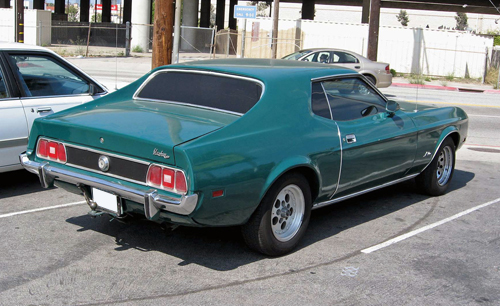
The original 1965 Ford Mustang was 181.6 inches (4,613 mm) long on a 108-inch (2,734mm) wheelbase, weighing about 2,900 lb (1,315 kg) with a V8 engine. By 1973, the Mustang was 193.8 inches (4,923 mm) long and a modestly equipped V8 car weighed more than 3,400 lb (1,540 kg). Neither interior space nor visibility were strong points.
THE LITTLE JEWEL
The 1974 Ford Mustang was downsized significantly, a daring move at the time. Based on Ford’s humble Pinto subcompact, the new Mustang II shed nearly 14 inches (356 mm) of overall length and around 300 pounds (136 kg) of curb weight. The V8 engines were gone, although a small-block 302 V8 (4,942 cc, but often advertised as “5.0”) was offered in Mexico; that engine rejoined the American line-up in 1975.

A 1974 Ford Mustang II notchback coupe, the most popular first-year model. No V8s were offered in the U.S. this year; the choices were the 140 cu. in. (2,300 cc) OHC Lima four from the Pinto, making 88 net hp (66 kW), or the 170 cu. in. (2,792 cc) Cologne V6, making 105 hp (78 kW).
In engineering terms, the Ford Mustang II, which Lee Iacocca called “the little jewel,” was a kludge. It rode a slightly stretched Pinto platform with extra sound insulation and a hastily contrived front-suspension subframe to reduce ride harshness. Even the engineers who designed the chassis admitted the results were heavier than they needed to be and in ride and handling, the Mustang II was more junior Thunderbird than Boss 302. Sharing the same engines as the much lighter Ford Capri, the Mustang II was also slow: even with a manually shifted V6, 0-60 mph (0-97 km/h) took more than 14 seconds.
Fortunately for Lee Iacocca, the new Mustang arrived just before the first OPEC oil embargo in the fall of 1973. After a sluggish start, the smaller, more fuel-efficient Mustang II racked up nearly 386,000 first-year sales.
FIGHTING THE FUTURE
Even before the Mustang II went on sale, Ford was already thinking about its eventual successor. In early 1973, Ford started work on a new platform known internally as “Fox,” which was slated to replace the compact Maverick, the U.S.-market Ford Granada (itself based on the Maverick), and the Mustang. At one point, there were apparently plans for a smaller version to replace the Pinto, but the Fox/Pinto was canceled early on.
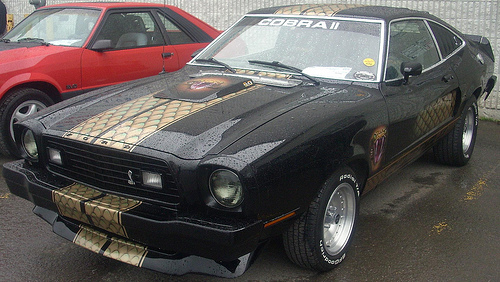
Ford offered an assortment of over-decorated, performance-themed Mustang IIs, including this ostentatious King Cobra edition. Their actual performance was sluggish; none had more than 139 hp (104 kW). (Photo: “’78 Ford Mustang King Cobra (Sterling Ford)” © 2009 Bull-Doser; released into the public domain by the photographer, resized by Aaron Severson)
Product planner Hal Sperlich, who had recently led the development of the European Ford Fiesta, thought the Fox should be a “world car” sharing its underpinnings with the European Ford Cortina/Taunus. Sperlich also pushed hard for front-wheel drive, arguing that it would improve fuel economy by making the cars lighter and more space-efficient.
Sperlich had Iacocca’s patronage, but he clashed with other Ford executives, including chairman Henry Ford II, who hated small cars and was wary of front-wheel drive. He had eventually approved the $1 billion FWD Fiesta program, albeit with great reluctance, but he balked at front-wheel drive for U.S.-market cars; it seemed too radical and too expensive for his liking — or, for that matter, the liking of Ford’s finance executives.
Ford’s concerns about costs became all the more acute in 1974. The energy crisis sparked by the OPEC oil embargo hit the auto industry like a tsunami. For a time, all new car sales were down significantly and American consumers, fearful that the supply of oil might be turned off at any moment, temporarily turned their backs on big cars. Henry Ford responded by slashing $2 billion from Ford’s product development budget, declaring that he would keep the company afloat by limiting costs.
The decision was ill-timed. In December 1975, the U.S. Congress responded to the energy crisis by authorizing the first Corporate Average Fuel Economy (CAFE) rules calling for the average fuel economy of all new American cars to increase from around 13 mpg (18 L/100 km) to 18 mpg (13 L/100 km) in 1978 and 20 mpg (11.8 L/100 km) by 1980. To meet those standards, the domestic automakers were going to have to introduce smaller, more fuel-efficient cars. Compacts like the Maverick and Pinto, which American automakers had tended to regard with contempt, would now have to become their bread and butter. That meant Ford had cut its development budget at a time when the company most desperately needed new products.
Iacocca was not significantly more fond than Henry Ford of economy cars, but pointed out that offering small, frugal front-drive models would not only make Ford more competitive, but also permit the company to continue selling bigger, more profitable cars. To Iacocca’s immense frustration, Henry Ford remained intractable, favoring conservatively, conventional, modestly downsized versions of Ford’s existing platforms that Iacocca and Sperlich argued would cost too much for too little benefit. (The result of that plan was Ford’s long-running Panther platform, which arrived for 1979.)
Sperlich, who had never been adept at corporate politics, made the mistake of continuing to push after Henry had made up his mind, expecting that Iacocca could protect him. Unfortunately, Henry and Iacocca were by then barely on speaking terms, so Iacocca was no longer in a position to protect anyone. In October 1976, Henry forced Iacocca to fire Sperlich, who joined Chrysler in March 1977. There, Sperlich would lead the development of the front-drive K-cars and Chrysler’s extremely popular T-115 minivans.
THE FOX PLATFORM
Although it was far less sophisticated than Sperlich and Iacocca would have liked, the rear-drive Ford Fox platform was reasonably modern when it first appeared, not far in concept or engineering from contemporary European or Japanese family cars. It still used a live axle — as did contemporary Volvos, Toyotas, Mazdas, and Alfa Romeos — but was lighter and significantly more space-efficient than its Maverick and Granada predecessors. It had rack-and-pinion steering, MacPherson strut front suspension, and a new rear suspension with coil springs and trailing arms, replacing the Maverick’s Hotchkiss drive.
The Fox body’s front suspension was an unusual variation on the standard MacPherson strut design. (Curiously, although it was former Ford chief engineer Earle S. MacPherson who patented the MacPherson strut, Ford had never previously used it in an U.S.-market model.) Developed by engineers Bob Burns and Bob Negstad, the Fox’s front suspension used the shock absorbers as upper control arms, but mounted the coil springs on the lower wishbones rather than around the struts. Ford claimed this allowed lighter steering and a better ride, but its main advantages were that it permitted a lower fender line and a wider engine bay. The latter point was particularly important because the Fox platform would be offered with a diverse array of engines, including the 2,300 cc (140 cu. in.) Lima four from the Pinto, the 2,792 cc (170 cu. in.) Cologne V6 from the Capri, Ford’s traditional 3,280 cc (200 cu. in.) straight six, and the familiar small-block 302 cu. in. (4,942 cc) V8.
The first Fox-platform cars were the Ford Fairmont and Mercury Zephyr, which debuted for the 1978 model year, replacing the Maverick and Mercury Comet. In exterior dimensions, they were about the size of Volvo’s 240-series, roughly splitting the difference between the old two-door Maverick and the four-door Granada. They were far from pretty, but their boxy styling made good use of the modest dimensions. They were also reasonably light; even a four-door Fairmont with V8 and automatic weighed a modest 3,000 lb (1,360 kg).

The Ford Fairmont sedan was 193.8 inches (4,923 mm) long on a 105.5-inch (2,680mm) wheelbase, 1.3 inches (33 mm) longer than a Volvo 242 sedan. Despite its rectilinear styling, U.S. critics thought the Fairmont’s low beltline, large glass area, and interior details like stalk-mounted light and wiper controls made it feel more European than American. With the V8, which had all of 137 net horsepower (102 kW), it could do 0-60 mph (0-97 km/h) acceleration in 9.4 seconds and had a top speed of 106 mph (171 km/h) — sprightly for a family car of the time. (Photo: “Ford Fairmont sedan 1” © 2009 IFCAR; released into the public domain by the photographer, resized by Aaron Severson)
The Fairmont and Zephyr were anything but sporty — CAFE and emissions standards meant that muscle cars were no longer on the menu — but they had adequate performance. Ford opted for a firmer, more European feel to the ride and steering than was customary for American sedans of the time. Nonetheless, handling and braking were unexceptional even with the European Sedan Option (ESO) package, which included stiffer underpinnings and front and rear anti-roll bars.
Ford had high hopes for the new cars, projecting a first-year volume of 687,000 units. Actual sales fell short of that mark by nearly 75,000 cars, still hardly bad. The Fairmont and Zephyr continued to do reasonable business through 1983, after which they were restyled and renamed LTD and Marquis, surviving until 1986. Their platform, however, proved to be one of Ford’s most prolific. Ford eventually used the Fox platform on eleven different car lines — including the Mustang.
MUSTANG III: THE FOX MUSTANG
The shape of the next Mustang was another matter of contention in the mid-seventies. Buyers did not seem adverse to the idea of a smaller pony car, but even the most generous observers considered the Mustang II a trifle anemic. By 1976, sales of the Chevrolet Camaro and Pontiac Firebird had begun to recover handily and the bigger, sleeker Camaro outsold the Mustang by a significant margin in 1977 and 1978. It was once again time for a change.
For cost reasons, the Mustang needed to share an existing platform. Since the second-generation Pinto had been canceled, the new Mustang would instead ride a shortened version of the Ford Fox platform, sharing most of its hardpoints with the Fairmont. The Mustang would also share its body with a new Mercury Capri; American sales of the German-built Capri II had been declining and exchange rate problems were making importing the cars from Europe expensive. (Ford never imported the European Ford Capri III to the States.)
Each of Ford’s styling studios offered design proposals for the new Mustang, as did the Italian styling house Ghia, which Ford had acquired in the early seventies. The different proposals were bewilderingly varied, suggesting some deep-seated uncertainty about what the Mustang was supposed to be. Many of the more outrageous concepts were kiboshed by the need to share the Fairmont platform while the conservative, angular proposals looked like the shrunken Fairmont coupes they would have been.
It was designer Jack Telnack who finally set the direction for the Fox Mustang. Telnack was from the Detroit area, but his Ford career had taken an international turn, first with an extended stint at Ford’s Australian subsidiary and then with a three-year tenure as design director for Ford Europe. He returned to America in the spring of 1976 as head of advanced and international styling. Telnack, who had worked on both the original Mustang and the 1971–1973 generation, was dismayed by the conservatism of the design proposals and pushed for a more aerodynamic shape with what he considered a European flavor.
Stylistically, this was a big departure for Ford, flying in the face of Henry Ford II’s preference for vertical grilles and upright roofs. It also required Telnack to finagle permission to alter some Fairmont hardpoints. Such changes were not unheard of at GM, where Styling had more power, but they were rare at Ford, where the “package” dimensions set by Engineering were generally considered sacrosanct. Telnack also successfully pushed for a three-door body style with a wraparound hatchback akin to those of the contemporary Honda Accord and Volkswagen Scirocco, although inconclusive feedback from marketing studies prompted Ford to offer both three-door and more conventional two-door notchback body styles like those of the Toyota Celica.
After some initial reservations, Henry Ford II eventually decided he liked the slanted nose, something to which he had previously been almost categorically opposed. The resulting design was in no way radical-looking and its drag coefficient was an unexceptional 0.46, but Telnack later said it opened the door for the more dramatic aero styling of the 1983 Thunderbird, the Tempo, and the first Ford Taurus. For his efforts, Telnack was promoted to director of design in September 1978, just before the new Mustang went on sale.
MORE AND LESS
The new Fox Mustang and Capri went on sale in the fall of 1978 for the 1979 model year. Contrary to the general trend of the times, they were about 4 inches (102 mm) longer than their predecessors, although they were still smaller than the 1964 car: 179.1 inches (4,549 mm) overall on a 100.4-inch (2,550mm) wheelbase. The new Mustang and Capri were also significantly smaller than the contemporary Camaro and Firebird, which dated back to 1970. The new Mustang was usefully lighter than its Pinto-based predecessor, shedding about 200 pounds (91 kg). That was fortunate, for the new Mustang had most of the same engines as the Mustang II or, for that matter, the 1978 Fairmont.
The main addition was a new turbocharged version of the 2,300 cc (140 cu. in.) four. Still carbureted, it initially claimed 132 horsepower (98 kW), although for some obscure reason, Ford quoted its output in the old SAE gross rating scale that the industry had dropped in the early seventies; turbocharged Mustangs exported to Europe were rated at 118 net horsepower (88 kW). The still-available 302 cu. in. (4,942 cc) V-8 was more powerful, but at the time, most conventional wisdom said that CAFE would obsolete V8 engines by 1985, so Ford, like Buick and later Chrysler, looked to turbocharging as a way to combine reasonable power and fuel economy.
On paper, the turbo four didn’t seem a bad bet, especially since it was around 150 lb (68 kg) lighter than the V8, but its power band was narrow and its driveability left much to be desired. Mustang buyers were wary of the turbo engine, particularly once it became clear that its reliability was also sub-par. The V8 seemed a safer choice, offering performance comparable to the milder small-block V8 Mustangs of the sixties. A manually shifted 1979 Mustang V8 could do 0-60 mph (0-97 km/h) in less than 9 seconds, a notable improvement on the Mustang II.
The new Mustang’s suspension was much the same as the Ford Fairmont’s, including the option of Michelin TRX tires (a curious metric-size radial also used by some contemporary European cars). American critics were pleased with the Mustang’s handling, which wasn’t bad on smooth surfaces, but the four-link rear axle was not particularly well located and did not handle bumpy pavement gracefully. The Mustang and Capri also inherited the Fairmont’s mediocre brakes, which became one of their weakest points.
Whatever its ups and downs in recent years, the launch of a new Mustang inevitably drew a lot of press attention and had the car’s loyal fan base clamoring. First-year sales of the new car were almost 370,000, nearly double those of the final Mustang II.
That was nearly the only good news Ford got in 1979. The Fox-body Mustang and the newly downsized Panther-platform full-size cars got off to a good start, but then a new energy crisis triggered by the revolution in Iran sent gas prices soaring and buyers scurrying back to subcompacts. All Ford could offer those customers were a limited number of U.S.-market Fiestas and the aging Pinto, whose reputation was tarnished by the growing controversy over gas-tank fires. Ford’s market share dropped to its lowest point since World War II. Things got even worse for 1980, as Ford’s total volume — which had remained steady in 1979 despite the drop in market share — dropped by more than half a million units. By year’s end, the company had lost $1.54 billion.
That was exactly what Lee Iacocca had been afraid of, but by the time his fears came to pass, he was gone. Iacocca had made Ford a great deal of money over the years — conceiving the Mustang, the original LTD, and the Lincoln Continental Mark, among others — but he had challenged Henry Ford II too many times. After a final confrontation in the summer of 1978, Henry fired him. Iacocca officially took “early retirement” on October 15, 1978, not long before the new Mustang went on sale. In November, he followed Hal Sperlich to Chrysler.
Weary, in poor health, Henry Ford II made three decisions that would affect the future of the Mustang. First, he reluctantly authorized the front-drive Erika project, which would spawn the FWD U.S.-market Ford Escort and the compact Ford Tempo/Mercury Topaz. Second, despite his profound mistrust of the Japanese, in late 1979, he authorized the purchase of a 25% interest in Toyo Kogyo, the parent company of Mazda. Finally, shortly before retiring as chairman in 1980, he decided that Ford was once again going racing.
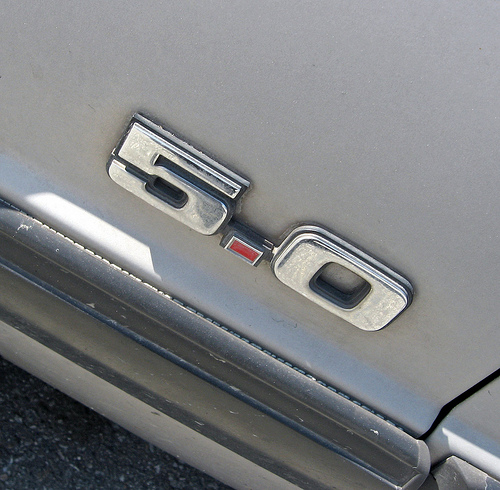
The actual metric displacement of Ford’s familiar 302 cu. in. V8 was 4,942 cc, but Ford preferred to round up to 5.0 liters.
A DAY AT THE RACES
Henry Ford’s grandfather ran his first auto race in October 1901 and Ford Motor Company had had on-again, off-again official and unofficial involvement in competition almost from the beginning. The golden age of Ford racing, however, was the 1960s. After an unsuccessful attempt to buy Ferrari in early 1963, Ford launched its “Total Performance” campaign, an all-out assault on nearly every form of motorsport — notably including the 24 Hours of Le Mans, which Ford won four years in a row between 1966 and 1969.
Ford North America abandoned its competition program in November 1970. Racing was (and remains) a very expensive sport and the company needed the resources to face federal emissions and safety standards. Ford’s European subsidiary continued to race in a more limited fashion throughout the seventies, but in America, even the remaining stocks of performance parts were scrapped, leaving many private racers out in the cold.
Henry Ford’s decision to return to racing 10 years later was a curious one. The company was losing money at a frightening rate — more than $3.5 billion between 1979 and 1983 — and new CEO Philip Caldwell had begun a brutal cost-cutting program that eventually trimmed $2.5 billion from the company’s fixed costs. Nonetheless, Ford desperately needed good publicity, particularly as the Pinto fuel-tank scandal escalated.
At the suggestion of Ford Public Affairs VP Walter Hayes, who had been Ford’s head of public affairs in Europe in the sixties, Ford launched a new organization called Special Vehicle Operations (SVO) to oversee its competition efforts. Announced in September 1980, SVO was funded by the Public Affairs department and headed by Michael Kranefuss, former director of motorsport for Ford-Werke in Germany. SVO was small, with a staff of about 30, and operated with an unusual degree of autonomy in the stratified corporate environment of Ford. Its mission was to support private racing teams using Ford cars and engines; develop performance parts; and create high-performance production cars, profits from which were supposed to fund the group’s other activities.

The Ford Mustang SVO was designed for flush-mounted composite headlights, but they were still not legal in the U.S. when the Mustang SVO debuted, so 1984 and early 1985 cars had sunken rectangular sealed beams instead. Other Fox Mustangs inherited the SVO’s “drooped” nose and composite headlights in 1987, although they had one or two slots between the headlights, giving them a different look.
Kranefuss began by re-bodying a Zakspeed racing Capri from European Group 5 competition as a Mustang, which made a promising showing in the IMSA GT class. This was followed by forays into NASCAR, Baja off-road racing, NHRA drag racing, Trans-Am, Formula One and CART, often with considerable success. By early 1981, SVO had also begun work on its first (and, ultimately, only) production car.
FORD MUSTANG SVO
Almost inevitably, SVO’s production car was based on the Ford Mustang. It was the only vaguely sporty model in Ford’s lineup at the start of the eighties; the aero-styled 1983 Ford Thunderbird and 1984 Lincoln Mark VII were still in the future.
In 1980 and 1981, the stock Mustang’s performance was at a low ebb. Still in serious danger of missing its CAFE requirement for 1980, Ford de-bored the 302 cu. in. (4,942 cc) V8 to 255 cu. in. (4,186 cc), which yielded a miserable 119 net horsepower (89 kW). The turbo engine was still available for a time, but was quietly dropped in 1981. It returned in 1983, now with fuel injection, but sales remained very low.
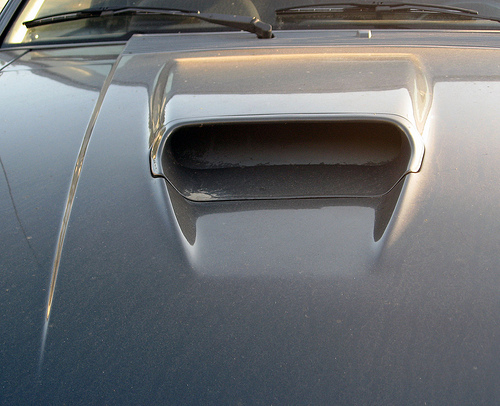
The Ford Mustang SVO’s prominent hood scoop feeds cool outside air into the intercooler. By cooling the pressurized charge before it enters the intake manifold, the intercooler makes the charge denser, increasing power.
Despite its limited public acceptance, SVO decided to base its “Special Mustang” on the turbo four. Turbos still seemed the way of the future and the 2.3-liter Lima engine’s lighter weight promised better handling than the V8. Furthermore, a turbocharged road car would be useful for homologation purposes. The SVO engineering team fortified the 2.3-liter engine with Ford’s new EEC-IV engine control system, electronic fuel injection, an air-to-air intercooler, and more boost — up to 14 psi (0.97 bar). Premium fuel was now required, but a dashboard mounted boost/spark limiter switch allowed the engine to survive on regular unleaded if necessary. With full boost pressure, the revamped turbo engine now claimed 175 horsepower (131 kW), a healthy increase on the earlier turbo and a good deal better than the anemic early-eighties V8s.
SVO’s budget for the special Mustang was only $7 million, but the engineering team made good use of the Ford parts bin and various aftermarket suppliers. The Mustang SVO got a new steering rack from TRW, adjustable Koni shocks, a Borg-Warner T-5 gearbox with Hurst linkage and Dyken heavy-duty clutch, bigger four-wheel disc brakes, Lear-Sigler sport seats, and new 16-inch wheels. There wasn’t much money for cosmetic changes, but the SVO got a new front fascia with a drooped nose, fog lamps, and provision for flush headlights. SVO also added a new hood with a scoop for the intercooler and an outré biplane rear spoiler.

The SVO’s rear spoiler was controversial within SVO. The promotions staff wanted to use the dramatic biplane wing of the European Ford Sierra XR4i, but their boss, marketing manager John Clinard, was very nervous that it would become the SVO’s stylistic albatross, like the grille of the 1958 Edsel. The XR4i’s spoiler had a similar shape, but the upper wing was mounted higher on the tail.
Convincing Ford’s regular engineering department to supply the new pieces at a cost SVO could afford was not easy. Despite those obstacles, development proceeded apace and in June 1982, SVO took two prototypes to the Quaker State Oil Longest Day of Nelson 24-hour endurance race. They fared well at first, but both cars suffered overheating problems and required new engines midway through the event. Still, their performance was promising and their handling was markedly superior to that of the contemporary V8 Mustang.
NEAR-DEATH EXPERIENCES
The production Mustang SVO was originally supposed to appear as a mid-year 1982 model, but it was delayed — and nearly died entirely — because Ford came very close to terminating the Fox Mustang on which it was based. In late 1980, the company decided to cancel the Fox-body Mustang and Capri at the end of the 1982 or 1983 model year and replace them with a front-drive model based on the next-generation Mazda Capella/626.
From a financial standpoint, this was a logical idea, particularly since CAFE requirements were slated to rise to 27.5 mpg (8.6 L/100 km) by 1985. The Mustang was such an iconic product for Ford, however, that many engineers, designers, and executives balked at replacing it with a Japanese-engineered car. The idea was shelved, although it would resurface a few years later.
With these delays, the production Mustang SVO didn’t appear until a few months into the 1984 model year. The SVO was well received by the enthusiast press, which was enthusiastic about the SVO’s technological sophistication and handling. The SVO was lighter and better balanced than the V8 Mustang and the bigger tires and re-tuned suspension and steering made the SVO decidedly more agile. It had much better brakes was quick, too, capable of 0-60 mph (0-97 km/h) in about 7.5 seconds with a top speed of 134 mph (216 km/h). Unfortunately, the Mustang SVO was also expensive. With a base price of $15,585, it cost over $6,000 more than a V8-powered Mustang GT, a sum that at that time was enough to buy an entire Ford Escort.
By the time the Mustang SVO appeared, the V8 Mustang was quickly recovering its former strength. The arrival of the Escort had given Ford some breathing room on its CAFE, leading to the reintroduction of the 302 (4,942 cc V8) in 1982. It had 157 hp (117 kW) at first, which climbed to 175 hp (131 kW) in 1983. The addition of fuel injection for 1984 actually trimmed horsepower to 165 (123 kW), although driveability and fuel economy were much improved. For buyers primarily concerned with straight-line performance, $6,000 was a hefty premium for 10 extra horsepower (8 kW) and notably less torque. The V8 was primitive compared to the turbo four, but it was also far more pleasant to deal with. The SVO’s engine was powerful, but it was also rough, noisy, and generally unpleasant, suffering annoying turbo lag.
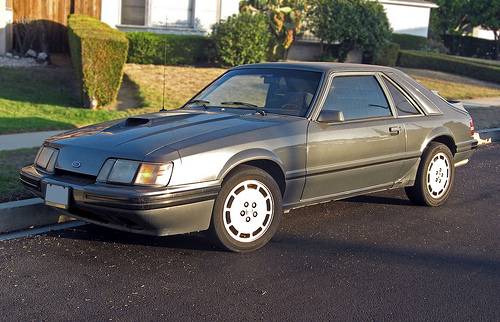
A Ford Mustang SVO weighs a bit over 3,100 lb (about 1,405 kg), nearly 200 lb (91 kg) lighter than a Mustang GT. Since most of that savings is off the nose, weight distribution is also notably better. The SVO has adjustable Koni shock absorbers, which give substantially better body control than the standard Mustang.
The Mustang SVO was left in a difficult bind. In performance and technology, it was competitive with imported sports coupes like the Nissan 300ZX and Toyota Supra and was closer to a Porsche 944 than either side cared to admit. Buyers of such cars, however, had long since dismissed the Mustang as a knuckle-dragging throwback. In their eyes, the SVO was still a Mustang. Mustang loyalists, meanwhile, more concerned with stoplight drag racing than handling and stopping, preferred the vastly cheaper, torquier V8. Mustang SVO sales were sluggish; although SVO had an annual production capacity of 10,000 units, they sold only 4,508.
Mustang sales in general were very gloomy during this period. Despite the revival of the 302, annual sales for 1982–1985 averaged fewer than 150,000 units, as bad as in the dark days of the early seventies. Strong competition from the newly redesigned Camaro and Firebird was part of the reason, but the growing ranks of thriftier, more sophisticated imports had also taken their toll.
UNATTENDED ENCORE
The Mustang SVO gained a number of useful improvements throughout its life. In early 1984, the SVO, like the Mustang GT and non-SVO Turbo GT, got a new Quadra-shock system, replacing two of the rear trailing arms with a pair of horizontally mounted shock absorbers to better control axle hop. For mid-1985, the SVO engine received a new water-cooled turbocharger with up to 15 psi (1.03 bars) of boost, intake manifold, cam shaft fuel injectors, and exhaust system, raising peak power by 25 hp (19 kW), to 200 hp (149 kW), and torque by 30 lb-ft (41 N-m), to 240 lb-ft (325 N-m). (Some sources quote 205 hp (153 kW) and 248 lb-ft (336 N-m) for 1985½ cars, but Ford brochures cite the lower figures.) To help put that power to the ground, the five-speed gearbox got closer ratios and a shorter (higher numerical) axle ratio, 3.73 rather than the previous 3.45:1. The SVO also finally received the flush headlights for which it had been designed, improving its drag coefficient to a reasonable 0.38.
Despite those improvements and a price cut of about $750, sales were even worse than the first year: fewer than 2,000. The big problem was that the regular Mustang’s V8 was now up to 210 hp (157 kW), more power than the Mustang SVO at a much lower price. For 1986, both the SVO and V8 claimed 200 hp (149 kW), but the SVO had less torque and still listed for over $4,000 more than a standard Mustang GT. Ford sold 3,382 SVOs for 1986, which would be its final year.
Thanks to the modest development cost, the Mustang SVO did not lose money; the break-even point was only 8,500 cars and total sales were 9,844. That was hardly an overwhelming success, though, and it did little to underwrite the costs of competition.

The mid-eighties Fox-body Mustangs are about a half inch (13 mm) longer than the original 1979 car, but their dimensions are otherwise similar. The Mustang SVO has unique 16-inch wheels and plastic rocker panel cladding, but its body is otherwise the same as the three-door Mustang GT’s. The SVO was not offered with the two-door notchback body or as a convertible.
The other reason for cancellation of the Mustang SVO was — once again — the apparently imminent demise of the Fox Mustang. By late 1983, Ford was again planning to drop the Fox-body pony cars in favor of a front-drive Mazda design, this time at the end of the 1986 model year.
FOX SPRINGS ETERNAL
As before, many Ford employees took umbrage at the idea of replacing the Mustang with a Japanese design. Someone leaked the news to the press, which unleashed a torrent of angry letters from outraged Mustang fans. Ford finally relented and promised that the Mustang would continue to be built in its own plants through at least 1993 rather than switching to the new Mazda facility in Flat Rock, Michigan, as originally planned.
Ford went ahead with the Mazda-based coupe anyway, which emerged in 1989 as the Ford Probe. Although it took its name from a series of highly aerodynamic Ford concept cars, it shared its front- drive platform and four-cylinder engines with Mazda’s Capella, sold in the U.S. as the 626 sedan and MX-6 coupe. Ford’s 2,986 cc (182 cu. in.) Vulcan V6 became an option in 1990, but other than that engine and the exterior styling, the Probe was primarily a Mazda design, closely related to the contemporary MX-6.
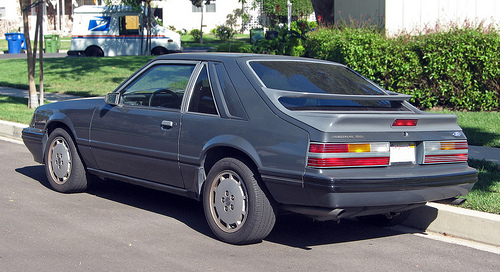
The Mustang SVO’s rear disc brakes were borrowed from the contemporary Lincoln Continental Mark VII along with a wider, heavier rear axle than other Mustangs. Front discs were bigger than the regular Fox’s, too. Other than the SVO, the only Fox-body Mustang with four-wheel discs was the limited-production 1993 Mustang SVT.
In the meantime, the Fox-body Mustang soldiered on. The Capri expired in 1986 after years of dismal sales, but the Mustang recovered nicely that year thanks to cheap gasoline and a resurgent U.S. economy. Since its tooling costs had been paid off long before, it cost less than many four-cylinder rivals; an LX 5.0 listed for less than $11,000. By 1987, the turbo engines were gone, but the V8 was up to 225 horsepower (168 kW).
The resurgent Fox Mustang seemed increasingly crude compared to its newer competition and even the aftermarket tuners who clutched it to their collective breast had no illusions about the Mustang’s flaws. For cheap speed, however, it had few rivals. Sales in the late eighties regularly topped 200,000 units a year.
Although it was still used in other Ford products, including the Ford Thunderbird Turbo Coupe, Mercury Cougar XR-7, and Merkur XR4Ti (an American version of the Sierra XR4i), the 2.3-liter turbo engine was on its way out. Although it was powerful, Thunderbird and Cougar buyers were even more put off by its agricultural feel and modest low-end torque than Mustang fans had been. The Thunderbird offered the turbo engine through 1988, but most buyers opted for the more pleasant and tractable 302 V8.

A center-mounted high stop light was standard on all 1986 Fords. We have no explanation for this 1986 Mustang SVO’s mismatched taillight covers; the right is correct, but the left was apparently borrowed from a stock GT.
The continued strength of the V8 engine was not without its costs. Ford failed to meet its CAFE targets for 1984 and only avoided paying a penalty in 1986 because the Reagan administration agreed to roll back the standard from 27.5 mpg (8.6 L/100 km) to 26 mpg (9.1 L/100 km).
THE HARDER THEY FALL
As much as Henry Ford II hadn’t wanted front-drive compacts, the Escort and Tempo did good business for Ford, as did the new front-drive Taurus. Thanks to those models (and robust truck sales), Ford made a dramatic recovery in the mid-eighties, racking up record profits.
As with Chrysler, however, Ford was again heading for a fall by 1990. A spree of ill-timed acquisitions, including the purchase of Jaguar for a hefty $2.5 billion, ate up the company’s cash reserves. When the economy turned sour again by decade’s end, Ford again lost ferocious amounts of money. In that climate, the Mustang’s future was yet again in doubt. The Fox-body Mustang’s last really good sales year was 1989, but Ford had little money to spare for a redesign.

Non-SVO Mustangs got a facelift in 1987, gaining flush headlights like those of the now-departed SVO. While the three-door hatchback tended to be the Fox Mustang’s most popular body style, the two-door notchback sold well throughout the model’s life. Some buyers strongly preferred the two-door Mustang LX 5.0 package to the GT; the LX had the same engine and suspension as the GT, but was lighter, cheaper, and less ostentatious, omitting the GT’s spoilers and ground-effects kit. (Photo: “87-93 Ford Mustang” © 2007 IFCAR; released into the public domain by the photographer, resized by Aaron Severson)
Hoping to emulate Mazda’s more efficient, less expensive design process, Alex Trotman, head of Ford’s North American Operations, assigned engineer John Coletti to form a small, largely autonomous team — a great deal like SVO — to develop a new Mustang. By allowing the team to work outside Ford’s normal design and engineering channels, Trotman hoped Coletti’s group could redesign the Mustang for a modest $300 million, a fraction of Ford’s normal development costs for a new model.
Coletti’s team, which started work in January 1990, developed the new design — known internally as SN-95 — in less than a year. The time and budget constraints ruled out a completely new platform, so the team was left to revamp the now-elderly Fox. While the new Mustang bore little external resemblance to its predecessor, its chassis, now dubbed “Fox-4,” was a direct descendant of the long-departed Fairmont.
Launched for the 1994 model year, at an eventual cost of $700 million, the SN-95 Mustang was not an outstanding seller, but it did arrest the sales slide of the early nineties. The Mustang outsold the faster, sleeker fourth-generation Camaro and Firebird and weathered the implosion of the coupe market, which claimed the Ford Probe in 1997. After a major facelift in 1999, the Fox-4 survived through 2004.
AFTER THE FOX
We’re not sure how much Ford spent to develop the Fox platform in the mid-seventies, but they certainly got their money’s worth. Ford used it for 16 years — 26, if we include the Fox-4. By the end of its long life, the platform was quite dated and some of its flaws (like axle hop) were never fully corrected, but it was a great financial success.
SVO continued to do well in competition, but it never built another production car. It did explore several other projects, including a Thunderbird SVO and the Ghia-styled MN34 mid-engine sports car, which would have been powered by a bigger version of the Ford Taurus SHO’s Yamaha-built “Shogun” DOHC V6. The project died because Ford Division needed the money to develop a replacement for its Bronco II sport-utility vehicle, which eventually became the highly successful Ford Explorer.
Some Ford executives hadn’t given up on the idea of offering hotter street cars, so in 1991, Ford sales and marketing VP Bob Rewey and chief technical officer Neil Ressler established the Special Vehicle Team (SVT) specifically to develop and market high-performance versions of Ford production vehicles. Naturally, its core product was a hotter version of the Mustang, known as the Mustang Cobra. SVT has been moderately successful, but it has had little new product in recent years and there are persistent rumors that it will be shuttered.
What of the Mustang SVO? The Pabst Blue Ribbon image of other Fox Mustangs has so far limited their collector appeal — which strikes us as somewhat unfair — but they still have a small but loyal following. The 302 Fox-bodies remain popular with tuners (and probably will remain so until the last survivor has succumbed to corrosion), but if any eighties Mustang becomes a serious collectible, it will probably be the SVO.
Not being overly fond of either smoky burnouts or the peculiar Midwestern sport of “doing donuts,” we’ve never cared much for Mustangs of this vintage. Shade-tree hot-rodding is fine, but we prefer cars that have more polish out of the box. In that regard, the SVO did many things right; its steering feel, shift linkage, and even the placement of the pedals were much improved over the standard LX 5.0. Sadly, the only things the regular Mustang inherited from the SVO were its aero nose and the quad shock system, which was never entirely effective at taming the V8’s torque. The Mustang GT would have been a substantially better car with the Mustang SVO’s improved suspension, brakes, and controls. It’s too bad that there weren’t many buyers willing to pay for them.
FTC DISCLOSURE NOTICE
In April 2010 (approximately two years after the original publication date of this article), Ate Up With Motor accepted a paid advertisement from AmericanMuscle.com, a company that sells Mustang parts and aftermarket accessories. At the time this article was conceived and written, we had no relationship with that company or any other business connected with the Mustang or Mustang accessories and we received no compensation or consideration for the writing of this article. We have no personal experience with AmericanMuscle.com’s products and offer no opinion about or endorsement of those products.
NOTES ON SOURCES
Our account of Ford’s woes in the 1970s, including the fate of Hal Sperlich, comes primarily from David Halberstam, The Reckoning (New York: William Morrow and Company, 1986); Joseph White and Paul Ingrassia, Comeback: The Fall & Rise of the American Automobile Industry (New York: Simon & Schuster: 1995); and Lee Iacocca, Iacocca: An Autobiography (New York: Bantam Books, 1984). Other sources included the Auto Editors of Consumer Guide, Encyclopedia of American Cars: Over 65 Years of Automotive History (Lincolnwood, IL: Publications International, 1996), and “Jack Telnack: Chief Designer of the 1979 Ford Mustang,” HowStuffWorks.com, 16 February 2007, auto.howstuffworks. com/jack-telnack.htm, accessed 18 October 2009; Steve Bauer, “The Fast and Furious Special Vehicles Team,” Muscle Mustangs & Fast Fords March 2009, www.musclemustangfastfords. com, accessed 20 October 2009; Jim Brokaw, “Mustang II,” Motor Trend December 1973, reprinted in High Performance Mustang IIs 1974–1978, ed. R.M. Clarke (Cobham, England: Brooklands Books, 1993): 7-8; Rich Ceppos, “Ford Mustang SVO,” Car and Driver Vol. 29, No. 4 (October 1983), reprinted in Car and Driver Road Test Annual 1984: 53-57, and “The Best American GT,” Car and Driver Vol. 32, No. 12 (June 1987): 40-47; Rich Ceppos, Csaba Csere, and Larry Griffin, “Dearborn vs. Goliath,” Car and Driver Vol. 32, No. 1 (July 1986), pp. 54-59; Rich Ceppos, et al, “The Best-Handling American Car Is…,” Car and Driver Vol. 29, No. 11 (May 1984): 35–45; Csaba Csere, “Ford Probe GT,” Car and Driver Vol. 33, No. 9 (March 1988): 42–47, and “Ford Taurus SHO,” Car and Driver Vol. 34, No. 6 (December 1988): 36–40; John Dianna, Ted Orme, Chuck Nerpel, et al, “Turbo Capri RS,” Motor Trend Vol. 31, No. 12 (December 1979): 53–58, 102–107; John Dinkel, “Mustang II: Technical Analysis & Driving Impressions,” Road & Track Vol. 25, No. 1 (September 1973): 32–37, and “New from Ford: Mustang II V-8,” Road & Track Vol. 26, No. 1 (September 1974), reprinted in High Performance Mustang IIs 1974-1978, pp. 26-27, and “Technical Analysis & Driving Impressions: Ford’s New Mustang & Capri,” Road & Track Vol. 29, No. 12 (August 1978): 36–43; Ford Division of Ford Motor Company, “1983 Ford Mustang” [brochure 004A], February 1983; “1984 Ford Mustang” [brochure 031-Rev.], December 1983; “1984 Ford Mustang SVO” [brochure], October 1983; “1985 Ford Mustang” [brochure 024-Rev.], December 1984; and “1986 Ford Mustang” [brochure 008], August 1985; Ford Division Training and Communications, “Performance Profile: 1985½ Mustang SVO” [dealer information leaflet] Vol. No. 5PC 034; Foureyedpride.com: The Early Fox Site, foureyedpride. com, accessed 26 September 2014; Alexis Gossseau, “Ford Mustang GTP: too hot!” IMSAblog, 10 August 2007, alex62.typepad. com/ imsablog/ 2007/08/ ford-mustang-gt.html, accessed 19 October 2009; Michael Jordan, “Mustang vs. Camaro,” Car and Driver Vol. 28, No. 12 (June 1983): 35–41; Jeff Karr, “Bang for the Buck,” Motor Trend Vol. 41, No. 11 (November 1989): 42–76; Randy Leffingwell, Mustang: America’s Classic Pony Car (Ann Arbor, MI: Lowe & B. Hould Pub., 1999); L’Editrice Dell’Automobile LEA, World Cars 1979 (Pelham, NY: Herald Books, 1979); Jim McCraw, “The ’75 Mustang V8 Is Here,” Hot Rod June 1974, reprinted in High Performance Mustang IIs 1974-1978, pp. 22-25; the Mustang SVO Owners Network website, www.mustangsvo. org, accessed 19 October 2009; “Mustang II Mach 1,” Road & Track January 1974, reprinted in High Performance Mustang IIs 1974-1978, pp. 11-14; the Old Car Brochures website (oldcarbrochures.org); “Road Test: Ford Mustang Ghia (Motor Road Test No. 33/79: Ford Mustang Ghia Turbo),” Motor Road Tests 1979: 6–9; Bill Sanders, “Engineering and Driving Ford’s Horse of a Different Color,” Motor Trend Vol. 22, No. 9 (September 1970): 59, 86; Don Sherman, “Ford Fairmont: Ford builds a Volvo, and it works,” Car and Driver Vol. 23, No. 3 (September 1977): 27–34, “Preview Test: Ford Mustang and Mercury Capri,” Car and Driver Vol. 24, No. 2 (August 1978): 36–44, and “Preview Test: Mustang Cobra,” Car and Driver Vol. 25, No. 3 (September 1979): 33–38; Kevin Smith, “SVO vs G.T. 350,” Motor Trend August 1984, reprinted in Shelby Mustang Ultimate Portfolio 1965-1970, ed. R.M. Clarke (Cobham, England: Brooklands Books, 2003), pp. 210-216; SVO Club of America, “Mustang SVO History” (11 September 2008, SVOCA, www.svoca. com, accessed 19 October 2009; “The Making and Selling of the Smallest Car,” Motor Trend Vol. 22, No. 9 (September 1970): 56–57, 84–85; Dave Wallace, “Turbo Cobra,” Hot Rod January 1979: 12–15; Paul Weissler, “Turbocharging the Mustang,” Popular Mechanics Vol. 151, No. 8 (August 1978): 84 and 134; and Tom Wilson, “Fox Mustang 30th Anniversary – Big Three-Oh,” 5.0 Mustangs & Super Fords April 2009, 50mustangsuperfords.automotive. com, accessed 20 October 2009.
This article’s title was suggested by the song “(You’ll Never) Outfox the Fox,” composed by Sammy Cahn and Sylvia Fine, featured in the Danny Kaye film The Court Jester (produced, written, and directed by Melvin Frank and Norman Panama, United States, Paramount Pictures, 1956).
Don’t know where you get your information, but SVO’s of any year have never had an air-to-water intercooler, from the factory. Thunderbirds with the same drivetrain have never had an air-water intercooler. At least not from the factory. There were aftermarket intercoolers that were air-water but certainly not from the factory.
That error came from the Leffingwell book (p. 173, if you’re curious) — comparing it to the SVOCA chronology suggests that Leffingwell conflated the intercooler with the water-cooled turbo housing, which I hadn’t previously caught. I’ve amended the text accordingly.
As an owner of a 1984 SVO and a 1986 SVO, I agree with Kurt for the fact that Factory SVO’s never came with a Air to Water intercooler. Good article!
I already corrected the when Kurt left his comment back in October — thanks!
There’s another mention in a figure caption which is probably what the commenter was referring to.
Aaaack. Fixed.
The 1978 King Cobra shown pictured with this article has custom graphics and is not representative of any original equipment design.
Fair enough. It was the only picture I could find for the article; if I get another, I’ll swap it out.
But with 1 factual error. The mazda flat rock plant was always a uaw plant. When mazda decided to build their NA plant the facts that ford owned a sake in them, and that they’d be producing a ford product (rebadged mx6) was enough to get them to build in michigan and to embrace the uaw before they even began construction.
Read the book Working For The Japanese. It’s all about the flat rock plant from the start and how the mazda and the UAW embraced the JIT system of manufacturing. It’s a great read.
Ack, you’re quite right. At some point, I need to go back to check if my original sources were incorrect on that point, or if I just misread/misremembered, but I’ve amended the text, in any case. Thanks!
“First was more power: various engine revisions, notably a water-cooled turbocharger and increased boost pressure, raising peak horsepower by 30 hp (22 kW), to 205 (153 kW)”
The revisions in 1985 that made the biggest difference in power were a longer duration cam, and bigger fuel injectors, along with a new EEC-IV calibration. These were mid-year changes, by the way. The water-cooled turbo was intended to reduce warrantly claims, due to oil coking in the exhaust side turbo bearing. If there was a boost pressure increase, it was very minor.
Let me add here that I really enjoy your articles and I hope they become permanently archived for future generations.
They are an excellent reference for today’s auto buffs and for future historians. Hence, I feel compelled to point out factual and editorial anomalies; I hope you don’t mind! :)
As I re-read the article text, I see Aaron had the mid-year aspect covered. So please disregard my comment. My bad. Cheers!
You have a most impressive approach to your commentaries on featured cars. I was there (looking up from the bottom) and you must have been somewhere within as well — you have a great grasp of the internal politics (and geo-politics), the marketing, the engineering compromises and the risks/rewards that all these firms confronted. What is sad is that they all come out sounding like losers eventually. The personalities, the nameplates and the models. Sic Transit Gloria.
I am not sure which year the Nelson Ledges 24 hour race had SVO as an entry, but if it was the same year as our own Capri V8 they did not have an engine failure, unlike the Chrysler and Volvo turbos which didn’t last till nightfall. Nasty as it was, the EFI EEC 4 Turbo four was unkiillable.
The SVO rack might have been a ZF part, better than the in house equivalent, and the Japanese clutch company is either spelled Daikin or Daiken. They were real soldiers in keeping the SHO Taurus together
despite the 35 ft lbs more torque that Yamaha delivered beyond the
contracted amount.
The Probe would have been a great product to have given Mercury who never had anything unique before or after the Mustang was dragged back from cancellation. And they are now history.
If the referenced press leak was what produced that result, I guess my decades of tenure there was not as totally useless as I remember it. But I still should withhold my name if you would be so kind, as it was a shameful deed however necessary at the time.
Fantastic article. Thanks for the great read.
Does anyone know if SVO executives were issued a complimentary car during the production run? I found a seller that is telling me he has a 1985.5 Ford factory executive car he’s selling! Any information would be greatly appreciated!
I really don’t know myself. Ford executives did often have the option to get a company car as part of their compensation package, so that part is plausible. (I’m admittedly not entirely clear on the details of how that worked — whether the car was treated as compensation or if there was some kind of discounted lease or purchase arrangement — so if anyone has any insight on that, I’d be curious to hear it.) It’s also plausible that some of the people who worked on the project decided to buy one for themselves. Beyond that, I don’t have any insights.
I had an early production SVO. It had the quad-shock rear suspension that the article says became part of production in 1985. I believe that all SVOs, from the beginning of production had the quad-shock arrangement. Also, another detail that might be specific to California vehicles; the lower boost setting made more useable power on premium fuel than the high boost setting. This was probably due to the 91 octane premium available in California compared to the higher octane rating in the majority of the rest of the country. Premium fuel in the low boost setting allowed for a broad high torque curve, whereas the high boost setting might have made for a higher peak power but at the expense of useable torque over the majority of the rpm range.
After doing some checking on the first point, neither of us was entirely correct, although you were closer than I. According to Ford literature, both the 1984 GT and the SVO got Quadra-shock, but as a mid-year change beginning early in the 1984 calendar year. (Do you happen to know your car’s build date?) So, it appears that a few early SVOs had the four-link/dual-shock layout — presumably including the preview cars the press drove, since the pre-launch reviews don’t mention quad shocks — but the large majority of SVO production had the later setup. I clarified that in the text, which had indicated, incorrectly, that Quadra-shock was one of the mid-1985 changes. Thanks for bringing it up; I should have looked more closely to begin with.
Interesting point about the boost settings. My question would be whether that was a reflection of fuel grade — my observation has been that premium outside California is typically 92–93 pump octane, which is meaningfully but not dramatically higher — whether California cars had different boost settings than 49-state cars, or whether there was some intersection between the high-boost settings and some other California-specific emissions-related settings.
As a point of minor general interest, some California gas stations do sell 100 pump octane unleaded racing fuel; there’s one such station not far from here, which sometimes attracts small nighttime crowds of people with highly boosted turbocharged and supercharged cars.
Amazing the difference a decade makes. Since you are correct that rust or shadetree hot rodding has destroyed most Fox Mustangs, the survivors are getting to be more collectible (valuable). It’s hard to touch a decent driver survivor Fox that hasn’t been modded for less than 7k now, with really clean and low mile examples being 10k or more. The notchback LX V8 is the coveted one.
I am about to purchase an 89 GT 5 speed convertible from the original owner. It’s not perfect nor is it a great car, but its a car I’ve always wanted since 10 year old me sat in one while my Dad shopped for Rangers. I want to do car shows and ice cream runs with my family, especially my sons. Hopefully they’ll appreciate the V8 burble as the sun shines.
Your work is appreciated. People forget the human/ money side to automobiles when they are created. Your work showcases that well.
I admit that even I’ve grown a little more charitable to the Fox Mustangs in recent years, as coupes of any kind have become increasingly rarefied, aimed mainly at the rich stockholders who are the only real beneficiaries of automakers’ deciding we should all drive crossovers or pickup trucks.
There is something honest about the Fox Mustangs and the conceptually similar European Capri that preceded them (I’m speaking of the British and German-built cars, not the Fox-body Mercury Capri we got instead of the European Capri Mk3). They were inexpensive sporty coupes that made a point of giving you exactly what you paid for, no more or no less. The V-8 cars were the product of a very specific kind of merchandising calculus: “If you want the good powertrain at this price, we must take this many dollars out of the interior materials and the styling budget.” I don’t know if it was admirable, exactly, but it was certainly unpretentious, and there’s something to be said for that. (I still think it’s shameful that that extended to the mediocre brakes of most V-8 cars, which was an unwelcome throwback to automakers’ mid-sixties insistence that their cars’ brakes were good enough and offering better brakes as an option might have the commercially dangerous effect of implying the standard items were unsafe.)
Agreed. And agreed on the brakes. Until I looked at this car, I forgot 1989 meant you will get drum brakes (from a Fairmont) to stop a car capable of 130 mph.
Another interesting aspect is tires. The 89 GT wore 225/60/VR15 Goodyear Gatorbacks. Online resto place will sell you new ones: at $325 a tire. It is very hard to find a V-speed tire in that size now, only the Asian tire makers will make/ sell you one. H speed gives you touring tires. I like the look of the original “turbine” wheels and want to keep the car as stock as possible. The asian tires are cheap enough and it won’t be a daily driver, but something about putting Nankang tires on domestic iron is strange.
For a man devoted to car minutiae, I figure you’d appreciate this tidbit.
The thing I don’t understand about the brakes is that Fox platform had rear discs available. They were standard on the Versailles (a lot of which ended up losing their rear axles for this purpose, I think), on the SVO, on the end-of-line Mustang Cobra, and some others. Not offering them even as an extra-cost option on GT and LX 5.0 cars was very odd. This is the point I was making about the SVO; it’s not hard to understand buyers favoring the 5.0 over the turbo 2.3, but the SVO had some other improvements that could have filtered down to the regular GT and didn’t. I suppose it came down to Ford’s continually expecting that the Fox Mustang was about to be replaced. (The hotter versions of the Probe, which was originally supposed to be the next Mustang, had four-wheel discs and eventually ABS at least as an option.)
I haven’t kept track of resto tire prices, but I imagine a lot of odder old sizes are tricky to find these days. (The more powerful Mk3 Ford Capri grades had 205/60R13s, which also seem likely to make modern vendors scratch their heads.) I shudder to think how much a replacement set of Michelin TRX tires must run at this point!
It seems Mustang, especially in Fox form, was supposed to die many times, but it always held on as a “fan favorite”. If you consider the SN95 cars a Fox, it outlived the Probe that was supposed to replace it!
The 93+ Probe was a good looking car and the GT a fine performer in its own right. But it’s not a Mustang.
I agree that the SVO stuff should have made it to the GT at least, if not all Mustangs. Especially brakes!
At this writing TireRack has Kumho Ecsta LX Platinum tires in 225/60-15, $86 and change per tire. They’re billed as grand touring tires, so I don’t know if that’s enough for you, but they’re V-rated.
Funny thing is that SVO’s “Lima” 2.3L Turbo was Brazilian made. A proud product of Taubaté, São Paulo.
Indeed! A while back, I saw an interesting industrial film from the late ’70s or early ’80s showing that plant in action.
I was curious where you found the pictures of the SVO used in this article. I think it might be mine… My brother purchased it in 2012 and I purchased it from him shortly afterward in 2013.
I happened to see it on the street at one point. It would have been before your brother bought it.
Some more on the design of the design development for the Fox Mustang.
I was told that Jack Telnack had just returned from Europe, not even resuming at the Dearborn office yet, when he got a phone call at home from a very senior Ford exec. The message was that the design created under Gene Bordinat’s direction was so bad he needed to immediately get to the studio to see it and to make a crash design program to create a worthy Mustang. I believe that Jack’s #2 during the project was Fritz Mayhew.
Bordinat was getting closer to his retirement in 1980 and his greatest attribute as a Design VP was his brown nosing. Telnack on the other hand had just delivered some fantastic design for Ford of Europe and had more in the pipeline that were going to be released.
Telnack succeeded Bordinat as VP Design and then later on was replaced by J. Mays.