
As we saw in our first installment, in January 1930, a few weeks after the stock market crash of October 1929, Cadillac introduced its fabulous V-16. After a few months of strong sales, its popularity suddenly dipped sharply. The cause was not yet the economic crisis, but the introduction of a new internal rival, the Cadillac V-12. This week, the story of the 1931-1937 Cadillac V-12 and the 1938-1940 Cadillac V-16.

SIXTEEN INTO TWELVE
During the top-secret development of the V-16, Cadillac occasionally claimed that they were working on a V-12 engine. Although the V-12 story was used as a cover for the V-16, the story was not false: Owen Nacker, Cadillac’s head of engine development, was also designing a 12-cylinder engine that would share some of the tooling and many of the components of the V-16. The Cadillac Twelve was announced on July 30, 1930, and went on sale in November.
The new Twelve was a 45-degree V-12 of 368 cu. in. (6,033 displacement); in basic architecture, it was essentially a bored-out V-16 shorn of four cylinders, although there were many detail differences. The 45-degree bank angle, shared with the Sixteen, was not the 60-degree angle that would have been ideal for a V-12, but in practice it made little difference. The V-12 was very smooth but far less powerful than its 16-cylinder sibling, rated at 135 gross horsepower (101 kW).
The Cadillac V-12 chassis rode a shorter wheelbase than the V-16, a choice of 140 or 143 inches (3,556 mm or 3,632 mm) compared to the V-16’s 148 inches (3,759 mm), but offered a similar assortment of Fisher and Fleetwood semi-custom bodies. It was difficult to tell the V-12 and V-16 apart unless you were close enough to read the emblems, but the V-12 cost about $2,000 less model for model, starting at $3,795.
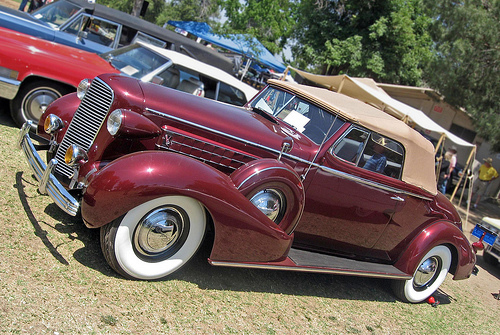
By 1936, all Cadillacs had independent front suspension, hydraulic brakes, and all-steel bodies, replacing the previous wood-metal composites. This 1936 Cadillac V-12’s sidemount spare tires were becoming old-fashioned despite efforts to integrate them stylistically by adding painted covers, but the division’s customers tended to be conservative in their tastes.
While a Cadillac V-12 might have had less snob value than Cadillac’s V-16, the V-12 was still in a very elite class. Thanks to its lower prices, the V-12 quickly outsold the V-16. Cadillac sold 5,725 V-12 cars in the 1931 model year, remarkable for a car that cost more than many upper-middle-class annual salaries.
INTO THE ABYSS
By the middle of 1931, however, it was clear that no matter how many times President Herbert Hoover insisted that a return to prosperity was just around the corner, the economy was getting worse, not better. As unemployment figures mounted, even buyers who could still afford prestige cars were becoming more circumspect.
For the 1932 model year, sales shrank to 296 V-16s and 1,709 V-12s. Cadillac’s overall sales dropped from about 15,000 in 1931 to only 4,698 in ’32. For the 1933 model year, they were only 3,173, including 952 V-12s and 125 V-16s. In an effort to make the limited sales sound like a mark of exclusivity, Cadillac announced that they would limit V-16 production to only 400 units a year. It was in vain: V-16 sales never even approached that level again.
By 1932, GM’s leadership was seriously considering dropping the entire Cadillac division. Its sales were well below the break-even level and it was clear that the staggering $54 million investment in the V-16 cars (around $700 million in today’s dollars) would never be recouped. Many of Cadillac’s rivals were already bankrupt or close to it.
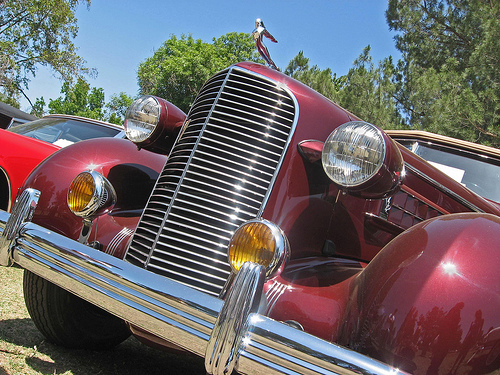
By 1936, the antiquarian styling of the early Cadillac V-12 and V-16 models had evolved considerably. Note the “fencer’s mask” grille, the increasingly massive front fenders, and the streamlined headlight pods. Harley Earl’s stylists were gradually integrating the disparate components of the automobile into a single, unified whole, hiding the actual mechanical components.
RACE RELATIONS
A major part of Cadillac’s salvation was not exotic prestige cars, but a new marketing approach. Service manager Nicholas Dreystadt had noticed that there were a fair number of well-to-do black Cadillac owners; despite the division’s strict but unwritten whites-only sales policy, black customers were buying Cadillacs anyway, using white friends or employees as intermediaries. Dreystadt thought it ludicrous that Cadillac would turn away nonwhite customers at a time the division was struggling for survival. He eventually went over the head of Cadillac general manager Lawrence Fisher to make the case directly to GM’s Executive Committee.
The committee was not enthusiastic about Dreystadt’s proposal to market Cadillacs directly to black customers, but reluctantly agreed when he insisted that it would restore Cadillac’s profitability in only 18 months. Dreystadt’s assessment was correct: Cadillac sales for the 1934 model year rose by more than 70%. In June 1934, GM management made Dreystadt Cadillac’s new general manager.
Dreystadt, a German immigrant who had begun his career with an apprenticeship at Daimler-Benz, was worlds away from the dapper and ostentatious Larry Fisher. Dreystadt seldom wore business suits, favoring tweed sport coats, and had little regard for fashion; he was known to show up at the office wearing mismatched shoes.
Dreystadt’s primary focus was on efficiency. He had always been bothered by Fisher’s cost-no-object attitude; Dreystadt wasn’t categorically adverse to spending money if it presented a clear advantage, but he disdained waste and needless excess. Under his leadership, Cadillac took a more ruthless approach to cost controls. By 1937, the division’s average per-car production costs were no higher than Chevrolet’s, which made Cadillac once again GM’s most profitable division.
THE END OF THE MULTICYLINDER ERA
Larry Fisher had attempted to bolster the sales of the Cadillac V-12 and V-16 with a few minor improvements for 1934, including higher compression ratios that boosted power to 150 horsepower (112 kW) and 185 horsepower (138 kW) respectively. The extensive list of factory custom bodies was also whittled down to a more manageable size. It was to little avail: only about 50 V-16s and a few hundred V-12s were sold each year.
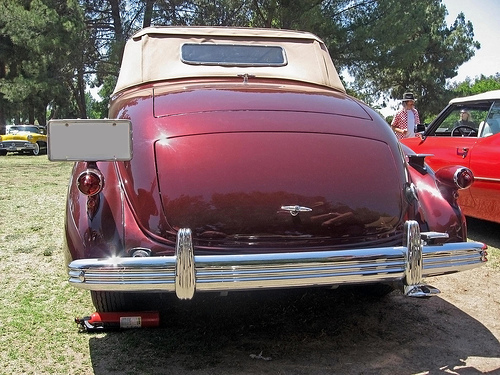
Like the V-16, the Cadillac V-12 came standard with a trunk-mounted spare, normally carried in the lower rear compartment, but deleted in this case in favor of the optional sidemounts. The upper compartment on this Fleetwood convertible coupe is the rumble seat — note the steps on the right side of the bumper and the right fender.
1937 was the final year for the Cadillac V-12. The new 346 cu. in. (5,676 cc) monobloc V-8 was nearly as powerful (135 hp), far lighter, and much cheaper to build. Much of Cadillac’s business was shifting to less-expensive models like the Series Sixty. Thanks to Dreystadt’s cost-cutting, the cheaper models were still profitable, but sold in far greater numbers than the multicylinder cars.
It would not have been surprising if Cadillac had also dropped the V-16, which had sold only 207 units in the previous four years. Since both Lincoln and Packard still had V-12s, however, Dreystadt could not afford to lose face by dropping all multicylinder models. Instead, in 1938, Cadillac unveiled a completely new V-16 engine.
Sharing nothing with its predecessor other than the number of cylinders, the new engine was an L-head design with its cylinder banks set at an unusual 135° bank angle. Unusually for the era, its bore and stroke were “square” at 3.25 inches (82.6 mm) each, giving a displacement of 431 cu. in. (7,069 cc). The new V-16 was smaller and around 250 pounds (115 kg) lighter than the earlier engine, but was rated at the same 185 horsepower (138 kW).
Sadly, the new Cadillac V-16 had none of the earlier V-16’s fine exterior detailing. The cars that carried it were also less distinguished. Although bodywork was still built by Fleetwood, the vast array of semi-custom bodies was gone and the V-16 models looked much like any other Cadillac save for length and price. Two special limousines were built for the use of President Roosevelt, but the real star of the Cadillac line was the new Sixty Special, which was less than half the price of the V-16.
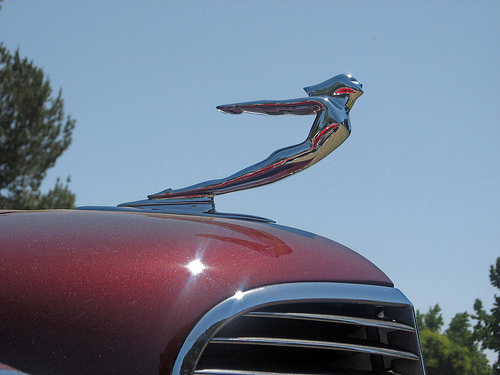
This 1936 Cadillac V-12 convertible coupe shows off the optional hood ornament, the Goddess. Although a heron mascot was also available in the early thirties, the Goddess would become Cadillac’s standard hood ornament, although its design became increasingly abstract after the war.
These final V-16s sold better than their predecessors, but not by much: 311 in 1938, 136 in 1939, and 61 in 1940, its final year. By then, only Lincoln still offered a V-12, a thoroughly unremarkable, notoriously unreliable flathead with less horsepower than even Cadillac’s V-8. Packard dropped its Twelve after 1939, and Packard’s leaders, Alvan Macauley and George Christopher, were now focused more on near-luxury models like the Packard One Twenty.
THE FALL AND RISE OF THE DINOSAURS
In all, Cadillac sold 4,386 V-16s and 10,821 V-12s between 1930 and 1940. They would have sold better had it not been for the Depression, but they would probably have faded away by the early 1940s anyway. Improved technology made eight-cylinder engines nearly as smooth and powerful as the old multicylinders, with far lower costs and more modest fuel consumption. The age of custom coachwork was coming to an end, as well. Harley Earl’s Art & Colour division was now setting the pace for automotive styling, and even wealthy customers were increasingly content with cheaper, factory-built luxury cars.
By the time civilian automobile production resumed after the war, Cadillac had largely taken Packard’s place as America’s preeminent luxury marque. It was not until 1950 that Cadillac consistently outsold Packard, but the latter’s sales would only decline from there, where Cadillac’s grew steadily almost every year until 1979.
Although some European manufacturers returned to the V-12 layout after the war, multicylinder engines largely disappeared in the U.S. after Lincoln’s V-12 Continental went out of production in 1948. Packard contemplated a new 480 cu. in. (7,857 cc) V-12 in 1955, essentially a 12-cylinder version of its new V-8, but by then Packard was living on borrowed time. GM’s corporate engineering staff developed an advanced all-aluminum SOHC V-12 for Cadillac in the early sixties, displacing up to 500 cu. in. (8,194 cc) and making about 400 gross horsepower (298 kW). At one point, it was slated for the front-wheel-drive 1967 Eldorado, but it was canceled around 1965 and GM refused to even release photos of the engine until decades later. It was not until Chrysler unveiled its V-10 in 1991 that any American automaker again offered an engine with more than eight cylinders.

The badge on a 1938 Cadillac V-16. Sadly, the car no longer has its original engine.
As for the V-16 layout, the only postwar 16-cylinder engines offered for production cars were the short-lived Cizeta-Moroder V16T, sold in tiny numbers in the early 1990s, and the Bugatti Veyron’s 7,993 cc (488 cu. in.), turbocharged W16. Cadillac built a 16-cylinder concept engine for its 2003 Cadillac Sixteen show car, but it was not intended for production and, with rising fuel economy and carbon dioxide emissions standards, it’s unlikely Cadillac will ever build anything like it again.
In strictly practical terms, the Cadillac V-12s and V-16s were absurd even in their time, but they’re magnificent cars in every respect, acclaimed as genuine Classics. Survivors are prized collector’s items today, commanding very high prices that can top $300,000 at sale or auction. Just as it was in 1930, that’s enough to buy a nice house in some parts of the U.S. — a king’s ransom for a decidedly regal car.
NOTES ON SOURCES
Our sources for these articles included Dennis Adler, Speed and Luxury: The Great Cars (Oceola, WI: MBI Publishing Company, 1997), pp. 58-63; the Auto Editors of Consumer Guide, Encyclopedia of American Cars: Over 65 Years of Automotive History (Lincolnwood, IL: Publications International, 1996); John Barach’s Cadillac History site (1999-2008, Motorera, www.motorera. com/ cadillac/index.htm, accessed 5 December 2008); Arch Brown, “Regal Ragtop: 1935 Cadillac V-12 Fleetwood Convertible Sedan,” reprinted in The Hemmings Motor News Book of Cadillacs: driveReports from Hemmings Special Interest Autos magazine, eds. Terry Ehrich and Richard Lentinello (Bennington, VT: Hemmings Motor News, 2000), and “SIA comparisonReport: Battle of the Behemoths: Cadillac V-16 versus Marmon V-16,” Special Interest Autos #106 (July-August 1988), pp. 24-31, 59-60; Arch Brown, Richard Langworth, and the Auto Editors of Consumer Guide, Great Cars of the 20th Century (Lincolnwood, IL: Publications International, Ltd., 1998); John Steele Gordon, “The Man Who Saved the Cadillac,” American Heritage, 20 July 1995, www.americanheritage. com, accessed 5 December 2008; Maurice D. Hendry and Dave Holls, Cadillac: Standard of the World: The Complete History, Fourth ed. (Princeton, NJ: Automobile Quarterly, 1990); Beverly Rae Kimes, ed., Standard Catalog of American Cars 1805-1942, Second ed. (Iola, WI: Krause Publications, Inc., 1989); Wilfred Leland, Master of Precision (Chicago, IL: Wayne State University Press, 1996); Samuel B. Malin, “The Cadillac V-16—Some Notes on Its Design,” The Michigan Technic Vol. 43, No. 4 (January 1930), pp. 10, 40, 48; Alan Merkel, “Where Did All the Sixteens Go?” Special Interest Autos #106 (July-August 1988), pp. 32-35, 64; Yann Saunders’ Cadillac Database (2001, www.car-nection. com/ yann/Dbas_txt/indx2001.htm [now www.cadillacdatabase. com], accessed 4 December 2008) and Glossary of Terms, 12 December 1999, www.car-nection. com/ yann/Dbas_txt/Fact_ndx.htm [now www.cadillacdatabase. com], accessed 17 January 2000); Norman F. Uhlir, “History of the Cadillac V-16 1930-1940,” Motor Trend January 1965, pp. 78-83; Rob Wagner, Classic Cars (New York: MetroBooks, 1996), pp. 20-28; and Richard Wright, “Industry History Chapter 10,” The Auto Channel, 1996, www.theautochannel. com, accessed 5 December 2008).
Information on Cadillac’s postwar V-16 and V-12 came from the Auto Editors of Consumer Guide, “Great Expectations: Cadillac’s Postwar V-12 and V-16,” Cars That Never Were: The Prototypes (Skokie, IL: Publications International, Ltd. 1981); Roger Huntington, “It makes sense…New V-12 for Cadillac,” Motor Trend Vol. 17, No. 9 (September 1965), pp. 70-71; Richard M. Langworth, “Cadillac’s Colossal Postwar Multi-Cylinders: V-12s and V-16s for the Sixties? Well, maybe…” Special Interest Autos #64 (August 1981), pp. 24-29; Karl Ludvigsen, The V-12 Engine: The Untold Inside Story of the Technology, Evolution, Performance and Impact of All V-12-Engined Cars (Sparkford, Yeovil, Somerset: Haynes Publishing, 2005); and Daniel Strohl, “Success! Cadillac’s OHC V-12 engine photos found,” Hemmings Blog, 14 April 2010, blog.hemmings. com, accessed 19 October 2010.
Our inflation estimates were based on the United States Bureau of Labor Statistics Inflation Calculator, data.bls. gov/ cgi-bin/cpicalc.pl. Please note that the inflation figures cited in the text are approximate and are provided solely for general reference — this is an automotive history, not a treatise on the historical value of money, and nothing in this article should be taken as financial advice of any kind!
These are fascinating cars, I must say. What’s the reason for the 2nd V16’s almost flat-engine layout though?
The post-war demise of the American V12 is also strange, in a country where bigger is usually better. Jaguar, Mercedes, BMW, Ferrari, Aston-Martin, Lamborghini and Toyota all went for the prestige of the twelve in the past 50 years, usually with success. Is it because the cartel-like, let’s-do-what-the-other-guys-do paradigm of the Big Three prevented them from trying to compete on the global luxury car market?
Cadillac competed with Rolls-Royce, Hispano-Suiza or Maybach in the 30s, so a V8 wouldn’t have been quite enough. European twelves only reappeared gradually after the war, but Cadillac was not in the same league any more. They were coasting by ’55, bloating by ’65, impotent by ’75 and terminally Cimarron by ’85. By which time BMW, Benz and others were the standard of the world, US included.
You know, I don’t know that I’ve ever seen a specific explanation for the 135-degree bank on the second V-16. Looking at the engine, my assumption is that it was to make more room for the various manifolds, since the second-generation V-16 was a side-valve engine. The wider bank angle would lower the center of gravity, of course, but on cars like this, I can’t really see that being a major consideration.
Ferrari originally developed V-12 less for prestige and more because it allowed more horsepower from a given displacement with less mechanical stress — lots of valve area, very short stroke. With Jaguar and the others, of course, prestige was the big motivator.
I think the major reason the U.S. automakers didn’t go that way in the ’50s was that Cadillac and Continental lost a lot of money on their ultra-prestige cars. Had those been profitable, it would have been substantially more likely for subsequent cars to have V-12s or even V-16s. (As discussed in the Eldorado article, Cadillac did fairly seriously consider a new V-12 in the ’60s, but abandoned it because the engine wasn’t any more powerful than the V-8s, cost a lot more, and, by the mid-sixties, looked like it was going to be difficult to make emissions-compliant.) Packard also considered a V-12, but ultimately didn’t have the money.
The major U.S. automakers were (and still are) really, really big corporations. I believe GM was the largest in the world in the ’50s and ’60s, and Chevrolet alone sold more than the entire British auto industry. In the postwar world, when you get to be that big, you have buildings full of business analysts dissecting every decision you make to see if there’s a way to squeeze a few more pennies out of it. One side effect of that is an eradication of sentiment, which doesn’t leave a lot of room for prestige cars or niche products.
From an MBA’s perspective, a product that will sell 100,000 units at a profit of $100 each is ALWAYS twice as good as a product that makes a $5,000 profit but only sells 1,000 units and both are infinitely better than a product that loses money, regardless of what the product is or what it may do for your brand or your reputation. So, from that standpoint, there’s really no business case for making a prestige V-12 car. Even Toyota ultimately shied away from offering the 1GZ-FE engine in anything other than the Century for that reason. (I tend to think that had the Japanese economy not sunk so rapidly in the early ’90s, there would have been a V-12 Lexus LS.) Obviously, for European companies like BMW or Mercedes, the cost of the V-12 was justifiable because they’re conscious of the need to maintain their position in the pecking order, particularly with the way the high-end Germans have been going aggressively down-market for the past 20 years, but they’re coming at it from a different corporate mentality.
The real problem for Cadillac and Lincoln was that they never really appealed to the Baby Boom generation in any significant way, at least until the SUV boom. When the Boomers started having money, they turned up their noses at the traditional Cadillac formula and Cadillac’s well-known missteps with updating that formula didn’t help. Cadillac had been SO successful for so long (and until so recently) that it would have been very hard for any manager to make a case for a radical change in direction even if they hadn’t been struggling with CAFE and the various corporate dictates to downsize, increase commonality, and then the radical reorganization of the Roger Smith years. Furthermore, there’s no guarantee it would have worked. Part of the Boomer resistance to Cadillac was that it had been such a powerful status symbol for the Establishment values the Boomers had spent their teens and twenties rejecting, and I don’t know that a V-12 would have helped.
If Cadillac or Lincoln had done a V-12, what would they have put it in that buyers would have respected? The Allanté, I suppose, but it was FWD, and how well would it have done if Cadillac had sold it for $20,000 or $30,000 MORE than a 560SL to cover the cost of the bespoke engine? They could have done like Toyota did and really build a completely new car aimed at the S-Class and 7-Series, but Toyota spent a terrifying amount of money on the first LS/Celsior, so I can’t really fault anyone for not wanting to roll those dice.
We could speculate endlessly about what Cadillac should have done, but I don’t think a V-12 or the lack thereof was really a big factor in that one way or the other.
my father bought a 1935 cadillac v 12 7 passanger from maloney funeral home in Chicago June 1940. I have pictures of it. no side mounts or radio, but had jump seats, wide white walls, wire wheels, heater. he took his family at the time: wife, mother-in-law, sister-in-law, 3 children, I wasn’t born yet to Duluth MN from Chicago mostly along U. S. rt 12 to Minneapolis then up to Duluth. What an adventure…
Can anyone give a source to where the authentic paint chip colors are for the 1931 V12 Cadillac?
I don’t have that information, but you might want to check out the New Cadillac Database (www.newcadillacdatabase.org) — they might be able to help.
It must have taken a while for the significance of the October ’29 crash to come home to the luxury buyer–that the economy was going to nose-dive for years. They hadn’t all bought stock on margin like one set of my grandparents.
I hadn’t realized the V12 was that large a share of Cadillac sales as late as ’33, or that the ’33 total was lower than ’34, with its radical new styling and IFS. Hendry said they used the V8 wheelbases, so I wonder what the price differential was between the 8 and 12 versions of similar bodies.
Initially, the price differential varied a LOT from body style to body style. For example, in 1930, the difference between the Eight and Twelve for a Fisher five-passenger sedan was “only” $200 (still a lot of money at the time), but for a Fleetwood seven-passenger sedan, the spread was $780. By 1933, it looks like there was a fairly uniform $700 difference between the Eight and Twelve for the same body styles, and it appears a certain amount of rationalization had taken place in terms of the range of styles catalogued.