
This week’s subject may be the most obscure of all Ferrari road cars. In fact, a fair number of histories of the marque omit it entirely — which is odd, because it was one of the best-selling cars Ferrari S.p.A. ever built. On the other hand, for the first few years of its existence, it was not officially a Ferrari at all. We’re talking about the often-overlooked Dino 308 GT4.

IL COMMENDATORE
Enzo Ferrari was born in Modena, Italy, in February 1898. After an inglorious stint during the First World War as a mule-shoer for the Italian army, he sought work in the automobile industry. By the 1920s he had become a racing driver for Alfa Romeo. In 1929, he founded Scuderia Ferrari (roughly, “Team Ferrari”) as the factory-sponsored Alfa racing team.
In the late thirties, Alfa reclaimed direct control over its racing efforts, reducing Ferrari’s leadership to a subordinate position. This naturally sat ill with the stubborn, mercurial Ferrari, who was finally fired in November 1938.
A little less than a year later, Ferrari established his own manufacturing firm, Auto-Avio Costruzioni di Ferrari Enzo. Although his severance agreement with Alfa forbade him from participating in motorsport until the 1943 season, Ferrari’s company anonymously constructed a pair of racers for the 1940 Mille Miglia, Italy’s 1,000-mile (1,600-km) road race.
Scarcely six weeks later, Italy was plunged into World War II, bringing racing activity to a halt. Ferrari was put to work manufacturing war materiel and was later forced to move his works from Modena to Maranello in the vain hopes of evading Allied bombardment. After the war, he was left discouraged and disillusioned. According to legend, it was only the persuasion of his old friend, racing champion Luigi “Iron Man” Chinetti, that convinced him to return to building cars.
The first new car to wear Enzo’s name, the 12-cylinder Type 125S, made its public debut in May 1947, beginning a long line of Ferrari cars.
DINO FERRARI
By most accounts, Il Commendatore, as Enzo was known (having been granted that title by the Italian government in 1928), was a difficult man to get along with. He had a towering ego, a ferocious temper, and a vast appetite for self-promoting melodrama. Like many domineering men of his stripe, Enzo’s primarily sentimental weakness was his almost mawkish adoration of his son, Alfredo. Alfredo Ferrari, born in 1932, was Enzo’s only legitimate son; his birth had ended Enzo’s career as a race driver. The elder Ferrari doted on the boy — known familiarly as Alfredino, or just Dino — whom Enzo saw as his anointed successor, the one who would carry on his legacy.
In 1957, Enzo went so far as to give his son credit for setting the direction for a new V6 engine, a configuration about which the young man had written an article for a leading Italian automobile magazine. It’s unclear exactly how much Dino actually contributed to the engine, which was mostly the work of veteran engine designers Vittorio Jano and Aurelio Lampredi, but Enzo always publicly insisted that it was Dino’s concept.
Dino didn’t live to see the finished product. He may have been as strong-willed as his father was, but the flesh was less robust. Dino suffered from muscular dystrophy, which left him weak and often bedridden. He finally died on June 30, 1956, of kidney failure. He was only 24 years old.
Dino’s death left Enzo heartbroken and his mourning continued for years. There was little doubt among Ferrari’s acquaintances about what Il Commendatore meant when he entitled his 1962 memoir See Le Mie Gioie Terribili (My Terrible Joys).
Inevitably, the six-cylinder engine was dubbed the “Dino V6.” An unusual 65° configuration (wider than the ideal 60° to allow a more efficient angle for the intake valves), the little V6 initially displaced only 1,490 cc (91 cu. in.). It got its first taste of competition at the Grand Prix di Napoli in April 1957, coming in third. The V6 soon replaced the older Ferrari-Lancia V8 and earned an impressive competition pedigree. A bigger 2,417 cc (148 cu. in.) version was developed for Formula 1 and later powered Ferrari’s first mid-engine sports-racer, the 1961 246 SP.
MID-ENGINE FERRARIS
The sixties saw a substantial shift in sports-car design philosophy away from front-engine designs toward mid-engine layouts. A mid-engine car places the engine behind the driver, but ahead of the rear axle. (Technically, “mid-engine” simply means that the engine’s center of gravity is between the axles, so there are both front-mid-engine (FM) and rear-mid-engine (RM) designs; nevertheless, the term most commonly describes a “RM” layout.) Mid-engine configurations improve handling by moving the mass of the engine closer to the car’s center of gravity, reducing its polar moment of inertia; this makes the car easier to maneuver and gives sharper turn-in response. It can also allow the car’s body to be shorter and lighter and improves weight distribution to the benefit of both acceleration and braking.
Enzo Ferrari was resistant to the trend for a long time, but by 1960, it was clear that mid-engine design was the way of the future. By 1961, Ferrari had introduced its first mid-engine racing models. Nevertheless, Enzo remained exceedingly resistant to offering mid-engine street cars despite considerable pressure from his own engineers and colleagues like designer Sergio Pininfarina.
According to Pininfarina, Ferrari considered mid-engined cars too dangerous for his non-racing customers. Such concerns about safety were not purely humanitarian; Ferrari had actually been charged with manslaughter after a Ferrari driven by Count Alfonso de Portago crashed during the 1957 Mille Miglia, killing Portago and navigator Ed Nelson and killing or injuring more than two dozen spectators, some of them children. The ensuing legal battle had dragged on for about eight years, earning Ferrari considerable bad publicity.
Beyond that, by most accounts, Ferrari built road cars only grudgingly and his interest in those cars was at best sporadic. Racing was Enzo’s great passion, the object of an almost religious devotion. The only reason he deigned to make road cars in the first place was that he was persuaded (again by Luigi Chinetti, who subsequently became Ferrari’s principal U.S. distributor) that selling street cars would help to underwrite the costs of racing.
The other consideration, of course, was that racing homologation often required that a certain number of copies of a car be offered for public sale before the racing version was permitted to compete. In practice, those rules had a variety of loopholes that builders approached with a certain amount of what we will politely describe as creative accounting, but the production requirements were not something even Ferrari could wholly avoid.
THE FIAT DINO
In the mid-1960s, the Fédération Internationale de l’Automobile (FIA) set new homologation rules for the 1967 Formula 2 series requiring at least 500 copies of the engine to be sold prior to the start of the series. This requirement was a difficult proposition for Ferrari, whose street-car production was usually numbered in the dozens, not the hundreds.
In late 1964, Ferrari approached Italian automaker Fiat and made a deal with its new president, Gianni Agnelli, to mass-produce an updated version of the Dino V6. (This sort of partnership was not a wholly new idea for Ferrari, who back in 1960 had tried unsuccessfully to interest other manufacturers in series production of the Pininfarina-styled, 850 cc (52 cu. in.) four-cylinder “Ferrarina” and had sold a subsequent four-cylinder design to ASA, which built several dozen examples under the name ASA 1000 GT.) The production V6 would be shared by both a new Fiat sports car and a new Ferrari model: Ferrari’s first mid-engine street car. Both cars would be called “Dino.”
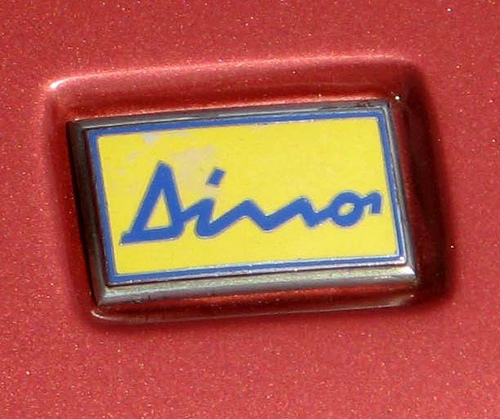
This badge first appeared on the Fiat Dino Spider in late 1966 and disappeared after May 1976, although there have been occasional rumors that Ferrari may revive it in some form.
Enzo’s about-face on the need for a mid-engine production car may have been prompted in part by the fact that Lamborghini was about to dazzle the world with the mid-engine Miura; Ferrari may not have cared much about street cars, but being one-upped by a rival was another matter. In any case, adding a cheaper V6 model made obvious commercial sense, as did branding the car as a Dino rather than a Ferrari. The Dino name would link the new model to the earlier racing Dinos while simultaneously forestalling any purist complaints about what constituted a true Ferrari.
Pininfarina showed Dino 206 show cars at the Paris show in late 1965 and at Turin in 1966, but these were essentially new bodies on the chassis of the earlier mid-engine sport-racer prototypes and nowhere near ready for production. A more definitive prototype appeared at the 1967 Turin show, but the first Ferrari-built Dino 206 GT didn’t go on sale until 1968.
Fortunately for Ferrari’s Formula 2 plans, the Fiat Dino Spider (also styled by Pininfarina) went on sale in late 1966. It was followed in the spring of 1967 by the bigger, four-seat Fiat Dino Coupe, this one styled by Bertone. Both were popular enough to more than enough to meet the homologation requirements for the engine. Fiat sold 7,651 Fiat Dinos between 1967 and 1972.
FERRARI DINO
The Ferrari Dino 206 GT used the same 1,987 cc (122 cu. in.) V6 as the Fiat cars, although the 206 GT version was rated at 180 horsepower (132 kW) rather than the 160 horsepower (117 kW) of the Fiat Dinos. Unlike the earlier prototypes, which had longitudinal (north-south) engines ahead of the rear axle, the production 206 GT’s engine was transversely (east-west) mounted, sitting on top of the transaxle and driving it through a series of spur gears. To keep the engine’s center of gravity as low as possible, the top of the transaxle case actually formed the engine’s sump. All of this made the powertrain far more compact than the earlier efforts, important for a small car with a wheelbase of only 89.7 inches (2,280 mm).
The 2.0-liter V6 proved to be less than reliable in civilian hands, suffering problems with low oil pressure, vapor lock, and plug fouling. In 1969, its displacement was expanded to 2,418 cc (148 cu. in.) and the aluminum block was recast in iron rather than aluminum. The bigger engine had more torque than the 1,987 cc version, making the 2.4-liter cars easier to drive on the street. It was also more durable and cheaper to build than the aluminum version, albeit somewhat heavier. Power rose to 180 horsepower (132 kW) for the Fiat version, 195 hp (145 kW) for the Dino, which was renamed Dino 246 GT.
Although cheaper than any contemporary Ferrari, the Dino 246 GT was a very expensive car: over $14,000 in the U.S., around 50% more than the hottest contemporary 911. On the other hand, the new Ferrari flagship, the 365 GTB4 Daytona, cost around $20,000 in the States, so the Dino was at least somewhat more attainable.
Of course, the Dino had virtues beyond its price. Not only was it fast — 0-60 mph (0-97 km/h) in less than 7 seconds, a top speed of around 150 mph (240 km/h) — it was nimble in a way the bulky, front-engine Daytona couldn’t match. The Dino was also beautiful, a virtual archetype of the modern sports car. Unsurprisingly, it sold very well by Ferrari standards, with some 3,700 built before production ended in 1974. A few purists sniffed that nothing with only six cylinders could be a ‘true’ Ferrari, but the Dino 246 is widely considered a classic.

A Dino 246 GTS (photographed outside the Indianapolis Motor Speedway in 2005) shows off its classic lines. The GTS, introduced in March 1972, was as close as Ferrari came to producing a Dino convertible. It had a lift-off roof à la Porsche 911 Targa or the Porsche 914. In all, 1,274 were sold in only two years, roughly a third of total Dino 246 production. (Photo: “Ferrari Dino” © 2005 Rdsmith4/Dan Smith; resized and used under a Creative Commons Attribution-ShareAlike 2.0 Generic license)
THE BERTONE-STYLED DINO 308 GT4
It was almost inevitable, then, that the Dino 246’s replacement, the Dino 308 GT4, would be seen as a retrograde step. Introduced in October 1973 at the Paris show, the 308 was less compelling in almost every way than the 246 GT it replaced.
There are a number of theories as to why the 308 GT4 ended up the way it did, but many blame the influence of Fiat. The Dino project had been a kind of courtship between Enzo Ferrari and Gianni Agnelli, who announced in June 1969 that Fiat had purchased a 40% interest in Ferrari. Enzo would retain 49% of the company until his death with an additional 1% going to Pininfarina. (Notably omitted from the press releases was the fact that the remaining 10% was granted to Piero Ferrari, Enzo’s son with his longtime mistress, Lina Lardi, whom Enzo did not acknowledge until after his wife’s death in 1978.)
Ferrari had been shopping for a larger business partner since the beginning of the decade. He had actually entered serious negotiations with Ford in 1963, although that deal had collapsed acrimoniously, ostensibly over the question of who would have ultimate authority over competition-related decisions. The Fiat deal was more to Enzo’s liking, leaving him in control of the company’s racing efforts, but allowed him to step back even further from the road cars.
On the face of it, the “blame Fiat” theory makes sense because the new Dino 308 GT4 had all the overtones of corporate decision-making. Where the 246 GT had been a pure two-seater (and a cramped one at that), the 308 GT4 was a 2+2, stretched 8.3 inches (210 mm) in wheelbase to make room for a pair of tiny “occasional” rear seats. This seems to have been an obviously commercial decision, the logic presumably being that a 2+2 would sell better than would a two-seat coupe.
Since it’s difficult to envision Enzo caring a whit for such considerations, the decision to make the GT4 a 2+2 may well have come from Fiat. However, both Piero Ferrari and Marcello Gandini, who styled the 308 GT4, have claimed that Enzo took a strong personal interest in the development of the new Dino and its 2+2 layout. They also say Enzo was responsible for the similarly controversial decision to assign the styling of the new car not to Pininfarina, but to Stilo Bertone.
Bertone — and Gandini — had recently penned the spectacular Lamborghini Countach, but Piero Ferrari says the reason for assigning the GT4 to Bertone was that Enzo had been fond of their work on the Fiat Dino Coupe. However, while the Fiat Dino had also been a 2+2, it was also a considerably more orthodox design than the wedgy GT4, which some historians have alleged was a previously rejected Lamborghini concept.
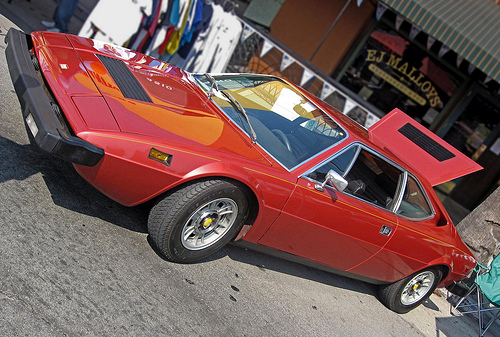
A U.S.-spec Dino 308 GT4 is 176.7 inches (4,488 mm) long on a 100.3-inch (2,550mm) wheelbase, but although that makes the 308 GT4 a bit longer than most sixties Ferraris, it looks shorter, a function of the awkward proportions of the 2+2 cabin. The rear seat might hold one adult, seated sideways, for a very short trip, but it would have to be raining hard to make it worth the effort.

The Dino 308 GT4’s shape bears a decided resemblance to its contemporary and principal rival, the Lamborghini Urraco — no surprise, since both cars have the same configuration (mid-engine, transverse V8, 2+2) and both were styled by Bertone’s Marcello Gandini at around the same time. The Urraco was intended to be Lamborghini’s entry-level model, but it was a commercial failure, selling fewer than 800 units in eight years of production. It is arguably a better-looking car than the 308 GT4. (Photo: “Lambo Uracco UK” © 1976 Charles01, modified (rescanned) 2007 by the photographer; released into the public domain by the photographer, modified (color balance adjusted) 2010 by Entheta, resized 2008 by Aaron Severson)
Under the skin, the 308 GT4 was essentially a stretched version of the earlier Dinos, retaining a transverse, mid-mounted engine and a tubular steel chassis welded to steel body panels. American models had heavier bracing front and rear to meet U.S. safety standards.
Bigger than the 246 GT, the 308 GT4 was inevitably heavier, weighing nearly 3,000 pounds (1,330 kg) in European trim. Cars bound for the U.S. weighed about 300 pounds (135 kg) more than that thanks to their bulky and not terribly attractive 5 mph (8 km/h) bumpers. The extra bulk was hardly compensated by the rear seat, which was a torture chamber for anyone bigger than an 8-year-old. It was more helpful as a place to stash a briefcase or a picnic basket, although the new car also boasted a reasonably sized trunk behind the engine compartment.
SIDEWINDER EIGHT
The big news was that the Dino V6 was gone, replaced by a new 90-degree V8. Ferrari had used V8s in racing before, but this was the company’s first production eight. The V8 displaced 2,927 cc (179 cu. in.), although Ferrari preferred to round up to a full 3.0 liters. Like the V6, the V8 had two overhead camshafts for each cylinder bank, although the cams were now driven by rubber timing belts rather than chains. With four dual-throat Webers, the European engine claimed 250 horsepower DIN (184 kW) at a lofty 7,700 rpm. The smog-controlled U.S. version was rated at 240 horsepower (179 kW) SAE.
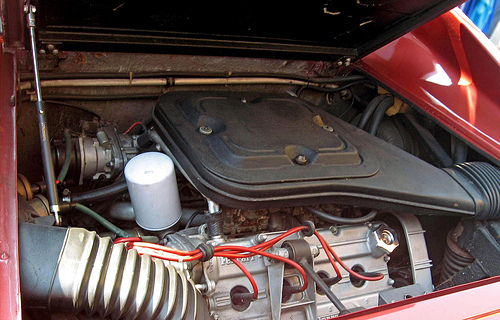
The greatest virtue (and most enduring feature) of the Dino 308 GT4 was its V8 engine, which led to a long line of Ferrari V8s, including today’s F430. The engine sits relatively high because it’s mounted atop the transaxle, whose case actually forms the V8’s sump. The inartistic lump of an air cleaner hides four Weber 40 DCNF two-throat carburetors.
Despite the extra weight, the V8 made the Dino 308 GT4 about as fast as its predecessor was. In European trim, the V8 Dino was capable of 0-60 mph (0-97 km/h) in about 6.5 seconds and a top speed of over 150 mph (240 km/h). Its handling was appropriately adroit, although the suspension was tuned for understeer, sacrificing some of the 246 GT’s agility to make the 308 less prone to rotating its tail at the limit. Lifting the throttle in a tight turn on slippery surfaces could still make it spin, but that now took considerable effort. As a further safeguard against oversteer, steering lock was very limited, which made maneuvering in tight spaces frustrating.
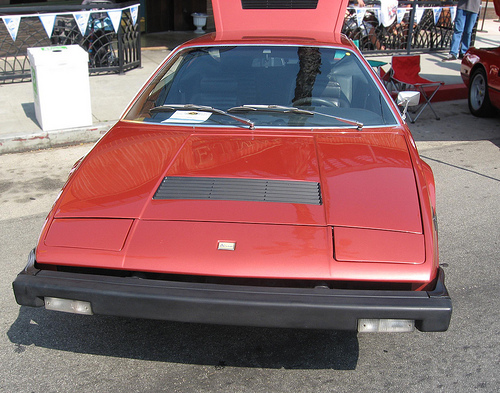
U.S. Dino 308 GT4s had huge, awkward-looking bumpers, mandated by federal safety requirements. European models were spared this visual indignity, but curiously did not have outside mirrors until the introduction of the mildly revived Series II cars in mid-1975 — federalization wasn’t all bad. The grille on the aluminum hood feeds air into the radiator, which is mounted in front despite the fact that the engine is behind the cabin. Having coolant lines running under, around, or through the cabin tends to make mid-engine cars uncomfortably warm in hot weather.
The U.S. version, heavier and less powerful, naturally was somewhat slower than the European cars, needing 7 second or more to hit 60 mph (97 km/h) and having a top speed of perhaps 140 mph (225 km/h). That was in no way slow, particularly for the mid-seventies, but it wasn’t invincible and there were still various cheaper rivals capable of humiliating the 308 GT4 at any legal speed.
Unfortunately, Dino 308 GT4 owners couldn’t be any more confident of winning a beauty contest than a drag race. Compared to the more graceful Pininfarina Ferraris, even the somewhat brutish Daytona, the 308 GT4’s styling was severe. Trying to cram a 2+2 cabin into a mid-engine sports car rarely ever looks very good; the raison d’être of mid-engine layouts is to keep the front and rear overhangs as short as possible, which makes the bigger cabin of a 2+2 look stubby and chunky. Mostly, though, we would say the fault rested with Gandini’s fascination with wedge shapes. The 308 GT4’s sharply creased lines and slab sides gave it none of the voluptuous surface detail of Pininfarina’s best efforts. There was little to draw the eye other than the unusual but awkward proportions of the car itself.

The Dino’s “flying buttress” roof pillars, a feature introduced on Ferrari’s 1964 250 LM, became almost a cliché of sixties and seventies sports cars, found on everything from the Maserati Merak to the 1968 Dodge Charger. Aft of the 308 GT4’s engine compartment is a trunk, which is actually large enough for a golf bag or two, an unusual feature for a mid-engine sports car.
THE FORGOTTEN FERRARI
European response to the Dino 308 GT4 was lukewarm at best. The new car fared somewhat better in the States simply because for a time it was the only new Ferrari model certified for sale in the U.S. The Daytona was gone by time it bowed and Ferrari never attempted to federalize the fearsome 365 GT/4BB and 512BB “Berlinetta Boxers” (the cars that finally put paid to Enzo’s hesitation about offering a 12-cylinder mid-engine road car). The painful spectacle of Ferrari dealers with no actual Ferraris to sell was probably the major reason that in July 1975 the factory started adding the Ferrari badge and cavallino emblem to the 308 GT4.
The unloved 2+2 was thoroughly upstaged by the new two-seat car, the 308 GTB, which debuted at the 1975 Paris show. Styled by Pininfarina, the GTB was about the same size as Bertone’s 2+2, but had infinitely better proportions. It was as pretty and sensual as the 308 GT4 was severe and its shape survived well into the eighties. (Its lift-roof GTS version also became the world’s most recognizable Ferrari model, thanks to its starring role on the popular TV series Magnum, P.I.) Tellingly, the production 308 GTB never wore the Dino badge, which was abandoned completely in May 1976.
In Europe, the 308 GT4 was supplemented from 1975 by a 208GT4 model with a 1,991 cc (122 cu. in.) version of the V8 that put the car in a more favorable tax bracket. The 208GT4 had 180 horsepower and could run 0-60 mph (0-97 km/h) in about 8.5 seconds with a top speed of around 135 mph (217 km/h). About 800 were sold in total, most of them in Italy.

The air intake ducts behind the 308 GT4’s rear quarter windows are functional, but they manage to seem both fussy and stark — the way the intake is cut into the C-pillar is distracting, but the duct itself is an empty hole. The right-side duct channels air into the carburetors, the left into the oil cooler.
You might expect that the debut of the far more popular Ferrari 308GTB would have meant the end of the line for the 308 GT4, but it lingered on for several more years. Apparently, someone (probably the Fiat management) thought Ferrari should have at least one “affordable” 2+2 — another indication, like the unceremonious cancellation of the Dino brand, that Enzo Ferrari was no longer paying much attention to passenger-car production (if indeed he ever had).
In 1978, the engines were detuned for emissions purposes, dropping to 230 hp (169 kW) in Europe and 205 hp (153 kW) in the U.S. Otherwise, the cars otherwise continued almost unchanged until December 1980. Total production was 2,826, which was still enough to make the 308 GT4 one of the best-selling models in Ferrari’s history. It was replaced by the Mondial 8.
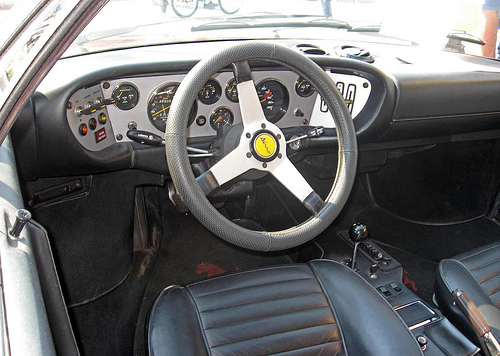
The interior of the Dino 308 GT4 is businesslike, but far from beautiful. Vital controls are mostly close at hand, but the radio is mounted sideways in the center console, ahead of the shifter. It’s difficult to reach for either passenger, particularly since the 308 GT4’s seat belts did not have inertia reels. Curiously, the dash has gauges for oil pressure, oil temperature, and water temperature, but it doesn’t have either an ammeter or a voltmeter, which would’ve been a useful addition.
The Dino 308 GT4 was not a bad car, particularly by the modest standards of mid-seventies sports cars, but it had the same weaknesses as any other Ferrari (spotty build quality, limited practicality, a choppy ride, heavy fuel economy, and exorbitant repair and maintenance costs) without the compensating virtues (blazing speed, badge snobbery, fabulous looks). The latter was the real killer; if the 308 GT4 had been as gorgeous as the 246 GT, history would happily overlook everything else. The 308 GT4 certainly looked exotic, but it didn’t look like a Ferrari. If you didn’t know better, you could mistake it for a Lamborghini Urraco or even the significantly cheaper De Tomaso Pantera — not a thought to warm the hearts of a Ferrariste laying out big money for Maranello’s latest. As a result, it’s not one of the more desirable Ferraris for modern collectors.
Your author, ever one for the perverse, finds something oddly appealing about the 308 GT4’s red-headed stepchild status. It’s one of the least-adored scions of perhaps the world’s most revered automotive family. (On the other hand, it must be said that we would also be amused by the idea of making a hot rod out of a Checker Marathon and for very similar reasons.) As a notable oddball, the 308 GT4 scores highly, but in other respects, the last Dino remains a hard car to love.
NOTES ON SOURCES
Our sources included Jesse Alexander and Karl Ludvigsen, “Ferrari Dino 246,” Sports Cars Illustrated Vol. 4, No. 3 (September 1958), reprinted in Ferrari Cars 1957–1962, ed. R.M. Clarke (Walton on Thames, Surrey: Brooklands Books/Enthusiast Publications, 1977), pp. 33–37; the Auto Editors of Consumer Guide, “Ferrari 308 GT4,” HowStuffWorks.com, 7 May 2007, auto.howstuffworks. com/ ferrari-308-gt4.htm, accessed 3 September 2008, and Lamborghini: Supercar Supreme (Lincolnwood, IL: Publications International, Ltd., 1994); Yaroslav Bozhdynsky, “ASA 1000 GT,” n.d., www.bozhdynsky. com/cars/ asa-1000-gt/ [dead link], accessed 25 July 2014; Mike Covello, ed., Standard Catalog of Imported Cars 1946-2002, Second Edition (Iola, WI: Krause Publications, 2001); “Dino 196 Ferrari,” The Autocar 26 December 1958, reprinted in Ferrari Cars 1957–1962, p. 48; “Dino 246: Analysis of Enzo Ferrari’s New Vee-Six Formula 1 Car,” The Autocar 28 March 1958, reprinted in Ferrari Cars 1957–1962, pp. 24–27, 11; Edward Eves, “Ferrari Dino,” Autocar 8 March 1973, reprinted in Ferrari Dino 308 1973–1979, ed. R.M. Clarke (Cobham, England: Brooklands Books, 1982), pp. 10–13; “Ferrari for the Masses,” Sports Cars Illustrated Vol. 6, No. 5 (November 1960), reprinted in Ferrari Cars 1957–1962, pp. 83; “Ferrari 208,” and “Ferrari 308,” CarsFromItaly, 2008, www.carsfromitaly. net, accessed 3 September 2008; Paul Frère, “Interview: Enzo Ferrari,” Road & Track Vol. 25, No. 1 (September 1973), pp. 60–63; L’Editrice Dell’Automobile LEA, World Cars 1979 (New York: Herald Books, 1979); Pete Lyons and the Auto Editors of Consumer Guide, Ferrari: The Man and His Machines (Lincolnwood, IL: Publications International, Ltd., 1989); Günther Molter, “Road Impressions of the Little Ferrari,” Autosport 7 October 1960, reprinted in Ferrari Cars 1957–1962, p. 82; Andrew Noakes, “Beauty and the Best,” Classic & Sports Car August 2006, reprinted in Mercedes 230SL – 250SL – 280SL Ultimate Portfolio 1963–1971, ed. R.M. Clarke (Cobham, England: Brooklands Books Ltd., ca. 2010), pp. 172-176; André Ritzinger, “Fiat Dino: a poor man’s Ferrari,” RitzSite, n.d., www.ritzsite. nl/ Fiat_Dino/01_Fiat_Dino.htm, accessed 3 September 2008; Mark Wan, “Ferrari 308 GT4 (1973),” AutoZine.org, n.d., www.autozine. org/ Archive/Ferrari/ classic/308 GT4.html, accessed 1 September 2008; “Ferrari Mondial (1980),” AutoZine, n.d., www.autozine. org/ Archive/Ferrari/ classic/Mondial.html, accessed 15 January 2014; and “Fiat Dino (1966),” AutoZine, n.d., www.autozine. org/ Archive/Fiat/ classic/Dino.html, accessed 10 December 2013; Brock Yates, Enzo Ferrari: The Man, The Cars, The Races, The Machine (New York: Doubleday, 1991); and the Ferrari GT4 Wikipedia® page (en.wikipedia.org/wiki/Ferrari_GT4, accessed 3 September 2008).
Road tests consulted for this article included Patrick Bedard, “Fantasy Cars for Everyman,” Car and Driver June 1975, reprinted in Car and Driver on Ferrari, ed. R.M. Clarke (Cobham, England: Brooklands Books, Ltd., 1985), pp. 91-95; Paul Frère, “Dino 308 GT4,” Road & Track September 1974; “Dinos: Is newer better?” Autocar 16 August 1975; “Ferrari Dino 308 GT4,” Road Test March 1976; “Autotest: Ferrari Dino 308 GT4 2+2,” Autocar 13 March 1976; “Red Devil,” CAR July 1976; “The Ferrari 308 GTB,” Motor Sport December 1976; “Ferrari’s little red rocket,” Modern Motor July 1977;, all of which are reprinted in Ferrari Dino 308 1974-1979, ed. R.M. Clarke (Cobham, England: Brooklands Books, 1982); and “AutoTest: Ferrari 308GTB,” Autocar 23 October 1976, pp. 49–54.
Historical exchange rate equivalences were estimated based on data from Lawrence H. Officer, “Exchange Rates Between the United States Dollar and Forty-one Currencies” (2009, MeasuringWorth, https://www.measuringworth.org/exchangeglobal/; used by permission). Please note that all exchange rate equivalencies cited in the text are approximate and provided for illustration and general informational purposes only; this is an automotive history, not a treatise on currency trading or the value of money, and nothing in this article should be taken as financial advice of any kind!
its time to change your thoughts about the gt4,its gaining steadily in popularity,and its one of the cheapest ferraris to service and maintain,and it does not rust as bad as some of the other seventies tin
[quote]its one of the cheapest ferraris to service and maintain,and it does not rust as bad as some of the other seventies tin[/quote]
That may be, but it wouldn’t be saying much on either count, really.
It’s not that it’s without virtue, but, like the Porsche 914, Jaguar XJ-S, or Lotus Elite, I have a hard time seeing it ever being as desirable as, say, a 275GTB/4 or an E-type. Its biggest selling point is that it’s one of the cheapest ways to be able to say you own a Ferrari, but I would still expect Daytona owners to turn up their noses at it.
who cares ??
In 1981 as a young 22 year old with more money than sense residing in England I purchased a 1978 model(RHD) in red(is there any other color?) with only 6000 miles on the clock,all I can remember about the car was horrendous insurance costs,phenominal service bills (for the time) just to get that Ferrari dealer stamp in the service book and try as I might I could not get those 4 twin choke webers to stay in tune)(british weather I guess),it was the most frustrating,most fun I have ever had with a sports car
I don’t know that I agree that it will be sought after, but I definitely agree that its great virtue is that its owners are more likely to drive it and drive it hard. In that way, it’s much like the Porsche 914; the 914 is often derided for not being a true Porsche, but its modest values make it far more likely to be driven like a true Porsche than a contemporary Carrera or 930.
Looks like this comment didn’t stand the test of time as the 308 GT4 is now a highly sought-after car. There’s a small community of folks who always loved these cars and knew they were special from the moment we laid eyes on one, turns out… we were right.
Yes, the Dino is still available. This is a Series 1 Dino which is the best model. Lighter weight and high lift cams that the future ones do not have. only 76 Series 1 Dino’s were build. 33 European models of which this is one. It was purchased in Holland in February, 1975 and came to th U>S in 1982. Stored for 10 years – driven only a few kilometers and then sold in 1992 to another Doctor. I purchased it in 1998 and have enjoyed every minute for shows, rallies and just ddriviing fun. I have all books, factory workshop manual, service manual, owner’s manual and original sales brochure plus all the trophies I fired it up this week just to keep the fluids fresh. Started on first turn of the key as always. I do have a pending offer that includes a trade, but I am not sure I want to go that route. I don’t need a pickup truck! Let me know if you need more info or have questions. I have had it appraised and it is valued at $58,000. A similar Dino sold at auction in Houston last April for $94,800! Thanks for your interest.
Great article (and great website as well!)
Speaking of which, can you dig a little bit deeper into Alejandro de Tomaso? Perhaps as part of a piece on the Pantera? He seems to be yet another oddball, and is very much in the spirit of AUWM.
Nevertheless can’t wait for the next article, whatever the subject may be!
Great Article
I read with great interest the history of the American cars, pre 1980’s.
I don’t know if other car periods interest you, but enough dust has settled to read about other car periods, like the 90’s and the early 2000’s.
I loved the article about the Lexus LS and the Cadillac Allante and would love to read about oddball cars like the Aston Martin Lagonda, Lamborghini Countach or some blink and you missed it brands like Isuzu.
Although not a fan of Hyundai, I would love your take on how they turned things around and started making good cars for a change.
Looking forward to reading more. I’ve read almost everything you’ve written.
The Lagonda is a likely choice, if I ever get enough photos. (Interestingly, I did see one in the wild not terribly far from where I live, although I wasn’t able to get pictures of it that night.) It certainly qualifies as interesting, both for its over-the-top seventies futurism and the many travails of Aston itself.
At the moment, I’m not as inclined to do cars that originated after about 1990 (although naturally there are some that began before that point that continued into the nineties and beyond). The problem is that it becomes increasingly difficult to sort out the history from the press releases, if you see what I mean. From a site branding standpoint, it would also tend to overlap a lot with consumer used car review sites, which isn’t really where I want to be. I can’t provide used car valuation or tell people the best place to get a new radiator, but that’s what a lot of users would undoubtedly come looking for. I may make some exceptions (I’d do the Subaru SVX, for instance), but that’s my general thinking.
In fairness to Isuzu, while their passenger cars haven’t been vastly successful overseas, they’re not exactly a flash in the pan — they’ve been around since World War 1, and they’ve been a mainstay of the commercial truck market for decades. You can’t win all the time, I suppose!
Hi there
I had read about the Lagonda on a few sites after reading a Time Magazine List of 50 worst cars ever made. I would love to have one for the shock appeal.
I read somewhere on the site that you are very stringent about pictures, either your own pics or with explicit permission and hope it hasn’t limited us from reading about some very interesting cars.
Keep up the good work,
David
I have to agree that this is certainly a driver’s car. Good examples can be purchased for under $30,000. For the price of a new Camry, I would much much rather be driving a beautiful classic Ferrari. If I were to buy a 308, there is no doubt I would drive it every day. And I would drive it hard. That’s just my two cents though.
Hey, thanks for discussing this car. I think we talked about it before. I think I liked it because it was such an oddball, but now I see it’s just a dumbed-down Urraco.
NOBODY in last 35 years ever stoped to praise,salute,hail to the lil bambino its there loss and a grave mistake to not appriciate this cars for what they are not if it was a f50 attitude!!!long live this gt4.
I find them easy to love far nicer than the lambo or maz of the day
timeless modern with a vintage flare understated not ridiculas looking and at ten cents on the price of a 246 I own two but will let the us spec car go as the euro is more loveable
for drivers not posers Love that it says Dino not ferrari wouldnt catch me dead owning a red ferrari love the colours of the dinos and fiat dinos love the underdog story Hope to see the little dog bite the ass of ferrari snobs with a younger set of collectors! Love cars
have tons of them and loooove my dino
Aaron, in response to the local barber’s acquisition of one of these, I took the liberty of hot linking your as always fine analysis to my own blog, Looking Back Racing. It turns out that he already found and read your piece, which I am told he heartily agreed with. Thank you again for keeping your focus on the past high water marks, which this Ferrari, or any Ferrari surely would be. BTW, I assume that hot linking is in the nature of endorsing your content, and helping it find audience, not expropriating it under any false pretenses. If not, please advise.
I have no problem with people linking to these articles — my main concerns are that people not republish or reprint them (other than brief quotes appropriately attributed) without my permission and that people not hotlink the images, which makes the server cranky. Thanks!
Loved the article! I think Bertone would have enhanced the look of the GT4 by adding just a bit of curved emphasis of the fenders around the wheels. It wouldn’t have taken too much.
To those who criticize this car’s styling, have you seen this car ‘live’, and can you name a 2+2 of this era which looks and performs better? 2+2’s simply won’t look as sexy as two seaters. Get over it!
Since I don’t like the Ferrari Mondial or 400 styling, then I don’t think Pininfarina would have done a better job. Perhaps the GT4 reminds me of the BMW M1 from my college poster, but I like the look.
I’ve always been rather fond of the looks of the Ferrari 400, although I do admittedly have an unnatural fondness for sedanish coupes and as a bigger front-engined car, the 400’s proportions and packaging are obviously a different (and probably easier) proposition as far as styling goes. In general, I also prefer the Mondial to the GT4. There are points of the Mondial design that I find aesthetically awkward (the black flying buttress sections, for instance), but it lacks the stubbiness of the GT4. The longer wheelbase helps in that regard, but getting away from the upward sweep of the GT4’s nose and tail is a great improvement in my eyes.
The GT4 is certainly *interesting* to look at. There’s something about it (maybe the low windows and high beltline combined with the way the greenhouse is shifted forward) that reminds me of the British jet fighters of the fifties — compare it to the English Electric Lightning and you might see what I mean. However, it’s not what I’d call a beautiful design, particularly when you consider that it replaced the 246 GT/GTS, which IS a beautiful car that makes even people who don’t care about cars tilt their heads.
In fairness, trying to package four seats and a mid-mounted engine into a car that size is an unenviable design challenge, and it’s hard not to ask, “If this had to have four seats, why make it mid-engined, and vice versa?” There’s a reason a lot of mid-engined sports cars are strict two-seaters; mid-mounted engines have their advantages, but packaging efficiency isn’t one of them!
It bugs me when people claim the 308 GT4 “replaced the 246 Dino”! The 308 GTB/GTS model was in development, but was delayed by the Fiat power grab and the increasing US regulations. Ferrari was never going to “replace” the 246 with the 308 GT4, but bad timing and crappy marketing never corrected the illusion when it was the only model in the U.S. showrooms for awhile.
I respect that the 400 has it’s own appeal. I’d love to see one, someday. I like your English Electric analogy.
Well, whether the 308 GT4 was intended to *succeed* the Dino 246 or not, it did *replace* it as Ferrari’s “entry-level” model, and since the 308 GT4 had the same mid-engine layout and also carried the Dino badge, I think it was entirely reasonable for observers to conclude that it was a replacement for the 246 GT.
This is a point that is often raised in regard to the Jaguar XJ-S. It’s true that Jaguar had planned to offer both an XJ-sedan-based luxury coupe (which became the XJ-S) AND a smaller sports car as a true E-type successor, but the company ultimately didn’t have the money to do both and decided the luxury car was the better commercial bet. If one looks at the XJ-S as simply a big personal luxury coupe related to the XJ6/XJ12 (which is what it was), I don’t think it would have inspired the same level of animus, although the styling would still have been controversial. However, the fact was that the XJ-S DID effectively replace the final Series III E-type as the closest thing Jaguar had to a sports car and remained in that role for 20 years. The GT4 was a similar situation, although it was obviously much more a real sports car than the big Jag and the two-seat 308 GTB and GTS arrived much more quickly than did the the Jaguar F-type!
An observer may “conclude” that, but it’s not accurate. The 308 GT4 was never intended as a replacement for the 246 GT. The timing of the introduction of that car and the demise of the Dino marque was purely coincidental, that doesn’t automatically make it a replacement. The 308 GTB was already in the works, and if you look hard enough you can find photos of the 308 GTB with Dino badges and wheels. I have an ad from 1975 introducing the “new” Dino, which is a 308 GTB with Dino badges and wheels. When you get the chance, open a door on any 308 GTB/GTS model and look at a little rubber plug that’s at the front of the door jamb, you’ll see the Dino logo on that. The 308 GT4 was simply the second car in the Dino line, if the Dino marque hadn’t ended, then in 1976 we would have had a Dino 308 GTB and a Dino 308 GT4.
Your criticisms of the GT4 are well-taken but not in light of the Mondial, which remains (with considerable justification) the least-desirable Ferrari of them all. Talk about ugly!
I’d be happy with a GT4 if I thought I could fit in one…
I wouldn’t call the Mondial the prettiest of Ferraris by any means, I just think it’s an improvement over the GT4. Again, I think the basic shape does a better job than the GT4 of dealing with the tricky mechanical layout, dimensions, and packaging requirements. What lets the Mondial down is the peculiar detailing. Discard the slats on the hood and the black buttresses in favor of extended, body-color sail panels and it’s really not that bad.
Admittedly, with exotic cars, “not that bad” is damning with faint praise. My bigger criticism of the Mondial’s styling is that it feels like Ferrari (or, perhaps more to the point, Fiat) said to Pininfarina, “We need it to retain four-place seating and this mechanical layout, it can’t be more than this number of centimeters longer or wider than the GT4, and we want it to have more of a family resemblance to other Ferraris.” It does that, sort of, but the compromises are readily apparent when the whole point of cars this expensive is that they’re not compromised the way mass-market family cars are. If you want something practical and sensible, you’d get a station wagon or five-door hatchback and save yourself a bundle of money in the process.
From what I’ve read, you’re more likely to fit in a GT4 than many other Ferraris.
I like Mr. Severson’s comment. The Mondial design makes me think that someone was trying too hard to doll up an otherwise decent design.
I’ve also read that Mr. Ferrari liked the four seat Ferraris to be more understated, making them more useful as an everyday driver without drawing so much attention. I can see that in the 400/412, and even in the post-Enzo model 465.
Honestly, that’s why when it comes to vintage Ferraris, I tend to find the 2+2s more appealing than the two-seaters until you get into the era of the 360 Modena and F430. The ’60s and ’70s four-seat cars have class without screaming, “Hey, look at me,” and without the heavyweight boxer vibe of the Daytona and 512.
That notwithstanding, I do find the Type 275 GTB/GTS a lovely, lovely car, although its stylistic impact has been somewhat diminished by frequent imitation, most obviously by the S30 Nissan Fairlady Z (Datsun 240Z/260Z/280Z).
After revisiting this conversation, I like your observation about the perception regarding the 308 GT4 replacing the Dino 246. It does make sense when put that way, even though I think the Ferrari-Fiat merger simply messed up with marketing and with anticipating the US regulations coming down the pike.
Surely the 308GT4 is an excellent compromise – space for the dog! – and quite easy for the home DIY maintenance person when items such as the clutch needs replacing. Some spares, either expensive (when you mention the word FERRARI) or hard to source came from ‘parts bins’ so please does anyone have any cross references/sources of parts used? I’d like to compile a list which owners could access. After all, most owners who haven’t yet had the pleasure. the ‘through chassis’ water pipes should now be leaking……
the refreshed 308 GTS that replaced the gt4 can be seen everywhere. The GT4, by contrast, is a rare sighting indeed, and by the contemporary tastes of today, holds up well. the angular styling and rear tail lamps give the GT4 occassion to second glance to informed observers. a rare specimen indeed, you can see a 308 gts almost anywhere in any city, but the gt4s are nowhere to be found, few people have one and if they do, you dont see them around. as a car spectator, I would say that the exclusivity of the brand was taken down by the flood of the later 308s that is not so with the GT4. History will reflect that the GT4 did not appear on Magnum PI, or any other television program, to its benefit. I would give the GT4 an enthusiastic “aye” to the later and as the old thinking fades, newer car aficionados will agree…..
Well said, The GT4 will in my opinion Triumph. It is a very underated car, Ferraris first mid engined 2+2, First and only Bertone designed, is a “Dino”
Shares 246 chassis/elongated and paved the way for Ferraris V8 era. Come on give it some credit!
One of Gandini’s master pieces, history will acknowledge this.
I have a 208GT4 with 49000Km it is as sweet as any Prancing horse breed!
Enough said.
Stephen,
I took the liberty of overwriting the original text with your updated comment so that the thread would stay consistent. Thanks!
This article is over 5 years old at the time I am writing this, bit I could not disagree more with the author’s conclusions. I don’t think Bertone was the wrong choice to design this car at all and think it has aged at least as well as the Alfa Romeo GTV he designed a decade earlier (which has skyrocketed in value the past 15 years). The wedge shape is a product of it’s time, but I also think it has aged considerably well. Much better than many other 70s sports cars. It was not meant to be a super car, but a true sports car. So long as it is a Euro spec model, without the ugly US bumpers and reduced performance and you have a 911 killer for the same aged cars. People don’t piss on the 911 because it is a 2+2, though it is also rear engined which makes it a lot less fun to toss around than a Dino 308 gt4. It is also faster and more fun than a 308 GTB/GTS by almost any measure, in my view it looks better too. Finally enthusiastic collectors seem to be agreeing after ages of it being the red headed step child of the marque.
The latter appears to be true, more so than when this was written.
To my eyes, the stylistic shortcoming isn’t the wedge shape or the 2+2 configuration or the mid-mounted engine (which poses a series of design challenges) individually, but the fact that it’s very difficult to combine those features into a single package that doesn’t look sort of awkward. That the 308GT4 still managed to turn out looking better than some contemporary front-engine sports cars like the Lotus Elite and Eclat is something of an accomplishment for the stylists of Stilo Bertone, but doesn’t exactly constitute a ringing endorsement. For the record, I’m not especially enthralled with the 911 either (although the early chrome-bumper versions are not without charm, and Porsche did a better job than most at integrating the North American bumpers without having them look like a junkyard modification).
In any event, styling is a highly subjective quality. Sometimes, things just work for you or don’t work for you, and far be it from me to talk you out of it.
The 308 GTS didn’t replace the GT4, haven’t actually heard anyone ever come to that conclusion. The 308 GT4 was replaced by the Mondial. The 308 GTB replaced the Dino 246 GT, whereas the 308 GTS was a later variant of the 308 GTB. Although, I do agree with the rest of your statement! As an owner and historian of the 308 GT4, I think they’re just about the best vintage Ferrari one can own.
Speaking of forgotten Ferraris, did Ferrari from the late-70s onwards ever develop any road-going 4/6-cylinder prototype engines beyond the Dino V8 engine?
Have read that Ferrari developed a 130 hp 1346cc 3-cylinder 2-stroke at one point, though also seem to recall 6-cylinder Boxer and large capacity 4-cylinder Turbo engines as well as a Bi-Turbo V8 with gear-driven cams amongst other things.
I don’t honestly know. I suppose they might have explored some alternative configurations in the event V-8 and 12-cylinder engines became unsalable, but after being acquired by Fiat, it doesn’t seem like there would be as much incentive to get into smaller, cheaper engines, since Fiat also had Lancia at that point. But I haven’t studied their R&D from that era.
Guess not, just like the idea of a V6-engined Ferrari continuing beyond the mid-1970s.
Quick note – the 308 GT4 was never intended as a replacement for the 246 GT. The 308 GT4 was a second car in the Dino line, whereas the 308 GTB was the intended replacement for the 246 GT. Sadly, the Dino marque came to an end before any 308 GTBs were put into production thus why they were manufactured as Ferraris and not Dinos.
Just reading this article for the first time here towards the last quarter of 2023! I must say, it hasn’t stood the test of time and is littered with a number of inaccuracies. For the record, I own a 308 GT4 which has won a number of awards at concours events, including “Best in Show” at a Monterey Kickoff concours. So I guess it does win beauty contests? Reading articles like this years after they’re written seriously intrigues me, sometimes authors of such articles hit the nail on the head, other times they completely miss their mark. This article is the latter.