
The word “new” is much abused in the automotive business. If you believe the ad writers and press releases, cars are all-new almost every fall, but the reality is that most cars are the product of a gradual evolution stretching back decades. Well into the 1960s, there was little on the average car that would seriously puzzle a mechanic from before World War I. Every so often, though, an automaker takes the plunge on a design that really breaks the mold, a car like the Mini, the Corvair, or this one: the startling 1955-1975 Citroen DS.

VOITURE À GRANDE DIFFUSION
As we saw in our history of the Traction Avant, André Citroën was a gambler and his reckless appetite for risk-taking eventually proved to be his undoing. In 1934, his company fell under the control of its largest creditor, the tire manufacturer Michelin. One might have expected that Citroën’s new management would be more conservative and circumspect than its devil-may-care founder, but remarkably, André Citroën’s successors proved to be no less daring than he. Almost from the beginning, they demonstrated a willingness to take chances that few other automakers in the world would have countenanced.
When Michelin took control of the struggling automaker in December 1934, Pierre Michelin became the new chairman, with Pierre-Jules Boulanger as his assistant and vice president of engineering and design. Michelin and Boulanger initially focused on the many teething problems of the Traction Avant, which had just gone on sale. By 1936, they had it well enough in hand to start considering new models. After Pierre Michelin was killed in an accident in 1937, Boulanger took over as the new chairman, launching two programs: a small, inexpensive people’s car, the Toute Petite Voiture (TPV, “very small car”), and the Voiture à Grande Diffusion (VGD, “mass-production car”), which was intended as the successor for the Traction.
The engineering of the Traction was already highly advanced for its era. Its semi-unitary construction, front-wheel drive, and rack-and-pinion steering were cutting-edge technology for the middle thirties, and topping them was a tall order. Boulanger wanted the VGD to be roomier, faster, and prettier than the Traction for the same price and weight.

No one, including Citroën’s marketing staff, could resist the obvious “Déesse” pun; by the mid-1960s, the top trim level of the Citroën DS was called “Pallas,” after Pallas Athene, Greek goddess of technology and invention.
The principal architect of the VGD was André Lefèbvre, who had been the chief engineer of the Traction. Given a clean sheet of paper, Lefèbvre laid out the basics for the new car. Like the Traction, it would have front-wheel drive and an integral body and frame. Unlike the Traction, it would have significantly different front and rear track widths (the distance between the left and right wheels), in the interests of reducing its turning radius — a major weakness of the Traction. The new car would be highly aerodynamic and it would be powered by a smooth, six-cylinder engine.
C’EST LA GUERRE
Citroën’s work on the new cars was badly disrupted by the outbreak of World War II. During the Nazi occupation, which began in May 1940, the Citroën factory was forced to build cars and trucks for the German forces. Boulanger ordered his engineers to hide their notes on the TPV and VGD projects and work on them only in secret. He was concerned that the Nazis might try to exploit the designs for military purposes, but he was also looking ahead to the postwar world, a vision that would further shape both projects.
Boulanger knew that after the conflict, France would be in bad shape. Roads and infrastructure were likely to be in poor condition for years to come and fuel would be scarce. (Indeed, fuel rationing would continue until well after the end of the war.) Fuel economy and the ability to handle rough roads took on a new importance for both the TPV and VGD.
Lefèbvre originally intended the VGD to use either a torsion-bar suspension, like the Traction, or rubber springs. In 1942, however, Boulanger came upon the designs of Paul Magès, one of the company’s junior engineers. Magès proposed a unique, self-adjusting suspension operated by a central, high-pressure hydraulic system. Many of the other engineers were skeptical, considering the system too daunting a technical proposition, but Boulanger was intrigued. He moved Magès to the development department and set him to work refining his concept for the VGD.
Civilian production resumed in 1946 and prototypes of the VGD were on the road by the end of the year. A working prototype of Magès’ suspension was installed on a Traction by 1949. Money and resources were extremely tight, resulting in protracted delays. Nevertheless, Boulanger was undaunted in his determination that the VGD should be the world’s most sophisticated car, a dramatic statement of what French industry could do.
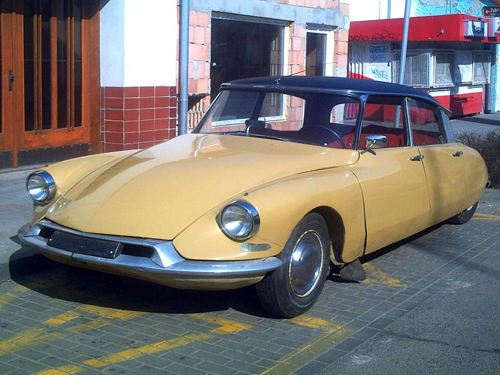
The unusual, streamlined styling of the Citroën DS is sometimes attributed — incorrectly — to the Italian styling house Bertone. It was styled by an Italian, true, but it was the work of Citroën’s gifted in-house designer, Flaminio Bertoni. Bertoni led the styling of Traction and the 2CV, as well as the Déesse. Ill health forced him to retire in 1957, but he was named a Master of Arts and Letters by the French ministry of culture in 1961. Bertoni died in 1964. (Photo: “Citroen DS 19 series 1” © 2008 Radek Weigel; released into the public domain by the photographer, cropped 2010 by Artur Andrzej; resized and modified (reduced glare) 2012 by Aaron Severson)
BERCOT EPOQUE
Citroën suffered a blow when Boulanger was killed in a car accident in November 1950. His successor, Robert Puisseux, appointed Pierre Bercot as the company’s new managing director. Amazingly, Bercot was even more forward-thinking than Boulanger was. His concern was not that the VGD (now known as “Projet D”) was too radical, but that it wasn’t radical enough. He told Lefèbvre that he wanted Projet D to be the most advanced car in the world, even if that meant further delaying the launch.

The engine in a 1960 Citroën DS19. The 1,911 cc (117 cu. in.) OHV four was decidedly undersquare — bore and stroke were 78 mm and 100 mm (3.07 in. and 3.94 in.), respectively — and had a rather agricultural character. In the DS, it had a compression ratio of 8.5:1, giving 83 hp (62 kW) with a two-barrel carburetor. (Photo: “Citroën DS engine” © 2012 Herranderssvensson (Anders Svensson); resized and used under a Creative Commons Attribution-ShareAlike 3.0 Unported license)
The delay was just as well, because there were still many problems to be ironed out. The engine was proving to be a particular roadblock. The VGD was originally planned around a water-cooled, six-cylinder engine, but after the occupation the water-cooled engine was dropped in favor of a new air-cooled, horizontally opposed six. Designed by Walter Becchia, it was essentially a marriage of three of the flat-twin engines from the TPV (now called “2CV”), with a total displacement of 1.8 L (about 113 cu. in.). Unfortunately, despite Becchia’s best efforts, the six wasn’t any more powerful than the big 1,911 cc (117 cu. in.) four from the Traction 11 and was thirstier and heavier, despite extensive use of aluminum. The six was finally abandoned in 1954. The existing inline six from the Traction was rejected as being too big and heavy for the new car and Citroën didn’t have the capital to develop another new engine. Projet D would have to use an updated version of the Traction’s big four — the new car’s only major compromise.
The styling of Projet D, like the 2CV, was by Citroën styling chief Flaminio Bertoni (no relation to the Bertone styling house). It was designed with an eye toward aerodynamics, still something of a black art in the automotive world even after the war. Although not a hardtop in the American fashion, Projet D had extremely slender roof pillars, enhanced further by the lack of side window frames. The result was panoramic visibility, albeit at the cost of making the car’s sloping fenders invisible to the driver. The exterior design was not finalized until only a few weeks before the car’s launch, largely because Pierre Bercot was worried that some of it looked too conventional or too familiar. Bercot wanted the car to look as innovative as its engineering.

The Citroën DS was a remarkably aerodynamic car for its era. Its drag coefficient (Cd) was 0.36, lower even than the slippery Porsche 356; later European models with covered headlamps had a Cd of only 0.34. The low drag gave most D-series Citroëns a top speed of over 100 mph (160 km/h) despite the fact that 1,911 cc (117 cu. in.) versions had well under 100 horsepower (75 kW). (Photo: “1963 Citroën DS 19” © 2014 Niels de Wit; used under a Creative Commons Attribution 2.0 Generic license)
Bercot was also very concerned about secrecy. He was so infuriated when a French automotive magazine published spy photos of Projet D, along with accurate technical information, that he went to court in a failed effort to force the magazine to reveal its sources. After that incident, the project continued with a level of secrecy more befitting a military program.
CITROEN DS: THE GODDESS DESCENDS
When the production car, now named Citroën DS19, was unveiled at the Paris Salon d’Automobiles on the night of October 5, 1955, it was as if it had just arrived from Mars. Compared to the dated, upright styling of most of its European contemporaries, the new car was low-slung and almost impossibly sleek. The “Déesse” (“Goddess,” a pun on the French pronunciation of “DS”) was the most aerodynamic production car of its era. It was not necessarily beautiful, but it was striking, avant garde, and unmistakable.
Of course, American designers of this period were turning out futuristic-looking cars, too, but unlike its American counterparts, the Déesse was just as advanced under the skin. Like the Traction Avant, the DS had front-wheel drive, with the transmission mounted ahead of the engine. The inner structure was a steel unibody (initially with an aluminum decklid and hood), but the outer panels were unstressed and could be unbolted for repairs or maintenance. At Lefèbvre’s insistence, the DS made extensive use of plastics and synthetic materials inside and out: The dashboard was ABS and nylon, the carpet was nylon, and the roof was lightweight fiberglass to reduce the center of gravity. The DS was a big car by European standards, but it was relatively light for its size. The interior was roomy and comfortable in the best French tradition: well trimmed with luxuriously soft seats.
The DS’s engine was its least-sophisticated element and perhaps its greatest disappointment. Georges Sainturat, who had designed the big four back in the thirties, was assigned to update the familiar engine with a new aluminum cylinder head and hemispherical combustion chambers, but output was a still-meager 75 horsepower (56 kW). The big four was linked to a four-speed transmission with an unsynchronized first gear. Citroën had wanted an automatic transmission since the 1930s, but a true automatic was still beyond the company’s resources and the prospect of buying one from an outside vendor was apparently considered beyond the pale. Instead, the Déesse had “Citromatic,” a semi-automatic gearbox with an automatic clutch.

The Citroën DS19 sedan was 189 in (4,806 mm) inches long on a massive 123-inch (3,124mm) wheelbase, weighing around 2,760 lb (1,250 kg) at the curb. (Photo: “Citroën DS19” © 2008 Tony Hall; used under a Creative Commons Attribution-NoDerivs 2.0 Generic license)
Despite its modest weight and power, the Citroën DS had formidable brakes. The rears were conventional drums, but after seeing Jaguar’s success at Le Mans in 1953 with Dunlop disc brakes, Bercot and Lefèbvre decided to equip the DS with front discs. The discs were big — 11.5 inches (292 mm) in diameter — and mounted inboard to reduce unsprung weight. To keep them cool, a pair of scoops was incorporated below the front bumper, channeling air over the calipers. The DS was the first mass-production sedan in the world with disc brakes and they gave the Goddess excellent stopping power, despite its narrow tires.
HIGH PRESSURE
As remarkable as the Citroën DS looked, the real showstopper was Paul Magès’ hydraulic system. Power steering and power brakes were becoming increasingly common in the U.S., but the Citroën approach was far more ambitious. Like a jet airplane, it used a single engine-driven pump to provide a central 2,400 psi (165 bar) hydraulic supply, which provided power for the steering, brakes, automatic clutch, gearbox, and self-adjusting hydropneumatic suspension.
Most cars, then or now, use metal springs (coils, torsion bars, or semi-elliptical leaf springs) controlled by shock absorbers. Any conventional suspension is inherently a compromise: Stiff springs and shocks can support heavy loads and give assured, flat cornering, but they produce a harsh, bouncy ride, especially when the car is lightly loaded; soft springs and shocks give a comfortable ride on smooth pavement, but they bottom easily when loaded and allow the car to lose its composure over uneven surfaces. Most cars settle for something in the middle, but that wasn’t good enough for Citroën; Boulanger demanded a suspension that could adjust itself automatically to suit varying conditions.
Magès’ suspension used neither metal springs nor shock absorbers. Instead, each independently suspended wheel was linked to a short hydraulic strut, filled with pressurized oil, and a rubber sphere filled with nitrogen gas. The gas and oil were separated by a flexible rubber membrane. Since nitrogen is compressible but oil is not, the gas in the sphere acted like a spring whose ride height and effective spring rate could be changed by increasing or decreasing the amount of oil in the strut. Leveling bars automatically varied the struts’ oil pressure in response to changes in suspension load or uneven surfaces.
In essence, the suspension was soft when it was lightly loaded and moving over smooth, flat roads. If you added a heavy load of baggage or passengers or were driving over rough surfaces, the suspension would automatically stiffen to keep the car flat and level. The suspension also included a manual control to allow the driver to raise or lower the ride height for traversing uneven roads or to change a tire. Citroën had offered a simplified version of this system on Traction 15 models starting in 1954, but that version acted only on the rear wheels, mostly for load-leveling purposes. The DS suspension worked on all four wheels whenever the engine was running.

The Citroën DS has a “crab-toed” stance — the rear track (distance between the right and left wheel) is considerably narrower than the front, in the interests of aerodynamics. This configuration also allows the turning radius to be much smaller than that of the Traction, which despite its agility had been cumbersome in tight spaces. The DS’s fuel tank is located beneath the rear seat, so the trunk is deep and quite capacious. The hydropneumatic suspension automatically adjusts the ride height to compensate for load, so the tail doesn’t sag when the trunk is full of baggage. The self-leveling function (and front steering geometry, optimized to minimize bump steer) allows the Déesse to run surprisingly well on three wheels, as French president Charles de Gaulle discovered in August 1962.
The hydropneumatic suspension endowed the Déesse with otherworldly ride and handling. If it wasn’t quite the magic carpet that some enthusiastic fans claimed, the DS did have an uncanny ability to smooth out broken pavement. The Déesse was almost as plush as a contemporary Cadillac, but with far greater control. The DS still rolled in cornering, although less than the soft ride would suggest, but it hung on tenaciously and was remarkably composed in big, sweeping turns. Sharp vertical bumps like frost heaves and railroad tracks could catch it off guard, sending the limber Goddess bounding skyward before the suspension had had time to react, but overall, the big Citroën’s ride quality on rough roads was exceptionally good.
The suspension also gave the Citroën DS a character unlike any other car on the road. With the engine off, the Déesse would slowly slump down on its wheels like a drowsy cat. It picked itself up lazily when the engine started, accompanied by plaintive moans from the central hydraulic pump. The suspension would grunt as if in annoyance when a particularly rotund passenger climbed aboard and then sighed with apparent relief when that occupant alighted. In motion, the suspension’s constant adjustments were accompanied by a series of distant moaning sounds as the hydraulic pump cycled itself on and off.
The power steering, brakes, and semiautomatic transmission compounded these unearthly sensations. The steering, for instance, was rack-and-pinion, as on the later Tractions, with a fast ratio and much greater precision than most contemporary rivals’, but the hydraulic assist left no feeling of mechanical connection between the steering wheel and the road, so the steering was as finger-light and cloud-like as a big Chrysler’s.
Also sui generis was the brake pedal, about which even André Lefèbvre was dubious and which prompted Citroën dealers to offer tutorials to first-time DS buyers. The DS eschewed a conventional brake pedal in favor of a peculiar rubber button that resembled nothing so much as the cap of a large wild mushroom. The button was effective once mastered, but learning to modulate it without triggering an inadvertent panic stop (and possibly getting yourself rear-ended in the process) took practice.
The same was true of the Citromatic transmission. The clutch and actual gear changes were executed automatically, but the driver still had to make gear selections manually using a lever on the steering column. Like the brakes, the semiautomatic transmission was easy enough to use, but obtaining smooth shifts demanded finesse and a delicate touch.
The Citroën DS’ high-mounted tail lights were intended as a safety feature as well as a styling element, making them more visible to following drivers. The unusual lights and the shape of the rear clip were conceived at the last minute, only about a month before the DS19 made its debut, because Citroën boss Pierre Bercot decided the existing tail looked too much like a Volkswagen.
André Citroën had never had any interest in fast cars and speed was not among the lofty goals for the Goddess — it was intended as a family sedan, not a sports car. The aging engine struggled a bit with the Déesse’s weight, 0-62 mph (0-100 km/h) taking more than 18 seconds. Early DS19s had a top speed of over 90 mph (145 km/h), though, and after attaining that speed their aerodynamics would allow them to sustain it as long as the road remained level. Unfortunately, any overtaking maneuver or noticeable grade required frequent negotiations with the Citromatic gearbox, whose cumbersome operation did not encourage haste. To add insult to injury, the big four was lumpy and clattery when pressed, hardly in keeping with the Déesse’s general refinement. In compensation, the engine was all but bulletproof and was reasonably economical. Consumption of 26 mpg (9 L/100 km) was typical, with closer to 30 mpg (8 L/100 km) possible in gentle cruising.
LE IDÉE: CITROEN ID19
The Déesse’s impact was startling and Citroën took more than 80,000 orders in the first week after the launch. That was particularly remarkable given the car’s price (some $3,295 p.o.e. in the U.S.), which was significantly higher than the Traction’s. Both buyers and critics were divided about the DS19’s styling, but it was hard not to be dazzled by its suspension, brakes, and sheer technological chutzpah. If the Déesse’s specifications no longer seem quite as outré as they once did, it must be remembered that when the DS bowed, most of its contemporaries were rather rustic devices. The average automotive designer probably couldn’t have defined “coefficient of drag,” much less cared about it, and even radial tires were very rare.
Of course, many early Citroën DS customers found out that there’s a reason that most automakers prefer tried-and-true hardware to daring innovations. Citroën hadn’t just gone out on a limb with the technology of the Déesse; it had jumped off a cliff. Despite its protracted development, the Goddess had many early teething problems, exacerbated by Bercot’s obsession with secrecy. In his desire to maximize the Déesse’s impact, he had withheld its technical specifications even from Citroën dealers. The DS was a terrifyingly complicated car and even many dealer technicians didn’t know what to do with it (or have access to necessary parts) until well after its introduction. Once the early difficulties were resolved, the complex hydraulics were reasonably dependable, although the piping was leak-prone and fragile enough that it could not be removed without damaging it, complicating other repairs.
Bowing to these concerns — and complaints from dealers about the price — in 1957 Citroën introduced the ID (Idée, “idea”). The Idée was a cheaper version of the DS, sharing the Déesse’s suspension, but with conventional steering, brakes, and four-speed gearbox as well as a detuned (66 hp/49 kW) engine and more plebeian trim. From 1958, the sedans were joined by a wagon (a “Break,” also called Safari), which the hydropneumatic suspension made a versatile load-hauler.
The Citroën DS made little impact in the U.S. beyond a tiny audience of cognoscenti, but the new Citroën soon became as much of an icon in France as the Traction had been. By the sixties, the DS was the unofficial French state car, favored by most high officials, including General Charles de Gaulle. De Gaulle credited the Déesse’s suspension with saving his life following a 1962 assassination attempt; his chauffeur was able to drive him to safety because the DS19’s suspension kept the car level and drivable even after losing one wheel. (The coachbuilder Henri Chapron later built De Gaulle a special stretched Déesse known as the Presidentielle.) The cheaper ID, meanwhile, became a ubiquitous French taxicab.
Even the sourest British critics admitted that the Goddess was uniquely suited to French roads, gliding with imperturbable calm over the battered autoroutes of the Fifth Republic. The highest British compliment on the hydropneumatic suspension’s cloud-like ride was paid in the mid-1960s, when Rolls-Royce licensed the system for use on the 1965 Silver Shadow.
That imperturbable disdain for rough roads also carried the Goddess to many competition victories. The DS and ID19 were too slow for many forms of racing, but they proved themselves superb rally cars, more than once winning the grueling Monte Carlo rally. Like the Mini, which became the Goddess’s arch-rival in the 1960s rally scene, the Citroën was not fast, but could easily maintain high speeds, with little need to slow down.
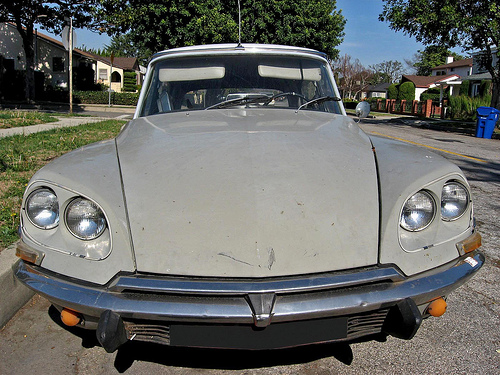
Although the D-series Citroëns underwent very few styling changes, the quad headlamps mark this as a post-1967 model. On European cars, these were covered by aerodynamic plastic fairings, but covered headlamps became illegal in the U.S. the same year, so American-market cars had exposed headlights. The D-series’ front compartment is very crowded, containing not only engine and drivetrain, but also the central hydraulic reservoir, the tool kit, and the spare tire, which Citroën claimed would act as a shock absorber in collisions.
THE ETERNAL GODDESS
Boulanger and Bercot had wanted the Citroën DS, like the Traction before it, to be so advanced in styling and features that it would still seem fresh for years. Unlike the Traction, whose 1934-vintage styling looked rather quaint by the time the last models were sold in 1957, the Goddess looked as flamboyant and as futuristic when production ended in 1975 as the original DS19 had back in 1955.
The Déesse underwent only minor, evolutionary changes during its 19-year history. The inadequate 6V electrical system gave way to a 12V setup in 1960, the poor sealing of the frameless side windows was improved, and more power was coaxed from the elderly engine. In 1965, that engine was finally replaced by a new, short-stroke four with five main bearings, a 1,985 cc (122 cu. in.) version for the ID and 2,175 cc (133 cu. in.) for the DS, which was now renamed DS21. The latter, with 109 hp (81 kW) could run 0-62 mph (0-100 km/h) in under 16 seconds, a more reasonable figure for the era, and could reach more than 105 mph (170 km/h) given enough room. (Citroën claimed a top speed of 115 mph (185 km/h), but to our knowledge, no independent tester achieved anything close to that speed.) Fuel economy was nearly as good as before, although the new engine was still rough and noisy.
Although rumors continued to abound of a six-cylinder model, the most powerful engine ever fitted by the factory was the later 2,347 cc (140 cu. in.) four with optional electronic fuel injection, making 130 hp DIN (96 kW). That was enough for 0-62 mph (0-100 km/h) in less than 11 seconds and a top speed approaching 120 mph (195 km/h). Meanwhile, Citroën eventually offered the Déesse with a conventional manual transmission as an alternative to Citromatic; a fully synchronized five-speed became optional in 1970. A Borg-Warner automatic transmission was added to the option list in 1971; national chauvinism aside, it probably should have been offered from the beginning.
The only major change to the Déesse’s styling came in 1967, with a new “shark-nosed” front clip and recessed dual headlamps. The lights had clear plastic covers, which further reduced the already impressive coefficient of drag. The covered headlights were not legal in the U.S., nor was the Déesse’s last great party trick, driving lights that swiveled with the front wheels to provide better illumination on curving roads. It made little difference, since U.S. sales were minimal. The Déesse was finally withdrawn from the American market in 1972 because it would have cost too much to modify it for the 1973 federal bumper standards.

On top-spec post-1967 Citroën DS models, the central headlamps swivel with the front wheels to point in the direction of a turn. Contemporary reviewers were ecstatic about the results, especially when driving on dark country lanes, but U.S. lighting standards prohibited moving headlights, so the system wasn’t offered in America. Note the small side-marker lights, added to meet 1968 U.S. safety regulations.
Even in its twilight, the Déesse had few rivals in sophistication or innovation; only the big Mercedes sedans matched the Citroën’s complexity. Total production of the D-series was 1,455,746, which was less than two years’ Impala production for Chevrolet, but reasonable for an expensive, eccentric sedan brimming with untried technology. During its lifetime, however, the Goddess’s less-advanced rivals had improved to the point where they offered most of the DS’s tangible benefits without its cost or idiosyncrasies.
LEGACY
Even Citroën could never really top the DS. The SM was in many respects a modernized DS with the six-cylinder engine the Goddess never had, and the Déesse’s direct replacement, the CX, was not quite the conceptual leap that its predecessor had been. Even now, the DS remains a high water mark for Citroën’s adventurous engineering spirit. Sadly, that appetite for adventure nearly brought the company to ruin in the early seventies. Citroën had never been long on capital, and the costs of developing the SM and compact GS put the company too far into the red. Michelin could no longer justify the financial burden, so in 1975, the French government ordered Citroën to merge with rival Peugeot.
Nevertheless, Citroën continued to refine the Déesse’s hydropneumatic suspension. Renamed “Hydractive” and fitted with electronic controls, it was used on the XM and Xantia sedans in the late eighties and early nineties. The latest version, Hydractive 3, is used in Citroën’s big C6 sedan. Air springs and hydropneumatic suspensions remain very rare on mass-market cars from other manufacturers, although they have gradually begun to reappear on high-end luxury models.
The Déesse’s engineering is no longer as astounding as it was 50 years ago, although its self-adjusting suspension is still something to see. So, too, is its styling, which, despite the sealed-beam headlights, skinny tires, and slender bumpers, looks as futuristic and iconoclastic as ever. The Goddess may have tarnished with age, but she still turns heads.
What really distinguishes the DS, though, is its unapologetic single-mindedness. The designs of most modern cars are filtered through endless marketing research analyses and focus groups that relentlessly strip away every controversial or challenging element. The Déesse was designed with no concession whatever to either engineering convention or public taste. Like the original Mini, it was the product of engineers given carte blanche, driven by an implacable faith in their own judgment and a casually arrogant disdain for what anyone else might think. For better or worse, we will probably not see its like again.
NOTES ON SOURCES
Our sources for this article included Wiljan Cats’ Citroën page, Cats-Citroën, www.cats-citroen. net, accessed 30 July 2008; David LaChance, “Tour de Force,” Hemmings Sports & Exotic Car #7 (March 2006), pp. 60-65; Julian Marsh’s remarkable Citroënët website, Citroënët, www.citroenet. org.uk, accessed 24 August 2008; Niels Heilberg, “Citroën Faces,” www.geocities. com/MadisonAvenue/ 4430/bluebook.html, accessed 1 August 2008; and Gavin Green, “Future Shock,” Motor Trend Classic #2 (January 2006), pp. 98-104.
We also consulted the following period road tests: “Citroen DS19 Startles Paris,” Autocar 14 October 1955; “Road Test: Citroën: The DS-19 drives boldly off the beaten path — and never feels the bumps,” Road & Track November 1956; “The Autocar Road Tests the Citroen DS19,” Autocar 7 December 1956; “Citroen ID-19,” Road & Track June 1958; “Citroën DS 19,” Car and Driver February 1962; “Citroen DSM: THRUSH Agents Take Cover…It’s Napoleon Solo on Wheels!” Car Life July 1965; “Citroen (DS21) Pallas M,” Autocar 3 December 1965; “Car and Driver Road Test: Citroën DS-21: Op-pop art nouveau (whirr!) on a 123-inch wheelbase,” Car and Driver February 1966; “Mobile palace (Motor Road Test No. 6/68 – Citroen DS 21 Pallas),” The Motor 10 February 1966; “Citroen DS23 Pallas,” The Motor 10 February 1973; and Peter Nunn, “Profile: Citroën DS: The Goddess,” Classic and Sports Car July 1984, all of which are reprinted in Citroën DS & ID 1955-1975, ed. R.M. Clarke (Cobham, England: Brooklands Books Ltd., ca. 1988); and Charles Fox, “Viewpoint: Citroën DS-21 Pallas,” Car and Driver September 1970, pp. 38–40, 73.
Historical exchange rates were estimated based on Werner Antweiler, “PACIFIC Exchange Rate service, Foreign Currency Units per 1 U.S. Dollar, 1948-2009” (2009, University of British Columbia, fx.sauder. ubc.ca). All equivalencies cited in the text are approximate and are provided for illustration and informational purposes only — this is an automotive history, not a treatise on currency trading or the value of money, and nothing in this article should be taken as financial advice of any kind!
The DS was an astonishing advance in design and technology that, unfortunately, Citroen didn’t continue. They produce fine cars, but, now, rather ordinary ones. I drove a DS on a thousand-mile jaunt in 1969 and experienced the magic carpet ride, touchy brake “champignon,” and semi-automatic transmission that caused the DS to bob elegantly during gear changes. It got the attention of locals in several small towns in Idaho, who swerved in my direction in their pickups to get a closer look. The adjustable suspension settings added to its otherworldly appearance, down low for a few blocks, then up on tiptoes to the end of Main Street. Gas stops gathered a crowd. Current aerodynamic designs make it look less strange, but we’ll probably never see its equal.
Living in France as a child from 1958-1962, the various Citroens were fascinatingly different from the North American cars we were used to. (Our family had a 1958 Simca Vedette Beaulieu, EU spec, with a 2.3l Ford V8.)
An omission from this fine and thorough article is the DS’s steering wheel. It had a single spoke, curved off from the steering column to join the rim on the left side. I understand the theory was that in a front end collision, the driver would not be impaled on the steering shaft. Instead, the steering wheel rim would collapse on the right side, forming with the spoke an angled surface that would slide the driver’s torso to the right.
Can anyone help me. I am restoring a 1972 citroen ds super and have a couple of problems. There are 4 foot pedals including one that appears to move only slightly to actuate a switch. What is it for.
2/ All of a sudden the car starter will not operate not even a click. Is there some sort of cutout in operation.
3 Once the engine is turned off does the car automatically select low suspension or can a higher setting be selected and remain in force after engine is cut.
Many thanks for your help. I live in SW France
Tony
Tony,
I believe the fourth pedal is the parking brake, which mechanically engages the front calipers. I don’t know of any way to lock the suspension in an elevated position without using the jacking stand, but I’m not an expert in these cars, so I don’t know for sure.
As for the starting problem, I’m afraid I’m not qualified to provide repair advice. My suggestion would be to find a local Citroën club, whose members may be able to offer technical suggestions or point you toward competent mechanics. Sorry!
Tony,
#1 The extra pedal is indeed the parking brake.
#2 While holding the key, try to turn the steering wheel and the key at the same time gently. May need a new ignition switch.
#2a Buy one anyway for backup.
#3 Place the suspension level on high and put four jacks under two wood beams that span beyond the width of the car in front of the rear and behind the front wheels making sure not going to crush any lines when the car rest, then put the suspension level all the way down suspending the car and the wheels will be off the ground. Viola!
#3a. Have the spheres recharged so that it will stay up for longer when you shut her down.
#4 Relax, have a glass of wine, You’ll be an expert before you know it.
Thanks for the input!
(For the record, please note that, just as we’re not able to provide repair information, we’re not qualified to guarantee any information provided by readers — as always, proceed at your own risk.)
Re: #3a: While the spheres serve as the “springs” for the suspension, the ride height (or lack there of) is purely a function of the hydraulic pressure in the suspension system. Once the engine is off the car will sink to it’s suspension stops.
Cheers, Jim
[quote=tony ptolomey]Can anyone help me. I am restoring a 1972 citroen ds super and have a couple of problems. There are 4 foot pedals including one that appears to move only slightly to actuate a switch. What is it for.
2/ All of a sudden the car starter will not operate not even a click. Is there some sort of cutout in operation.
3 Once the engine is turned off does the car automatically select low suspension or can a higher setting be selected and remain in force after engine is cut.
Many thanks for your help. I live in SW France
Tony
[/quote]
Tony- any answer I give you here will be very long and detailed, and probably met with some disdain from the moderators. Please email me back, I will try to help you- I have a small business working with and making new Citroen DS electrical systems. I can also explain some of the stuff that goes on in your hydraulic system.
mellon_man_bill@hotmail.com
Cheers-
Bill
As far as the one and best reference (U.S. Based – Southern California) for all things Citroen SM (although, presumably knowledgeable in the DS world too), I would direct you to Jerry Hathaway of SM World –
https://youtu.be/8e6SBhWqg9U
I’ve read your article, and I can give you some corrections about it, as I’m french and a true Citroën lover !
First, a little mistake : you’ve written “Volture à grande diffusion”. ‘Voiture’ will be better.
Then, ‘DS’ was never an acronym for ‘Désirée Spéciale’. The true story is that the prototypes for the VGD project were called D1, D2, D3. Then, Bercot and his collaborator Brueder choose ‘DS’ simply as a play with ‘Déesse’.
Then, the hydropneumatic Traction was launched not in 1953 but in april 54. For the DS engine, its crankshaft was still carried by three bearings : the five bearings arrangement was only reserved for the new ‘short stroke’ engines, released in 1965.
On the technical side, you’ve talked about the fiberglass roof, the ABS and nylon dashboard, but there were also aluminium hood and trunklid (this one lasted only a few years), and a few versions with plexiglas rear window.
Moreover, the DS had quite a few lesser known innovations :
-the pivot axis of the front wheels pass through the midplane of the tire. A quite unique feature (also seen on the SM, GS, and in a simplified form on the CX) that allowed an absolute freedom of steering reactions from bumps and guaranteeing the best stability in case of tire puncture or breaking on uneven surfaces ! In fact, it surely was quite helpful for the chauffeur of De Gaulle during the Petit Clamart attack…
-the suspension linkage is mounted on roller bearings, not conventional bushing. A very bold choice, mandatory for accurate self-levelling (without suspension frictions) and maintaining the best geometry in curves, free of any parasites moves ! Roller bearings are failing to pass all the shocks, but as the suspension is very soft, it’s not a big problem.
-for the brake system, Magès wanted an absolutely immediate braking. This is why the braking button has almost no travel : by reacting instantly, you save time and distance. Moreover, the LHM (green liquid used since 1966) has an incredibly high boiling point, almost as high as DOT5, because it is hygrophobic. And the high-pressure reservoir for the brake can fully compensate the possible (but rare !) brake fade.
What a car, isn’t it ?
Thanks for the notes! It does actually say ‘Voiture’ — the italicized font looks a little odd on some monitors. (I did go back and check, as French is obviously not my language!)
I didn’t know about the roller bearings or the steering geometry (although the latter makes a lot of sense). Oldsmobile later adopted a similar approach to the front pivot axis for the Toronado, although the actual geometry is quite a bit different. (Oldsmobile’s Andy Watt patented their arrangement in the mid-sixties.) It is indeed a remarkable car in every sense.
To amplify on the point, the front and rear anti roll bars are bolted to the frame with steel retainers using thin nylon bushings. No free play in the suspension!
And the hydraulic spheres had the “shock” screwed into the opening of the sphere, a cross drilled steel disc with washers held in with nuts with curved backs that limited the fluid flow. You could adjust bump/rebound by adding/removing washers.
Citroen on the DS did things with hydraulics that took other automakers 30+ years to replicate with electronics. A hydraulic line on the carb to drop the idle and prevent burning out the clutch when you put your foot on the brake? They did it.
Our family lived in Vaucresson (a suburb of Paris next to Versailles), France in the mid sixties. My father bought a used 1963 DS 19 in 1966. Very Parisian-silver roof and medium gray body.
The car was a delight to drive. The champignon brake pedal didn’t take a whole lot of training to use, and gear changes were easily mastered. No quarter mile burner, but still the fastest car at the time in France. Fast and comfortable.
The only problem with the car was its propensity to puke its hydraulic fluid on a fairly regular basis. You knew you were fucked when you came out to use the car in the morning and it was making love to the ground.
You kinda had the feeling that you were screwed when even French dealerships couldn’t effect lasting cures. Neither could Spanish shops.
The upside was that we got to know towns in France and Spain where our DS 19 broke down that we otherwise would not have. Fun stuff.
In Spain, car park dudes referred to our car as “El Tiburon”, or the shark.
The suspension wasn’t totally self-compensating. My mother would bitch that I was driving too fast. I figured that the fact that the car was bottoming out gave her the sensation that I was going too fast. I moved the suspension control up a notch and mama quit bitching.
Ultimately my father got rid of the DS 19 because it was just too
unreliable. It was replaced with a Simca 1000. Not as cool as the DS 19, but much easier to get around Paris traffic.
I’ve recently purchased a 1971 DSpecial. It’s a Euro spec imported to the US from France about a dozen years ago, so it’s got the turning headlights and lousy French seatbelts in front (and none in back). I’ll be swapping those out soon.
But I love the car. it’s amazing to look at. Its fantastic to drive. Not fast by any measure, but when I bought it, it was in Reno so I drove it all the way to Austin, TX. It’d cruise the highway at 75 mph and float along like silk. Wind, passing trucks, bad roads… Nothing broke it’s composure. She is a real joy to drive after over 40 years under her hood. She turns heads everywhere we go. Every stop for gas would gather new friends to ask lots of questions.
The car works wonderfully. No issues at all. No leaks. No problems. Amazing level of build and engineering.
Question: is the driver’s side window curved or flat? Mine shattered and cannot find a replaement. It is so close to flat that a local repair shop thinks a flat one can be made from the left side as a template.
Thanks.
I bought a 1971 DS a few months back. I flew to Reno and drove it home to Austin, TX and drive it nearly every day. It’s a truly amazing machine in a thousand ways. For over 40 years old, it runs great. Starts every morning and gets great mileage. It’s elegant to drive. Not fast, but easily cruises on any highway at 80mph.
I’ve been a fan of brilliant design my whole life and once I really learned about the DS and the risks the designers took, I knew I had to have one. I spent two years finding the right car and it’s the best thing I’ve ever owned.
Another terrific piece on a wonderful car.
You do not mention the most exclusive versions of the DS though: the convertibles and the Chapron specials.
The convertible came out in 1961 and was produced for ten years only. It was available as either a DS or and ID. The list price was about twice that of a sedan, as they were not produced at the Citroen factory but by the coachbuilder Henri Chapron (they were sold by Citroen and were official models though). Less than 1500 were made.
Chapron also made his own special DSs, with distinct styling and detailing, starting in 1958. The clientele could customize their car at will: extras could include a radio-telephone, TV, higher roof lines, armoured body panels, etc. The DS Chapron are extremely rare: only about a dozen were made each year, though many body styles were offered: two and four-light coupes and convertibles, sedans, etc.
The unique stretched “Presidentielle” made for de Gaulle in 1968 was not a hit with the old General, as it had a glass partition that could not be lowered (it was a DS windshield!) which de Gaulle did not like at all. He appears to have only used it once. His successor Georges Pompidou did use it occasionally after de Gaulle resigned in 1969, but it was ditched in favour of the Chapron-bodied SM parade cars in 1972.
Chapron continued making DS cabriolets until the very end of the DS in 1975 and beyond: in 1980, you could still drive your old DS to his carrosserie and have it turned into a “genuine” convertible–albeit for a prohibitive price.
[BTW, I have some personal pictures of DS convertibles and a few Chapron as well. You are welcome to use them if you wish.]
I have owned a 1969 DS21 for about a year. Driving a DS is a truly unique experience. The ride is fantastic and the handling is surprisingly good.
Actually, the brake “button” is very progressive and is very easy to use. Doesn’t take anytime at all to get use to and the brakes are very powerful.
I have the Citromatic. It is more commonly known as the bvh transmission which basically means “hydraulic gear box”. Properly setup, the shifts are very smooth and quick. Very easy to use and really adds a lot to the character of the car.
Properly adjusting the bvh requires following a very specific procedure. Most bvh that don’t work well are probably not adjusted correctly.
These are fantastic cars and have to be driven to be fully appreciated.
I think the brake button is probably one of those things like pushbutton transmission controls or steering hand grips rather than a steering wheel (adopted by various experimental vehicles over the years): easy enough to use and in some ways superior to the more orthodox method, but a little intimidating to the uninitiated.
Thanks for the link to Citroenet – many additions since you last visited.
http://www.citroenet.org.uk
Thanks, Julian. I must say I’m deeply impressed with the depth of information you’ve put together and I would highly recommend it to Citroën fans.
I would be pleased to learn of the optimumc compession pressure( psi )for the ds 23 fuel injected fitted with borg warner automatic (as distinct from the compression ratio). thanks.
I’m sorry, I really don’t know that — it sounds like something for which you’d need a shop manual.
Pls,Can you please inform me which other Engine can be used for a Citroen DS….An Engine that fits…not with carburetor.
all it will take just inform
Henry,
I’m afraid I’m not able to advise you on modifying or repairing cars — sorry!
Henry,
Bad news, almost zero! Very, very few successful DS engine swaps to other types have ever been made. A few reasons (among others!):
1. the DS engine turns counter-clockwise, unlike almost every other engine in the world.
2. the engine bay configuration is very confining, limiting replacement choices.
3. the inboard mounted disc brakes greatly complicate any consideration of an alternative transmission (which would mate to an alternative engine)
The peculiar and unique engineering of the DS, plus the crowded engine bay, greatly complicate any swap attempt. Not impossible, but extremely challenging!
HOWEVER, there is a brave Aussie giving it a shot!
http://www.aussiefrogs.com/forum/citro%EBn-forum/86204-future-ds-project-engine-swap-diesel-electric.html
If you don’t (or do) already own a DS, aussiefrogs is an excellent source of information and WARNING!
I would like to know the carbureter and distributer settings for the DS19 1111911 engine as i have recently aquired such an engine but with no carbureter
I don’t have tuneup specs, I’m sorry — you’d need a shop manual or repair guide for that. Depending on where you are, you might find one at a public library.
Overall a great article on a truly interesting car. I grew up riding in DS models during the 60s, with my father finally buying a ’72 SM Automatique in 1973.
Nit pick, the photo of the c-pillar cover and turn signal of the “DS-21” is really from an ID, the corrugated aluminum was on the lesser models, DS-19/21 had brushed stainless steel trim pieces with a gold DS model designation. I remember it from my father’s 65 DS19 that I helped part in 1979, along with a half dozen others from a neighbors yard.
A truly neat car to drive. I didn’t see it mentioned, in order to change the rear tire you need to pull the rear fender, which is held on by only one stainless bolt, same size as the lug nuts. The car came with a long steel shaft that fit into the trans to hand start the car using the same lug wrench, and the steel shaft could be used to lift the wheel back onto the hub. Since the wheels only had a small center hole it was interesting to get tires mounted and balanced back in the day in the US.
Ack, forgot to mention, the car doesn’t rise one wheel at a time, the rear rises first then the front as it lifts itself off the ground. The rear brakes get prnessure from the rear suspension to limit locking the rear brakes under light load situations, and when the pressure system fails the rear drops first as a warning to the driver. A joke among the Citroen crowd is that DSs don’t die, they just fail to get it up in the morning.
Thanks for the clarification!
Great write-up!
I had a 1969 DS21 Pallas back in 1974. I owned it for about a year, and became quite a good mechanic working on it … today’s internet would have made getting parts for it possible. Some more items of note:
The brake button pushes on a small slider beam under the floor. The slider beam actuates the front and rear brake circuits independently via valves which allow pressureized fluid to go to front or rear brakes. When there is more load in the rear of the car, pressure feed-back from the rear suspension moves the slider beam, which changes the ratio of front-to-rear braking: more load in back, more rear brake force. Awesome.
Even today, if an automaker made a car as advanced as the DS in 1955, it would be other-worldly. No company has ever put as much technology into a mass-produced car. I wish I still had mine. It had really cool pigskin leather seats, mohair headliner and carpeting, Citromatic gear box which could be shifted at full throttle just by moving the shift lever-the clutch was tied-into the GIANT hydraulic system. The fluid reservoir held 5 qts of DOT3 fluid mine was just before the green fluid, which is an aircraft hydraukic fluid). I went thru a lot of quarts……..
Being a USA version, my car had the full Monty hydraulic system except for the self-levelling-swivelling headlights — the US DOT did not allow them.
Cheers
It is said pre-war Citroen were looking at a sub-Traction project called the AX or 6CV, in retrospect it is a pity Citroen did not push forward with it (or at least the idea of such a model) as it could have helped fill a chasm between the 2CV and DS.
Citroen themselves did explore having the DS powered by smaller engines from a 850cc Flat-Twin to possibly the same 1.6 DS-derived unit (later considered for the ill-dated Project F) in order to remedy the void in their range though Citroen decided not to investigate it further.
Using a 1.6 DS-based engine for either the DS or a smaller DS-derived model would have still meant Citroen needed an earlier production version of the C-60 prototype to fill the gap in the range for the 1000/1100-1400cc segment.
The question is what could have Citroen done differently during the post-war period to allow them to launch a smaller DS-based Petite Goddess model by the mid-1950s soon after the DS?
The only post-SM Citroen I can think of that had any of the spirit of the DS was the Xantia Activa with its active suspension. Not all Xantias were Activas.
Rode in several DS cars back in the day as a young teenager not licensed to drive. Amazing on our gravel roads back in the early 1960s. Equally amazing was how quickly they went wrong and were deemed unfixable. Mais c’est la vie!
What I cannot understand in your description is saying it had rack and pinion steering “but the hydraulic assist left no mechanical connection between the steering wheel and the road”. Surely not? If so, what was the pinion there for? Cannot find anything definitive online myself.
Bill,
It’s been 11 years since I wrote that sentence, but I think the phrase that I was missing there was “feeling of” — viz., “left no feeling of mechanical connection.” This of course was a common problem with early power steering. I’ll have a look at amending the text. Thanks!
Though more relevant to both the DS’s successor the CX as well as the GS (and experimental precursors), Marcel Stabel’s book on the Citroen GS/GSA suggests Citroen looked at a number of different flat-4 engines ranging from 950-1430cc (the latter size planned for the C60 prototype) prior to the GS unit and even then considered a water-cooled flat-4 for the GS prior to the Peugeot takeover.
What is not entirely clear however is whether the planned water-cooled flat-4 which was to displace 1450cc, was in fact related to the 95 hp 1654cc flat-4 used in the Citroen Project L prototype that later formed the basis of the CX. Nor is it entirely clear whether Citroen eventually planned to convert the existing GS flat-4s to water-cooling pre-Peugeot takeover.
Living in the south of Portugal, there is no garages with machanical know how for DS 21
I had a new clutch and pressure plate fited, to my Citroen DS 21 Super 5 Model 1973.
Since there Is a little grinding of teeth (gears) when I put in the reverse gear, is there any adjustement to be made for this not to happen? I will be must thank full if some can help. Best wishs. Vic Gomes
I’m afraid I’m not able (or qualified!) to provide technical advice, sorry!
Excellent article!
Owned a 1962 Slough built ID in 1967. The best most beautiful car I ever owned.
We ddrove it to Paris & down to Austria.
With its long top gear you could cruise all day at 80 mph.