
Performance car enthusiasts tend to be a somewhat humorless bunch, whether you’re talking about Ferraristes, old-school muscle car fans, or import tuners. If they have one thing in common, it’s that they’re none too keen at being laughed at. That’s why it’s remarkable that one of the premier icons of the muscle car era is one of the most irreverent of them all: a budget Supercar named after a cartoon bird — the Plymouth Road Runner. This is its story.
THE SUPERCAR BOOM
The Road Runner story will only really make sense if you understand something about the way American cars used to be sold. Before the 1970s, most U.S. manufacturers offered their cars on a strictly à la carte basis. Even on high-end cars, you often paid extra for many accessories we would now consider de rigueur, such as heaters, windshield wipers, outside mirrors, and turn signals. Certain options might be unavailable on certain models or trim levels and required on others (resulting in that curiously American concept, the “mandatory option”), but each was, as the toy commercials like to say, sold separately.
The motivation for this curious financial prestidigitation was twofold: the à la carte approach allowed manufacturers to advertise lower starting prices, and it enabled dealers to mark up options individually, which was good for profit margins.
Up until the early 1960s, this approach worked to the advantage of racers, both professional and amateur, who could simply order the cheapest, lightest, barest-equipped model in the catalog with the biggest engine the dealer would sell them. If you were really going racing, you would strip off all the non-essentials anyway, so why buy them in the first place?
For several years, manufacturers were happy enough to abet such transactions. A stripped-out, big-engine business coupe was not a profit-maker, but only a handful were sold that way, and any racing victories they achieved were good publicity, whether on the track, the strip, or the street. Then came the fall of 1963 and the birth of the Pontiac GTO. As has oft been recounted, general manager Pete Estes, chief engineer John DeLorean, and ad man Jim Wangers figured out a way to transform the big-engine, midsize-car concept into a package they could promote aggressively.
The GTO package was originally just an option for the new A-body Pontiac Tempest. Priced at a bit under $300, it included the division’s big 389 cu. in. (6,372 cc) V8, dual exhaust, slightly stiffer suspension, and jazzy trim and badges. (“GTO,” incidentally, was a racing acronym meaning gran turismo omologato, “Grand Touring, Homologated,” in Italian.) Pontiac couldn’t exactly promote or advertise “stripped-out business coupe with a big engine,” but they could (and did) promote the hell out of the GTO. Even though the GTO was technically a violation of several General Motors corporate policies, it was a hit, helping to establish Pontiac as the most performance-oriented — and youth-oriented — automaker in America. The GTO soon inspired a host of imitators both inside and outside GM. By 1968, every domestic automaker except Cadillac offered at least one.
The success of the GTO and its ilk presented a dilemma for the hardcore street racers who had inspired them in the first place. To get all the performance-oriented options you needed (many of which were still extra-cost options even on a GTO or Oldsmobile 4-4-2), you were often compelled to order the performance model or package. Not only were those models highly conspicuous — an important consideration, given the dim view most municipalities take of street racing — they usually had hundreds of dollars worth of tinsel that the serious runner neither needed nor wanted. Since many of the diehard racers were under 25, an age at which most people even in that affluent era were not exactly rolling in cash, this put many of the serious factory-built street rods out of reach.

Plymouth had recently launched its own GTO rival, the GTX, which was new for the 1967 model year. Like the GTO, the Plymouth GTX was a fancier, big-engine version of a midsize car, in this case Plymouth’s intermediate Satellite. Plymouth went Pontiac a few better by making Chrysler’s big 440 cu. in. (7,206 cc) V8 standard on the GTX, along with the excellent TorqueFlite automatic. A 440-powered GTX would beat the stuffing out of most showroom-stock GTOs except the handful of cars worked over by Michigan’s Royal Pontiac or other performance-minded dealers, but the big engine, standard automatic, and plush trim pushed the GTX’s price well above the standard GTO. As if that weren’t bad enough, the Dodge Division soon insisted on offering its own Coronet R/T, which was functionally identical to the GTX and sold for a similar price. Unsurprisingly, GTX sales made for somewhat depressing reading.
THE BROCK YATES INITIATIVE
This sad state of affairs was noted by, among others, Car and Driver editor Brock Yates. At some point during the 1966 model year, Yates drafted a memo to Chrysler-Plymouth general manager Bob Anderson, outlining the problem and proposed a new variation on the Supercar theme: the econo-racer. This would be a stripped-down intermediate with a big engine, four-speed manual transmission, and a full set of gauges, all as standard equipment. There was to be no plush trim, non-essential equipment, or gratuitous decoration to drive up the price or attract wary gendarmes.
Anderson was highly enthusiastic about Yates’s proposal and forwarded the memo to Plymouth product planning. Yates received a noncommittal response — Anderson just said they’d consider it for 1968 — and had no idea what, if anything, Chrysler-Plymouth might do with his idea.
A key aspect of Yates’ proposal was a restrained approach to styling and marketing, including limiting color choices so as to cultivate an aura of understated menace. However, subtlety is not a concept product planners readily embrace, particularly when their division is struggling to establish itself in an image-conscious market segment. Plymouth product planning chief Joe Sturm and product planning analysts Jack Smith and Gordon Cherry didn’t want an understated street racer — they wanted an icon, something that would steal attention away from the GTO.
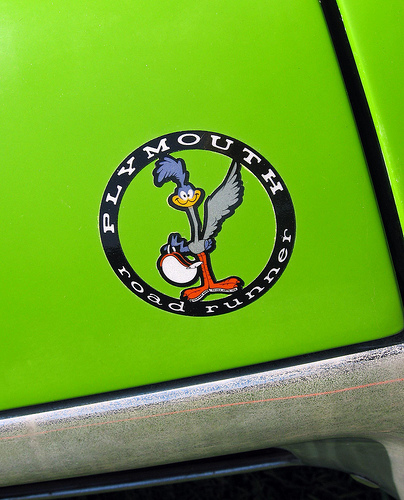
A week or so later, Cherry had a brainstorm while watching Saturday morning cartoons with his young children: a tie-in with Warner Brothers’ popular Road Runner cartoon character, whose maddening ability to elude Wile E. Coyote suggested exactly the kind of image Plymouth was hoping to cultivate. Cherry had to explain the premise to Smith, who wasn’t familiar with the cartoons, but Smith agreed that Cherry was on the right track. Smith subsequently presented the idea to Chrysler-Plymouth’s new ad agency, Young & Rubicam, who embraced the concept wholeheartedly; their idea had been to call the car the Plymouth La Mancha, after Man of La Mancha, the popular Broadway musical based on Cervantes’ 17th century novel Don Quixote.

Senior Chrysler management was none too happy with either the implicit self-mockery of naming one of their cars after a cartoon character, or the fact that doing so would involve paying licensing fees. Styling director Dick Macadam was particularly appalled. Dealers, however, loved the concept and their response, combined with the support of Young & Rubicam, finally persuaded management that the Road Runner’s irreverence was exactly the point. A $50,000 deal was struck with Warner Brothers for the rights to use the Road Runner and Coyote characters, while Engineering set to work modifying the Belvedere’s horn to approximate the Road Runner’s flippant “Beep-Beep.”
(As an aside, we have noticed that some historians inexplicably assert that viewers of the Warner Bros root for Road Runner in his frequent duels with Wile E. Coyote. Your author has never met anyone familiar with those cartoons who did not root for the Coyote — indeed, we would worry about any child who actually rooted for the bird — although we always assumed the point of Plymouth’s pitch was that by buying the car, you could be the Road Runner rather than his eternally frustrated pursuer.)

PLYMOUTH ROAD RUNNER
The Plymouth Road Runner was introduced as part of Plymouth’s revamped intermediate lineup for the 1968 model year. It was essentially a Belvedere two-door sedan fitted with the heavy-duty suspension normally found on cars earmarked for police or taxi duty. The standard engine was Chrysler’s familiar 383 cu. in. (6,276 cc) V8 with the cylinder heads and camshaft from Chrysler’s bigger 440 cu. in. (7,206 cc) engine, plus a high-rise intake manifold and dual exhausts. With single four-barrel carburetor, this combination yielded 335 gross horsepower (250 kW) and 425 lb-ft (574 N-m of torque), about the same as a base GTO. A four-speed manual transmission was standard equipment and the only really essential straight-line performance item not included was a limited-slip differential, which was available as part of the Performance Axle Group for an extra $87.50.

The base price of a Plymouth Road Runner was $2,870, which was a little above Brock Yates’ proposed target price, but undercut a base Pontiac GTO hardtop by $231. If you included the extra cost of adding a four-speed and heavy-duty suspension to the GTO, the price differential became closer to $500 — not small change in 1968. The Road Runner was also $559 cheaper than an equivalent Plymouth GTX.
Naturally, that budget price entailed certain compromises. Choosing a Road Runner over a GTX condemned you to flat bench seats, taxicab-grade upholstery, dog-dish hubcaps, and rubber mats instead of carpeting. There was of course a host of dress-up and luxury options, ranging from power steering and front disc brakes (unimportant to drag racers, but of more than passing interest for street driving) to a padded vinyl roof and a big swash of flat black paint on the hood. Buyers were well advised to exercise caution with the options list, which could add almost $1,000 to the list price. As a stripped-down street racer, the Road Runner was a bargain, but if you were looking for a fully loaded cruiser, the GTX made far more sense, offering better performance without the Road Runner’s low-rent ambiance.

When Car and Driver finally saw what had become of Yates’ idea, the editors were mildly appalled by what they saw as a gimmicky dilution of the original concept. They admitted Plymouth had managed the “econo” aspect of the equation and done a passable job with the “racer” part, but there was nothing stealthy or subtle about it. Nonetheless, they predicted it would sell like mad.
Chrysler-Plymouth was not so sanguine, grimly predicting initial sales of only 2,500 units. According to Cherry, Chrysler’s mostly straight-laced senior executives were never comfortable with the Road Runner’s whimsical image; they just didn’t get it. Nonetheless, the Road Runner turned out to be perfectly attuned to the cultural zeitgeist of its time. In an era of Rowan & Martin’s Laugh-In, the Smothers Brothers, and TV’s campy Batman, buyers could appreciate a performance car that didn’t take itself too seriously. The fact that it was legitimately fast and quite rugged didn’t hurt. Even with the standard engine and 3.55 axle, the Road Runner could go from 0-60 mph (0-97 km/h) in about 7 seconds and run the quarter mile (402 meters) in about 15 seconds with trap speeds in the 96–98 mph (155–158 km/h) range.

Some 44,599 Road Runners went out the door for the 1968 model year and Plymouth probably could have sold more if not for the conservative sales projections, which limited the supply of parts. Initially, all Road Runners were pillared two-door sedans, but a pillarless hardtop became available later in the year. Most had the stock engine, but a few were ordered with the 426 cu. in. (6,974 cc) Hemi, a $714 option that instantly expunged the ‘econo’ portion of the Road Runner’s econo-racer credentials in exchange for 425 gross horsepower (317 kW) and 490 lb-ft (662 N-m) of torque.
Plymouth expanded the line for 1969, adding a convertible model and a host of new options. An “Air Grabber” pop-up hood scoop was newly optional, as was the 440 cu. in. (7,206 cc) V8, which was nearly as strong as the Hemi for about one-third of the Hemi’s price. Motor Trend named the Road Runner its 1969 Car of the Year, and total sales rose to 82,109. Since Plymouth also still offered the GTX, which sold some 15,602 units for 1969, Plymouth’s sporty-intermediate sales now outpaced Pontiac’s by about 35%. (Pontiac sold 72,287 GTOs that year.)

THE SINCEREST FORM OF FLATTERY
Like the GTO before it, the Plymouth Road Runner was soon besieged by wannabes. Dodge, naturally, demanded its own version, the Super Bee, complete with its own cartoon mascot. Ford offered the Torino Cobra (so named to preserve Ford’s rights to the Cobra name, since the Shelby Cobra had recently been discontinued). While Chevrolet didn’t offer a specific econo-racer model, you could create a comparable package by careful use of the Chevelle/Malibu order form.

The Plymouth Road Runner returned for one more go-around in its original body shell in 1970, although sales fell to 41,484, a victim of skyrocketing insurance premiums for performance cars. The Road Runner also lent its name and decals to the Road Runner Superbird, Plymouth’s version of the streamlined Dodge Charger Daytona, offered as a NASCAR homologation special. Only 1,920 were sold and they are prized collectibles today.
The Road Runner and other Chrysler intermediates got a swoopy, “fuselage-style” redesign for 1971 and the graphics grew even more lurid than before. Although the new Plymouth Road Runners were attractive despite their gaudiness, punitive insurance rates continued to take their toll, dropping sales to only 14,218. Plymouth responded by making the standard engine the 340 cu. in. (5,567 cc cc) LA-series V8 rather than the 383, but even that engine could be prohibitively expensive for younger buyers to insure. For 1974, the 340 gave way to the 318 cu. in. (5,204 cc) V8, now offering only 150 net horsepower (112 kW).

LAST GASPS
Like most of its Supercar brethren, the Plymouth Road Runner’s muscles atrophied as the 1970s wore on, a result of lowered compression ratios and ever-increasing emissions standards. Surprisingly, the Road Runner remained popular enough to survive the decade. In 1975, when the intermediates were redesigned and renamed Fury, the Road Runner continued, now looking a little ill at ease in its new formally styled surroundings. The following year, it became a trim and graphics package on the compact Plymouth Volaré. The last Volaré Road Runners were sold in the 1980 model year.
By then, the à la carte approach to optional equipment was on the way out. Emissions standards put an end to the plethora of engine and axle ratio options that had existed in the sixties; each engine/transmission/axle ratio combination had to be certified separately with the EPA and NHTSA, which was simply too expensive. At the same time, Japanese automakers had whetted the appetites of American buyers for much more comprehensive levels of standard equipment, often in strict trim-level groupings. (That wasn’t necessarily the case in Japan, but it was customary for Japanese automakers’ U.S. offerings.)
By the late 1970s, domestic automakers were beginning to realize that that approach offered more than customer value. Limiting factory options also simplified production, lowered costs, and (at least in theory) permitted higher levels of quality control. Of course, the tiered approach has its own drawbacks, forcing customers to buy options they don’t need to get the equipment they wanted. For better or worse, however, true cafeteria-style new car optioning appears to be a thing of the past.

What of econo-racers? The idea pops up every now and then, often for racing homologation purposes, like Chrysler’s Dodge/Plymouth Neon ACR or Mazda’s rare RX-7 GTUs. In general, though, modern manufacturers are loath to pass up the profit margins of fully loaded cars with fully loaded price tags. Many of the lightweight, stripped-down factory specials you could buy, like the BMW M3 CSL or Honda’s Integra Type R, have actually cost more than their heavier, more luxurious siblings. Still, as long as there are cars of any kind, there will be people who will be enticed by the idea of a stripped-down body with the biggest engine that they can buy.
What’s been missing since the demise of the Road Runner is that touch of whimsy. Commercial tie-ins of the kind the Road Runner pioneered are now commonplace (even the Warner Brothers Loony Tunes cartoon characters popped up again on a special edition of Chevrolet’s undistinguished Venture minivan a few years ago), but they now have a calculated, even cynical aura that makes them far less amusing. Perhaps the closest modern equivalent to the Road Runner’s tongue-in-cheek spirit is BMW’s reborn MINI (particularly in its brilliant Canadian ad campaigns), but the MINI is a subcompact, not a muscle car. There’s nothing like the Plymouth Road Runner today, which is exactly what makes the deliberate, self-conscious silliness of the original so much fun.
AUTHOR’S NOTE
In 2012, we licensed a condensed version of this story to the Angie’s List classic cars channel. However, Angie’s List had no connection with the original article.
NOTES ON SOURCES
Our sources for this article included the Auto Editors of Consumer Guide, Encyclopedia of American Cars: Over 65 Years of Automotive History (Lincolnwood, IL: Publications International, 1996); Arch Brown, Richard Langworth, and the Auto Editors of Consumer Guide, Great Cars of the 20th Century (Lincolnwood, IL: Publications International, Ltd., 1998); Linda Clark, “1968 Plymouth Road Runner: A MoPar to Ruffle the Competition’s Feathers,” Special Interest Autos #75, May-June 1983, reprinted in The Hemmings Motor News Book of Chrysler Performance Cars, eds. Terry Ehrich and Richard A. Lentinello (Bennington, VT: Hemmings Motor News, 2000); Eric Dahlquist, “Beep Beep!” Hot Rod November 1967; “Car and Driver Road Test: Plymouth Road Runner,” Car and Driver January 1968; “Road Runner: Explosion in Budget Supercars, Car Life January 1969; Eric Dahlquist, “‘Beep-Beep-Beep!'” Motor Trend February 1969; and James Lee Ramsey, “The Bare Necessities,” Automobile February 2000, all of which are reprinted in Plymouth Muscle Portfolio 1964-1971, ed. R.M. Clarke (Cobham, England: Brooklands Books Ltd., ca. 2003); “Pour It On Six-Pack,” Car Life July 1969, and “Dodge Builds Bee with Bite,” Road Test December 1970, reprinted in Dodge Muscle Cars 1967-1970 (Brooklands Books), ed. R.M. Clarke (Cobham, England: Brooklands Books Ltd., ca. 1984); “Six Econo-Racers,” Car and Driver January 1969, and A.B. Shuman, “A Date with Three Strippers,” Motor Trend December 1969, reprinted in The Great Classic Muscle Cars Compared (Muscle Portfolio), ed. R.M. Clarke (Cobham, England: Brooklands Books Ltd., ca. 1999); James M. Flammang and the Auto Editors of Consumer Guide, Chrysler Chronicle: An Illustrated History of Chrysler – DeSoto – Dodge – Eagle – Imperial – Jeep – Plymouth (Lincolnwood, IL: Publications International Ltd., 1998); “History of the Plymouth Road Runner and Dodge Super Bee,” Allpar, www.allpar. com, accessed 25 October 2008; Matt Litwin, “Buyer’s Guide: 1968-’69 Plymouth Road Runner,” Hemmings Muscle Machines No. 98 (November 2011), via www.hemmings.com, last accessed 21 June 2022; Mike Mueller, Motor City Muscle: The High-Powered History of the American Muscle Car (Osceola, WI: Motorbooks International, 1997); remarks by former Chrysler-Plymouth product planner Jack Smith, originally presented in a speech in 2000 and transcribed on the web by Plymouth Bulletin and Allpar, www.allpar. com, accessed 8 May 2012; A.B. Shuman, “The Thing of Shapes to Come,” Motor Trend Vol. 22, No. 1 (January 1970), pp. 38–41; and Paul Zazarine, GTO 1964-1967 (Muscle Car Color History) (Osceola, WI: Motorbooks International Publishers, 1991).
The thing I do not have that this article represents is the ‘context of time’ and how much impact such a seemingly simple little diversion could have. And you’re absolutely correct…deliberate silliness and whimsy have been absent too long!
Funny how stripped out a budget car used to be.
Today’s bottom-feeders still come with a decent stereo, power everything, AC, and decent sized wheels.
It’s too bad that today’s performance cars can’t share platforms with more pedestrian high-volume cars. There used be a continuous spectrum from Mom’s Station Wagon to the Businessman’s Coupe to the Terror at the Strip. Nowadays I guess the Chrysler LX cars and a few imports (WRX, EVO, Civic) are the only ones like that.
I suppose the most whimsical of recent cars could also be the Scion xB (particularly the 1st generation). Who says a box isn’t a viable shape for a car?
[i]It’s too bad that today’s performance cars can’t share platforms with more pedestrian high-volume cars. [/i]
They certainly [i]can[/i] — and many of those that exist do. Consider the new Chevy Cobalt SS, which is quite a fearsome little car (although FWD and lots of turbocharged power is still not a good combination), or the old Dodge Neon SRT4. They’re just more of a niche than they were in the sixties, and they have to be cautious about pricing themselves out of the market, as the Japanese supercars did in the nineties (RX-7, 300ZX Twin Turbo, Supra Turbo, Mitsubishi GTO/3000GT VR4).
It really just comes down to what the automakers figure will sell; there’s no particular technological reason they can’t do it, and when they do, you can get impressive results (e.g., BMW M3).
The Scion xB was indeed a whimsical little car. As with the Mini, though, it fell into a different class than something like the Road Runner. With a subcompact, especially a hatchback, sexy is hard to achieve, so your major choices are staid, cute, or cheeky.
As the owner of several of these cars I can attest that my 1970 Road Runner has been one of the absolute best cars I have ever owned. It was comfortable to drive, cornered well for its size and weight and was nothing short of lure pleasure to drive. It was not fancy for sure, but it made you just feel good when you were behind the wheel. As a side note, my last 383 powered Road Runner (so called gas hog) got about 19 mpg and had exhaust emissions that were better than the new cars had to meet in the late 80’s. So the lies about them being so horrible for the environment are just another in a long list of ways to keep us from the cars we all loved back then. If they made the same car today, I would walk past all of the newer cars to buy one.
The Japanese had to sell their options in bundles, DX, LX, EX, because it was too complicated to ship all the different variations possible from Japan.
I often wonder if the US car companies have made a big mistake by following the Japanese manufacturers’ lead.
US manufacturers could differentiate themselves by allowing you to build your own car. The choosing of the options could be part of the “fun” of buying a car. They should market it as “customizing”.
This continues to be the way that they sell trucks, why not cars?
Part of the reason for the move away from a la carte ordering was cost and logistics. At Chevrolet, for instance, there were something like 165,000 different possible parts combinations for cars and trucks, and probably a few more that were technically disallowed, but installed anyway, through special order or accident. John DeLorean said the Chevy parts book at that point was 18 inches thick! Many of those combinations were rarely, if ever ordered — with Mopars of this vintage, for instance, there were only a handful of certain option combos — so the cost was daunting relative to the payoff. It also had a negative effect on quality control, because each car coming down the line could be significantly different. Part of the reason Hondas tended to be better assembled than a lot of their contemporaries was that there was such tight control over equipment variations.
Now, of course, there are the additional factors of EPA and NHTSA rules. One of the reasons power windows have become so common is that if you sell a car with and without p/w, you have to do separate side impact certifications, so it’s easier just to standardize and pass the costs along to the customer.
Some brands, like Scion, MINI, and smart, are pushing the customization idea for exactly the reason you describe, but they focus on dealer-installed accessories, where the extra complexity falls on the shoulders of the dealer, rather than the factory. Same idea, different direction.
well i have a Plymouth road runner 1969 conv. and it in great shape will still do a 1/4 i 6.5 sec and is a sleeper (meaning that you can not hear the raw power until i get on it) i had it since high school in the late 60 ‘s and restored it to its full glory .
Just wonder why the great car name “Roadrunner” isn’t being used today. A great car name!
Licensing issues, most likely. Chrysler licensed the Warner Bros. cartoon character for the original car and would have to do so again to revive it. Anyone else calling a car that, at least in the U.S. market, would probably run into trouble with both FCA and Time-Warner, even if it didn’t reference the cartoon character specifically.
Unacceptable answer. If you are going to compile/publish this information and host it free of charge, the LEAST you can do is track down parts in your spare time.
——–
Ok Aaron, that was sarcasm. Did you recognize it? Ever consider that you’re being punked with all these requests to find obscure parts or give internet-appraisals?
It would seem like a particularly obscure way to troll someone, although I’m hardly one to criticize people for having weird hobbies…
I had a silver w red pinstripe 1974 plymouth roadrunner and try as I might cannot find the answer to this simple question:Could the 74 RR be bought with a factory 360 CI 4 bbl
The base engine was a 318-cu.in. two-barrel V-8 with dual exhaust and bright tips. Its 170-hp rating was 20 hp higher than the single-exhaust Satellite 318 engine. Optional was a 245-hp, 360-cu.in. V-8, which was new, a 250-hp 400 or a 275-hp 440 engine.
Just located a rust-free complete 1969 383 roadrunner and I am very happy to join the fun. I have owned two dozen muscle cars over the past 30 years but this is my first roadrunner. I can already tell that I am going to love it!
Just purchased a ’69 roadrunner with a 383, console bucket seat 4 speed. All numbers matching! I had a column shift 383 auto when I was 17…..drove the new purchase in Phoenix prior to purchase and WOW! What fun!
Love reading about the history of these storied muscle cars
My father has a 1969 Roadrunner that he drag raced with it back in the day. Sadly, a few weeks ago, it was sitting behind his garage and the garage had a fire accident and the car is now partially burned up, the engine and transmission is destroyed, but I’m sure it can be cleaned, re-done and restored.
Fun fact about myself: I collect diecast models of all of the old classics and muscle cars from the 1930’s to 1990’s.
It is noted in the first paragraph under “Plymouth Roadrunner” that “The standard engine was Chrysler’s familiar 383 cu. in. (6,276 cc) V8 with the cylinder heads, camshaft, and *intake* and exhaust manifolds from Chrysler’s bigger 440 cu. in. (7,206 cc) engine.
For the record, it is not possible to fit a 440 (or any RB) intake manifold onto the low deck 383 (or any low deck B engine).
Thanks for pointing that out — I’ve corrected the error in the text (and the adjacent photo caption, which had repeated the same mistake).